The 450th anniversary of Titian’s death on 27 August 1576 is a good opportunity to revisit the Venetian master—an artist whose long career coincides with and sheds light on the early capitalist era. Titian’s seventy-year creative life spanned nearly three-quarters of the sixteenth century, a time of profound social transformation. Titian’s art bears witness to the enduring spirit of humanism in this rapidly changing world.
The British Marxist art critic John Berger argues that Titian was among the first artists to transform painting from a courtly craft into an independent profession. He negotiated his fees, accumulated wealth, cultivated powerful patrons, and claimed an authority unusual for artists of his time. Titian’s work reveals both the opportunities created by this new economic order and the anxieties produced by a world increasingly governed by ruthlessness, instability, and uncertainty.
Here, we want to trace decisive moments in Titian’s artistic and historical imagination through four landmark works: Assumption of the Virgin, Venus of Urbino, the Portrait of Ippolito Riminaldi, and The Flaying of Marsyas. Together, these paintings reveal transformation from the monumental confidence of High Renaissance humanism, through the withdrawal into private life, to the radical expressive freedom of Titian’s final years. His revolutionary technique emerged in response to the pressures of commerce, war, political reaction and plague.
To understand Titian’s art, we must first grasp the world that produced him. Venice, with around 200,000 inhabitants, was the capital of the Adriatic and controlled possessions across the eastern Mediterranean and traded as far as Holland and England. It was a mercantile oligarchy, an aristocratic republic whose constitution was determined by economic interests. This hybrid economic system—neither feudal nor fully capitalist—created a unique position for artists. The Medici in Florence and Venice’s merchant aristocracy became major cultural patrons. Titian, however, surpassed his predecessors. Berger observes that Titian’s self-portraits reveal “a man who is physically imposing and has considerable authority. You can’t take liberties with him.” Titian’s career represents the transition from feudal patronage to the art market. As Berger writes, Titian’s fear was “intimately connected with Venice, with the city’s special kind of wealth and commerce and power. All of which … had to do with the flesh.” Titian’s art absorbed these shocks, and his techniques evolved accordingly.
Assumption of the Virgin and the Monumental Style of the High Renaissance (1516–1518)
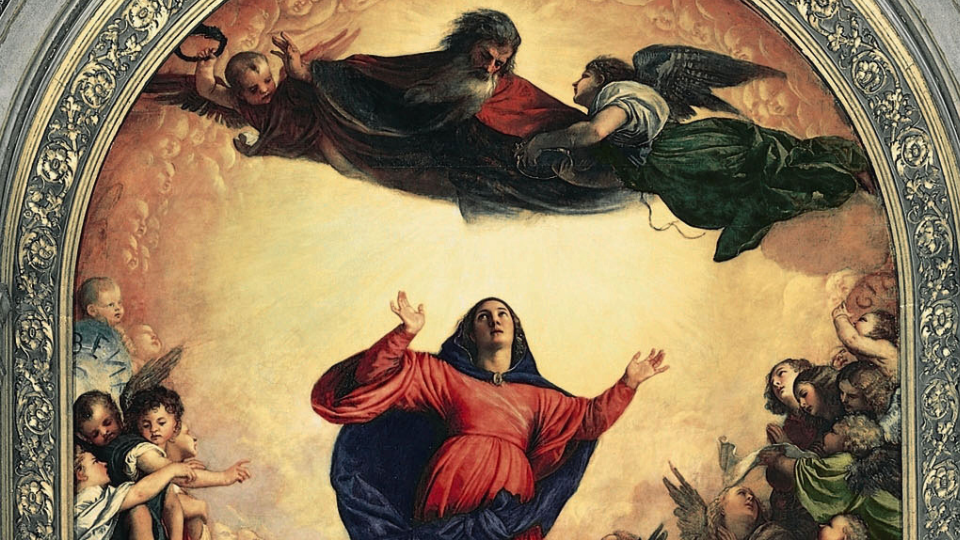
The Assumption of the Virgin for the Frari Church is regarded as the defining masterpiece of Titian’s early creative period. According to reports, the enormous figures of the Apostles and Mary—standing almost three meters tall—astonished the commissioning monks to such an extent that they hesitated to accept the painting. They found its scale and dramatic intensity almost sacrilegious. With this painting, Titian broke away from the tranquil altarpiece style of the 15th century in favor of a monumental language built upon powerful brushstrokes and harmonies of red, blue, and gold. God’s cloak, Mary’s robe and the apostles’ garments create a vertical red axis connecting heaven and earth. Soviet Titian expert Irina Smirnova notes that Titian begins here to work with “open strokes of a broad brush,” giving the folds of garments such vitality that his figures appear animated from within. Through his use of masses of color, light, and movement, Titian’s painting seems to dissolve the boundary between heaven and earth.
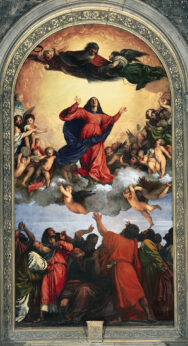
The lively depictions of the apostles represented a break with the meditative stillness of the saints that was customary in Venetian painting. They bear witness to Titian’s familiarity with the High Renaissance painting in Florence and Rome, by artists such as Raphael and Michelangelo. In particular, Titian transforms the Virgin’s role. Mary changes from an object of devotion to an active protagonist. Her strong, physical body turns upward, her robes billow, and her outstretched arms express both astonishment and acceptance, and viewers get a sense that she is experiencing the miracle rather than simply representing it. Titian monumentalizes and historicizes her, giving her the physical and psychological grandeur of Michelangelo’s sibyls.
The painting’s force reflects the confidence of Venice at the height of its republican power. In the Assumption of the Virgin, sacred history unfolds within the same world of bodies, light, and movement inhabited by the viewer. Titian created a monumental language equal to the heroic aspirations of his age.
Venus of Urbino and the Secular Ideal in a Darkening World (1538)
By the late 1530s, the world that had produced the High Renaissance was falling apart. Florence, once the great republic of civic humanism, had been crushed and transformed into a Medici duchy under Habsburg protection. The Sack of Rome had shattered the illusion that Italy controlled its own destiny, as Spanish-Habsburg power came to dominate the peninsula. At the same time, the Counter-Reformation treated the classical spirit and worldly pleasures that had nourished Renaissance culture with growing suspicion.
Venice remained the one great independent republic, but it stood increasingly alone—hemmed in by Habsburg power on one side and Ottoman expansion on the other. The great public confidence of the Renaissance retreated indoors. As Smirnova notes, Titian, Aretino, and Sansovino stood at the center of a brilliant artistic circle that defended Venice’s secular culture against this reactionary tide. It was in this increasingly embattled republic that Titian painted the Venus of Urbino, relocating the ideals of Renaissance humanism from the public world of church and civic life into the private sphere of the household.
Titian places Venus within the richly furnished interior of a contemporary Venetian palace, where mythology and everyday life become inseparable. The goddess is at once an ideal figure and a living Venetian woman, attended by servants searching a cassone—a wedding chest—while a small lapdog sleeps at her feet. In the context of Venetian marriage commissions, the lapdog signifies fidelity, the roses in Venus’s hand evoke erotic love, and the cassone anchors mythology in the material culture of patrician marriage. The sacred public world of the Assumption of the Virgin has given way to marriage, sexuality, and domestic prosperity.
The painting is almost equally divided in two behind Venus, whose reclining body stretches across nearly the entire foreground. The division is remarkably stark. A near-perfect vertical line separates the deep green shadow of the bedchamber from the ordered, brighter world beyond, falling almost precisely on the hand that covers her. On the left, darkness encloses her luminous, voluptuous body; on the right, the household comes to life. Servants work at the cassone; the geometric design of the floor tiles, columns, and walls orders the space, and beyond them a window opens onto the outside world. Beside this, Venus seems almost timeless. Titian sets the sensuality of the private body against the ordered, working world of the Venetian household, while the compositional divide brings the two into striking alignment at the point of sexuality, reproduction, and marriage.
Titian’s painterly achievement reaches a new level here. Smirnova notes that contours begin to “melt” into a “soft airy atmosphere,” particularly in the transitions between flesh, linen, and shadow. Through subtle shifts of warm and cool color, the flesh seems to breathe. Light moves across the surfaces, binding skin, silk, velvet, and stone into a single atmosphere, while each material retains its tactile identity: crisp linen, rich velvet, warm living flesh, cool stone, and the polished cassone—all created through paint.
The psychological conception of the nude is equally revolutionary. Venus meets the viewer’s gaze directly, transforming the classical nude from an object of contemplation into a participant in human exchange. Titian thus preserves the Renaissance belief in the dignity of earthly existence, but relocates it to the intimate world of the household. The painting celebrates sensuality and material life at precisely the moment when public humanism was losing ground. Yet this vision of individual beauty is inseparable from a social world of property, marriage and domestic labor, in which the female body itself is part of the exchange relations of patrician marriage.
Ippolito Riminaldi and the Inner Crisis of Humanism (c. 1528)
Beneath the celebration of worldly beauty, another current was emerging: a growing uncertainty, isolation, and the fragility of the humanist ideal. If Venus of Urbino affirms embodied existence within private prosperity, the Portrait of Ippolito Riminaldi reveals the unease within that same culture. Painted around 1528, more than a decade before Venus, it belongs to an earlier moment when the confidence of the High Renaissance was already beginning to wane. The individual once celebrated as the active creator of the world increasingly appears confronted by forces beyond human control.
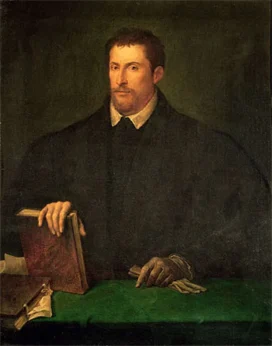
Smirnova identifies the 1540s as a decisive crisis of Renaissance culture, when the Council of Trent, the strengthening of the Inquisition, and expanding Habsburg domination contributed to a growing atmosphere of intellectual threat. Italy entered a “deep crisis in Renaissance culture,” in which humanist ideals entered into a “tragic conflict with a new social order.” Yet, the signs of this crisis were already manifest. Riminaldi, a jurist from Ferrara, appears against a restrained grey-olive background, without any markers of rank. The portrait concentrates almost entirely on the face and hands. Riminaldi seems absorbed in an inner world inaccessible to the viewer.
Smirnova notes the “vibrating” quality of the brushwork and the “almost imperceptible transparent shadows” that produce a sense of continual change. The boundaries of the face seem to soften and recede, as though the individual cannot be fully contained within a fixed external form. By contrast, the grey-blue eyes remain sharply focused, creating a point of almost painful awareness within the otherwise softened structure of the face. The closed book affirms Riminaldi’s humanist learning, with his bare hand resting protectively on it. The contrast between the bare hand on the book and the gloved hand on the table distinguishes the sitter’s inward life from his outward social role, further emphasized by the enormous dark garment that almost swallows the body. He is enclosed within a dark, almost airless space. Titian creates a visual equivalent of a divided consciousness.
The sitter appears physically present yet psychologically distant—a person who has inherited the ideals of humanism yet finds himself in a world of uncertainty. The blurred transitions of color, the absence of external narrative, and the sitter’s inward gaze belong to a world in which Renaissance certainty is beginning to fracture. As Smirnova suggests, like Shakespeare’s Hamlet, Riminaldi embodies a consciousness that perceives the failures of its world but can no longer act upon them.
The Flaying of Marsyas and the Late Manner (c. 1570–1576)
By the 1570s, Titian had entered the final and most radical phase of his work. The world that had sustained Venetian humanism was disappearing. Smirnova writes that the “beautiful world created in the imagination of Renaissance thinkers” had collapsed. The Inquisition, Habsburg domination, economic uncertainty and, finally, the plague of 1576 formed the background of Titian’s final years. He was working in a culture radically different from the one that had produced the Assumption of the Virgin and Venus of Urbino.
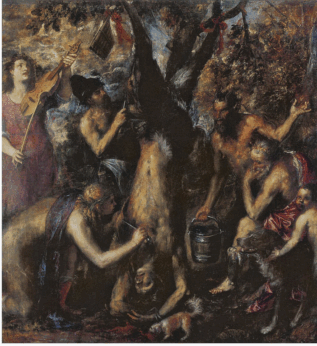
In this atmosphere, The Flaying of Marsyas emerges as one of the most extraordinary statements in European painting. The myth describes Apollo’s punishment of Marsyas, the satyr who challenged the god in a musical competition and was flayed alive. However, Titian transforms this into something more disturbing and universal. Smirnova compares the atmosphere to “a world like Dante’s hell.” Stable Renaissance classicism has dissolved into an entirely new visual language. Smirnova describes the use of “open, large brushstrokes,” color sometimes applied with the fingers, replacing precise description. The surface becomes a “fantastic chaos, a swift whirlwind of brushstrokes.” Titian abandons the illusion of a stable external world because that stability itself has become historically impossible. Violence is expressed through the instability of the painted surface. Color, gesture, and broken form become a language for suffering and endurance.
Berger argues that Titian was among the first painters to make the physical act of artistic creation visible. At the very moment when Renaissance ideals appear to have failed, the artist’s brushstroke and visible hand become the final answer to historical catastrophe: human agency confronting an uncertain world. Titian’s legacy remains vital because he refuses both illusion and despair. He shows that the world, in all its material density and human suffering, can be known, endured, and— against all historical odds—loved.
We hope you appreciated this article. At People’s World, we believe news and information should be free and accessible to all, but we need your help. Our journalism is free of corporate influence and paywalls because we are totally reader-supported. Only you, our readers and supporters, make this possible. If you enjoy reading People’s World and the stories we bring you, please support our work by donating or becoming a monthly sustainer today. Thank you!
CONTRIBUTOR