October carries special weight in the history of World War II, or as it is known in many countries, the World Anti-fascist War. This month marks 80 years since the verdicts against Nazi war criminals at the Nuremberg Trials. It’s also 85 years since the launch of Operation Typhoon, the German drive on Moscow that opened a months-long battle and ended in a catastrophic defeat for the Third Reich’s armies.
Wars of this magnitude do not happen by accident. They are meticulously planned to cause as much destruction as possible, and public consent for them is manufactured with potent propaganda—propaganda designed to make the people who consume it dehumanize and hate the victims. In this case, the victims were Europe’s Jewish communities, communists, anti-fascists, and ethnic minorities across Europe and Asia, above all in the Soviet Union and China.
After the USSR eventually defeated Hitler’s forces in Berlin in May 1945, many Nazis scattered around the globe. Some landed here in the United States, brought over deliberately through programs like Operation Paperclip, a secret U.S. intelligence initiative which recruited more than 1,600 German scientists, engineers, and technicians. Among them was Wernher von Braun, a former SS officer who went on to help lead NASA’s Apollo moon program.
But perhaps the most shocking case is that of Reinhard Gehlen, Hitler’s top spy chief on the Eastern Front. Our government did not merely turn a blind eye to his past. It bankrolled an entire intelligence apparatus, headquartered near Munich, that Gehlen led and staffed with former SS and Gestapo officers and that became the backbone of West Germany’s spy service.
A war of annihilation
By June 22, 1941, the war was already raging across Europe and Asia. That day, the Third Reich invaded the Soviet Union, launching what was, for Hitler, the central objective of the entire war: to cripple and destroy the USSR.
The invading force, made up of troops from Nazi Germany, fascist Ialy, Finland, Romania, Hungary, Slovakia, and Croatia, had one goal: Exterminate the Soviet state. Operation Barbarossa unleashed a campaign of terror and genocide. By the war’s end, the Soviet Union had lost an estimated 27 million people.
A war of extermination on that scale required precise planning and enormous resources, and some of that support came from American industry. Henry Ford of the Ford Motor Company, Thomas J. Watson of IBM, and James D. Mooney of General Motors all aided the Reich, and all three received the Order of the German Eagle, the highest honor Nazi Germany awarded to foreigners. Their contributions, and those of many others, helped make the Holocaust and Operation Barbarossa not only possible, but as lethal as they were.
Hitler’s spymaster
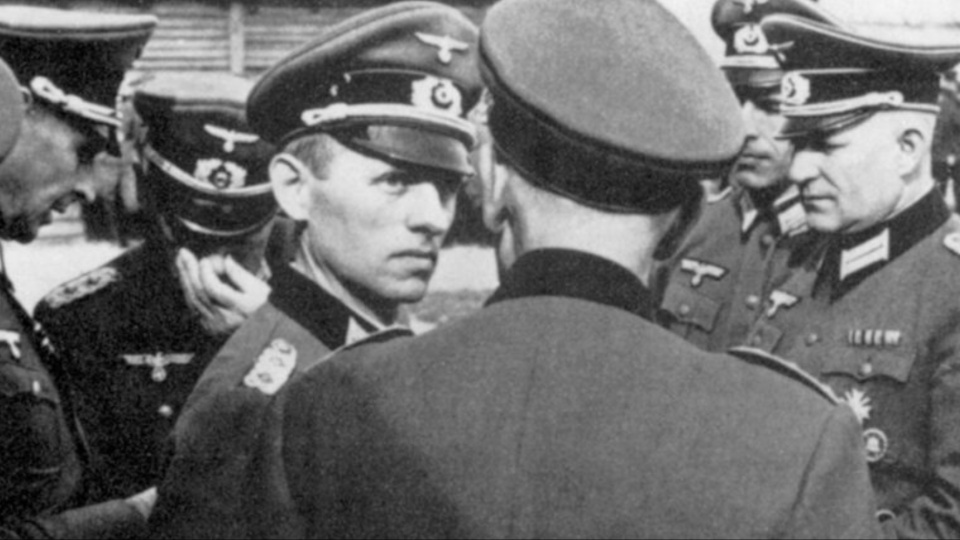
Gehlen was integral to the planning and preparation of Operation Barbarossa. After serving as a liaison officer to the army’s commander-in-chief, Field Marshal Walther von Brauchitsch, he joined the staff of Army Chief of Staff Gen. Franz Halder. By July 1941, he was a lieutenant colonel working on the Eastern Front, where he helped plan Germany’s defenses.
Barbarossa was devastating at first, but by the time it reached Moscow that fall, the offensive was stalling and falling short of its goals. The problem, Gehlen’s superiors concluded, was not a lack of military power but poor intelligence when it came to Soviet capabilities and resistance.
Fremde Heere Ost (FHO), or Foreign Armies East—the German army’s intelligence branch on the Eastern Front—was then led by Col. Eberhard Kinzel. Halder and other top brass groomed Gehlen to take over the FHO and make its intelligence gathering more rigorous. He took command in the spring of 1942, as the Barbarossa campaign was ending.
As Hitler’s chief of military intelligence on the Eastern Front, Gehlen spent the next three years restructuring the FHO and clashing ever more often with the Führer. When his reports failed to show a path to victory, Hitler fired him for being a “defeatist” in April 1945—just days before the war ended.
A bargain with Washington
Before his inevitable dismissal, Gehlen made a calculated decision: He ordered his staff to copy the entire contents of the FHO’s vault of intelligence on the Soviet Union. It is unclear whether someone in the intelligence world tipped him off to a coming clash between the West and the Soviet Union, or whether he predicted it himself.
What is known is that the materials were meticulously copied, packed into 50 heavy steel cases, driven into the mountains by select members of Gehlen’s staff, and buried in remote locations.
After his sacking, Gehlen went into hiding in those same mountains and waited for Germany to surrender. On May 22, 1945, he and his staff emerged and turned themselves in to the U.S. Army’s Counter Intelligence Corps. He handed over all 50 cases of Soviet intelligence information, and the trade bought him and his hand-picked staff far more than their freedom.
After months of interrogation, including a stint in the United States, Gehlen was back in Germany in 1946, running a new spy network for the U.S. Army. In 1949, the Central Intelligence Agency took it over.
With American money and support, the Gehlen Organization set up headquarters in Pullach, near Munich. Its ranks filled with veterans of the Wehrmacht, the SS, and the Gestapo, many of whom had taken part in the Third Reich’s genocidal crimes.
Running West Germany’s spies
The Gehlen Organization became the core of the Bundesnachrichtendienst (BND), West Germany’s Federal Intelligence Service. Gehlen served as its founding president from 1956 until he was forced into retirement in 1968.

His tenure was mired in controversy. The most embarrassing episode came in 1961, when Heinz Felfe was exposed as a KGB double agent. Felfe, a former SS officer, had joined the Gehlen Organization in 1951 and rose to head the BND’s counterintelligence operations against the Soviet Union and East Germany. Over the decade he spent there, Felfe handed Moscow more than 15,000 secret documents and blew the cover of nearly 100 West German intelligence officers.
That same year, the BND was caught completely by surprise when the German Democratic Republic built the Berlin Wall.
A comfortable retirement
After his forced retirement, one of the architects of Nazi terror—later bankrolled by the United States—lived out his days in comfort in Bavaria. Gehlen enjoyed lucrative publishing deals and a generous state pension. There have long been rumors that he also collected a supplementary pension from the CIA for his service. He died in 1979 at the age of 77.
In October 1946, the judges at Nuremberg sentenced 12 Nazi leaders to death. Barely two months later, Washington had one of Hitler’s spymasters back in business.
Anti-communism in the United States is not simply a difference of opinion. It was bought and paid for by our nation’s ruling elite, and propped up by intelligence and propaganda that came straight from the Third Reich.
No paywalls at People’s World
We hope you appreciated this article. At People’s World, we believe news and information should be free and accessible to all, but we need your help. Our journalism is free of corporate influence and paywalls because we are totally reader-supported. Only you, our readers and supporters, make this possible. If you enjoy reading People’s World and the stories we bring you, please support our work by donating or becoming a monthly sustainer today. Thank you!
CONTRIBUTOR