

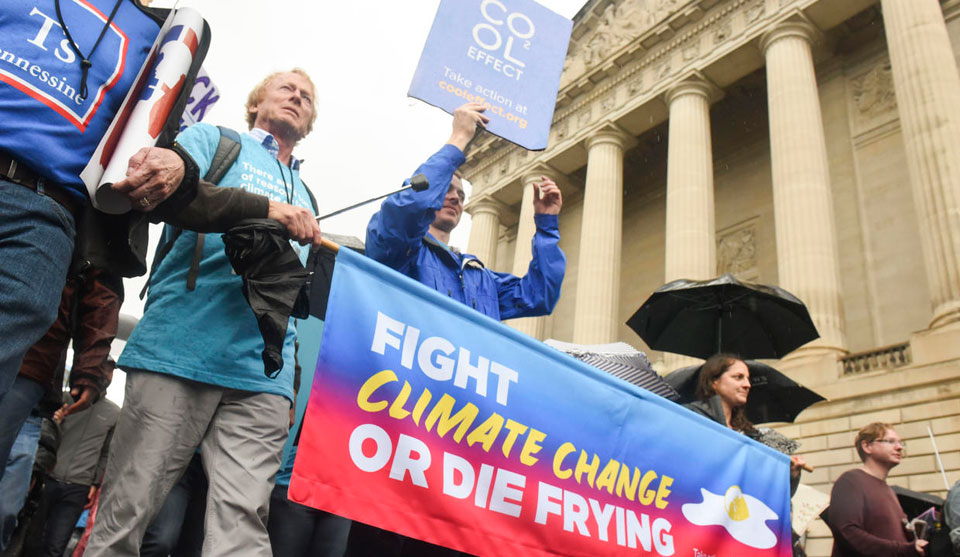
It is often said that elections have consequences. And that couldn’t be truer when it comes to the defining challenge of our time—the climate crisis.
The blue tsunami in the midterm elections swept Democrats to power in both houses of congress, key governorships, and state houses. Although inflation and the cost of fuel were at the top of voters’ minds, bipartisan concern over data centers—driven by fears of soaring electricity rates, heavy water consumption, and increased reliance on fossil-fuel energy—helped power victories for democratic candidates, underscoring the role that energy and climate played in the election.
After being urged to stay quiet about climate while campaigning, I hope that Democrats will recognize the unprecedented opportunity this provides for re-engaging on climate action, making it a central feature of their legislative agenda as they take power early next year. After all, actions speak louder than words.
The affordability crisis is being driven by higher energy prices, which propagate through the entire economy, raising the costs of most goods and services. Those higher prices, as I’ve discussed elsewhere, were a consequence of the corrupt policies of the Trump administration and enabled by the rubber stamp of a Republican congress—policies which I presaged would follow from a second Trump presidency as it sought to implement Project 2025.
Foremost among those policies were Trump’s tariffs. He sought to boost the fossil fuel industry by penalizing renewable energy, such as solar panels from China, while using trade threats to force foreign nations to buy American energy. Meanwhile, sweeping tariffs on foreign steel and aluminum inflated the cost of energy infrastructure. Ultimately, these supply chain strains—combined with retaliatory foreign tariffs—further drove up energy prices.
Then there’s Trump’s assault on domestic renewable energy. The administration has systematically targeted the renewable energy sector by halting major offshore wind projects, clawing back billions in federal clean energy funding, and eliminating key tax credits in an aggressive effort to favor the fossil fuel industry. By taking the least expensive sources of energy out of the mix available to consumers, Trump has further driven up energy costs.
And we haven’t even mentioned the impact of extreme weather events, made more frequent and more damaging by human-caused warming, that destroy infrastructure, kill crops, and disrupt supply chains and distribution systems, further driving up prices. A recent UN report found that Trump’s dismantling of US climate policy, including his withdrawal from the Paris agreement, noticeably bumped up planetary warming by an additional 0.1 degrees Celsius. That might sound like a small amount, but as I told the AP, it would shave about $1.2 trillion from the global economy.
Last but certainly not least is Trump’s misguided war of choice against Iran that, despite an ever-shifting list of supposed reasons, was ultimately about maintaining access to Middle Eastern fossil fuels. The war drove up energy prices for all of us but increased profits for American fossil fuel companies—something he misguidedly chose to boast of in the waning days of the election.
Our fragile fossil fuel-based economy leaves us exposed to volatility and conflict, making an urgent, accelerated transition to renewable energy essential for both economic stability and planetary survival. The ongoing conflict involving Iran under the Trump administration exemplifies the deep vulnerabilities and geopolitical dangers of global reliance on fossil fuels. Cutting funding for the senseless ongoing war on Iran would be a critical first step for the new congress.
But what can they do legislatively? Trump after all, wields veto power for ostensibly two more years.
Quite a lot, actually. Jake Bittle of Grist, for example, argues that newly empowered Democrats now have leverage to counter the Trump administration’s attempts to roll back federal climate regulations and can use budget oversight to compel federal agencies to release clean energy funding.
This will require true leadership. And if the senior institutionalists, like presumptive Senate Majority Leader Chuck Schumer and House Speaker Hakeem Jeffries, aren’t up to the challenge, they should move aside and let others step forward.
I think they might find some willing colleagues in the freshman class. Consider, for example, William Lawrence, part of a new generation of younger, and more environmentally conscious progressives. Lawrence was co-founder of the climate activist group known as the Sunrise Movement. He prevailed in a razor’s-edge House of Representatives race in central Michigan, ousting incumbent Republican Tom Barrett in Michigan’s 7th Congressional District. Lawrence made opposition to data centers a focal point of his campaign. He has called for a national moratorium on data centers.
There are many reasons that people oppose data centers. There are concerns over massive electricity and water consumption that drive up local utility bills, the chronic noise and air pollution from operations and backup generators, minimal creation of permanent local jobs, and broader skepticism toward the artificial intelligence boom. And of course, there is concern about the increasing carbon footprint and climate impact that comes with them. Opposition to the rapid growth of data centers is one of the few issues in modern American political history that unites citizens across the political spectrum. According to USA Today, “Data centers were on the ballot across the nation. They got crushed.”
A November 2026 national survey by USC Annenberg revealed that 77 percent of Americans believe the government is doing too little to regulate data centers. That’s miracle level bipartisan appeal. The only other things in America that garner that level of public support are Tom Hanks and a moratorium on robocalls.
A data center regulation bill could be the gateway to a broader climate and energy legislative agenda in the new congress. Democrats, however, would need to deal with the problematic Bipartisan American Affordability and Jobs Act (BAAJA) bill currently under consideration, a bill that is highly problematic from a climate and environmental standpoint because it guts foundational environmental laws to fast-track and “lock in” major fossil fuel infrastructure and gas-powered AI data centers.
Hakeem Jeffries has already signaled a bit more willingness to fight the BAAJA bill since the midterms results came rolling in.
Democrats could instead “pirate” BAAJA’s most popular ratepayer protection mechanisms while aggressively stripping out or replacing the environmental rollbacks, as they prepare the prospective new data center bill.
They could use fast-track parliamentary rules immediately after the new Congress convenes on January 3 to get the prospective new data center bill placed on Donald Trump’s desk by the second week of January. Dare him to veto it. And dare Republicans to sustain the veto if he does.
We’ve already lost two critical years under Trump and GOP congressional control, and when it comes to delay, the climate crisis is most unforgiving.
There is no time to waste. So how about it, Dems?
Bulletin of the Atomic Scientists
As with all op-eds published by People’s World, the views reflected here are those of the author.
No paywalls at People’s World
We hope you appreciated this article. At People’s World, we believe news and information should be free and accessible to all, but we need your help. Our journalism is free of corporate influence and paywalls because we are totally reader-supported. Only you, our readers and supporters, make this possible. If you enjoy reading People’s World and the stories we bring you, please support our work by donating or becoming a monthly sustainer today. Thank you!
CONTRIBUTOR