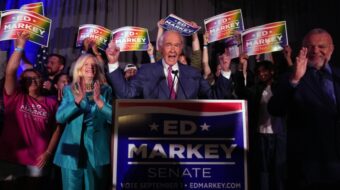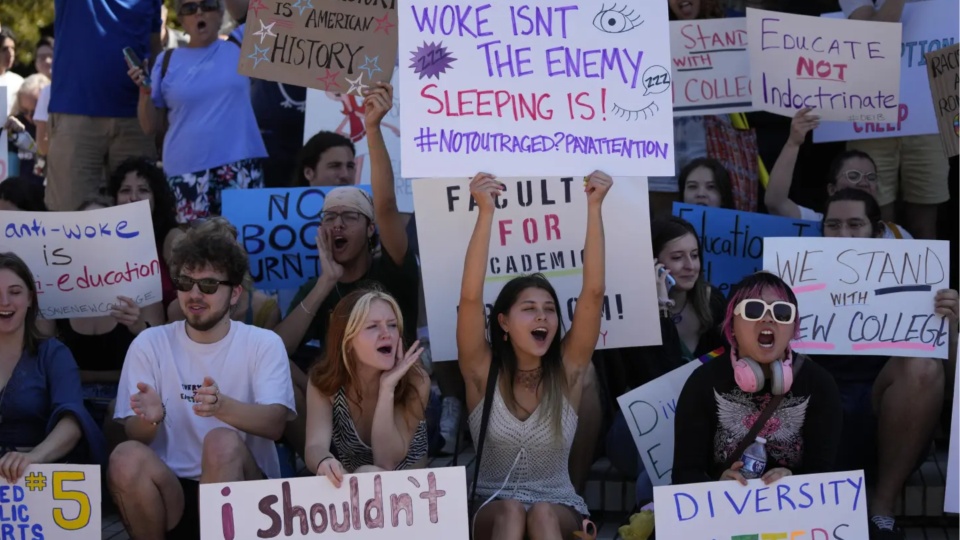
As insurgent, DSA-backed progressive candidates won Democratic primaries across the country, many Democratic Party leaders again invoked the specter of “wokeness” to portray progressive challengers as radically out of touch with ordinary working people. Like conservatives, these critics point to maximalist rhetoric around race, gender, and policing that emerged during and after the George Floyd uprising—from calls to “abolish the police” and gender-inclusive terms like “birthing people” to the ideological purity politics often associated with the activist left.
There are legitimate debates to be had about these politics. Cancel culture and illiberal tendencies toward policing speech have sometimes alienated ordinary Americans; some demands have proved unpopular; and left activists have sometimes substituted online virtue signaling for the difficult work of building broad working-class coalitions.
But the current debate obscures more than it illuminates. What politics are actually being described as “woke”? Who invokes identity politics, from what positions of power, and to what ends? Does “wokeness” really explain political transformations whose origins long predate the concept’s emergence?
- The socialist insurgency is not primarily an insurgency of “wokeness.”

The timing of establishment Democrats’ renewed fixation on wokeness is curious because—even accepting their definition of the problem—today’s socialist candidates are not primarily winning elections by campaigning on “woke” messaging. Their campaigns have foregrounded universalist, working-class demands: Medicare for All, affordable housing, universal childcare, stronger unions, and higher taxes on corporations and the wealthy.
This does not mean these candidates lack strong positions on immigration, racial justice, policing, Palestine, trans rights, or other contentious questions. They often do. But there is an important distinction between what activists believe, what organizations formally demand, what candidates emphasize, and what motivates voters to support them. The wokeness discourse routinely collapses all four.
- The significance of “wokeness” depends on the power of those who wield it—and how.
There is a second irony. While establishment Democrats and media pundits accuse the party’s left wing of being “too woke” for ordinary Americans, some have themselves weaponized identity politics to discredit class-based challenges from the left.
DSA is frequently derided because its membership is disproportionately young, white, and college educated. Critics have used that profile to question whether it can authentically represent Black and Latino working-class voters—even as many candidates associated with the socialist left are themselves people of color.
Hakeem Jeffries articulated this distinction explicitly in a 2021 interview with The Atlantic. Jeffries contrasted “Black progressives,” whom he described as approaching politics with systemic racism foremost in mind, with the “hard-left,” which he characterized as viewing America’s defining problem as “anchored in class.” The contrast cast Black politics as fundamentally rooted in race while reducing socialist politics to an overriding preoccupation with class.
The campaigns against Bernie Sanders offer another example. Sanders built a mass movement around universal public goods and a class-based critique of concentrated wealth, yet his supporters were repeatedly caricatured as young, angry, white male “Bernie Bros.” Such criticism existed alongside legitimate concerns about sexism among some Sanders supporters and Sanders’s difficulty winning Black voters in the 2016 primary. But it also illustrates the hypocrisy of party leaders who wield identity reductionism when it suits their political purposes, only to denounce it when deployed by the activist left.

This substitutes a politics of demographic authenticity for an argument over political economy: Rather than asking whether universal healthcare, stronger unions, affordable housing, or taxing the wealthy would benefit working-class constituencies, it asks whether the people advancing those policies look sufficiently like the people they claim to represent. Identity politics can function in multiple ideological directions—including as a language through which established political power defends itself against class-based challenges.
Dividing workers by race, gender, and nationality has never been an accident of American politics; it is one of the oldest tools corporate power has. A workforce split against itself bargains for less, organizes less, and votes against its own interests, and every wedge driven between Black and white, native-born and immigrant workers is money saved for the employers and Wall Street interests at the top.
- “Wokeness” is a red herring that obscures the deeper causes of working-class defection from the Democratic Party.
The current debate risks rewriting political history by treating contemporary progressive activists as the cause of a class dealignment that long predates the George Floyd uprising. Paul Heideman found that Democratic identification among both white and nonwhite workers declined steadily between 1972 and 2018.
The causes of this transformation are myriad and complex. But central to the story has been the Democratic Party’s embrace—particularly during the Clinton era—of “Third Way” politics, deregulation, free trade, financialization, and other elements of the neoliberal economic order. Plant closures, declining union power, stagnant wages, and economic insecurity contributed to profound social dislocation across many working-class communities.
Recent research strengthens the economic dimension of this account: Americans without four-year degrees began leaving the Democratic Party in the 1970s, and researchers estimate that changing perceptions of the parties’ economic policies explain roughly half of that shift. The same research documents Democrats’ retreat from policies such as stronger unions, higher minimum wages, job guarantees, and industry protection are also pinpointed as reasons causing working-class voters to abandon the party.
That vacuum matters. Donald Trump did not create working-class anger at American institutions. He found a language through which he could exploit it—redirecting economic and social dislocation toward immigrants, “liberal elites,” and other targets of right-wing populism. In doing so, he seized the language and terrain of rebellion that Democrats had increasingly ceded to the right, presenting himself as the insurgent against an establishment that had failed working-class communities.
To reduce this much longer history to a backlash against “wokeness” is to mistake one recent manifestation of working-class alienation for its underlying causes.
- The more consequential problem may be the elite capture of egalitarian politics.
There is a critique of liberal identity politics worth taking seriously. But its most consequential manifestation may not be an overeager 20-year-old activist saying something foolish online. It is what happens when people possessing enormous economic power co-opt the language of social justice without altering the distribution of that power.

Call it corporate anti-racism, elite capture, or “woke capitalism.” Corporations and elite institutions can celebrate racial and gender representation, adopt the vocabulary of equity and inclusion, and diversify the people occupying positions of power while leaving the underlying structural inequality of capitalism intact.
At the same time, it’s true that representation absolutely matters. Racism and sexism cannot simply be reduced to class, but a politics that decouples racial and gender equality from wages, unions, housing, healthcare, and economic justice risks reproducing the drastic inequality of unfettered capitalism rather than transforming it.
The question, then, is not whether politics should address race or class, but whether struggles against racial and gender hierarchy are connected to a politics capable of improving working people’s lives across racial lines.
- Illiberalism and state repression are not the same thing.
Finally, the wokeness debate collapses the difference between sectarian intolerance and government coercion. Parts of the progressive left deserve criticism for imposing ideological purity tests on allies and candidates, ostracizing people, enforcing expansive definitions of harmful speech, and a political culture that can make disagreement feel morally suspect. These lead to isolation and damage unity.
But those tendencies are not equivalent to Trump’s use of state power to restrict free speech, punish political dissent, dictate what public institutions may teach, and jail or deport critics. Both can be illiberal without being equivalent in mechanism or power.
A Twitter pile-on, a university controversy, an employer’s diversity policy, a state law restricting classroom instruction, and the federal government wielding coercive authority against political opponents cannot simply be deposited into a single bucket marked “cancel culture.”
That is why the real test of an anti-racist politics is not only the vocabulary it uses but whether it builds the multiracial unity of workers in common struggle in unions, on picket lines, in workplace and community organizing, and at the ballot box.
That may ultimately be the central obfuscation of the wokeness debate. A word that purports to explain everything—from awkward corporate diversity seminars to socialism, from activist jargon to government censorship—eventually explains almost nothing at all.
As with all opinion and news-analysis articles published by People’s World, the views expressed here are those of the author.
No paywalls at People’s World
We hope you appreciated this article. At People’s World, we believe news and information should be free and accessible to all, but we need your help. Our journalism is free of corporate influence and paywalls because we are totally reader-supported. Only you, our readers and supporters, make this possible. If you enjoy reading People’s World and the stories we bring you, please support our work by donating or becoming a monthly sustainer today. Thank you!
CONTRIBUTOR