
When Stanley Black & Decker, one of the world’s largest tool companies, got hit with President Donald Trump’s tariffs last year, the firm made clear that it would be sharing the pain with its customers.
The Connecticut-based company raised prices again and again, moves its executives said were necessary because of the new fees on imports.
Now, after the Supreme Court struck down Trump’s most sweeping tariffs earlier this year, the company is getting at least $298 million refunded. Instead of sharing that bounty with its customers, however, the firm has chosen different recipients:
Its own leaders.
The company is one of at least nine that have disclosed that they are using their refunds not to pay back the cash-strapped consumers who generally covered much of the tariff costs through higher prices, but to give bonuses, according to a ProPublica analysis of thousands of securities filings and earnings calls for publicly traded companies.
Other recognizable companies include the owners of discount department stores TJ Maxx and Marshalls and the golf equipment brand Titleist.
Dozens of other firms have said little about how they plan to use the money other than to characterize the windfall as the kind of earnings they use to determine executive bonuses.
The Trump administration has not publicly detailed which companies are getting the roughly $170 billion in refunds or how much they’ve asked for, and it has denied ProPublica’s requests for this information. But reporters found some of these details while reviewing the disclosures of thousands of publicly traded companies.
Some have described vague plans to pay the money forward by, for example, “returning tariff refunds to our members through pricing,” though they generally don’t say whether that involves price cuts or limiting future increases. Others are paying back businesses they sold products to because they had itemized receipts that detailed the tariff markups.
But consumers hoping for refunds appear to be largely out of luck. With the help of artificial intelligence, ProPublica identified companies that said they planned to refund customers with their tariff windfalls. Almost all of them deal with other businesses, not consumers.
“Executive bonuses are probably the least just way to use this money because it wasn’t anything the executives did that they should be rewarded for. It was a government mistake that resulted in a refund,” said Gregory Germain, a corporate law professor at Syracuse University. “It really explains why it’s so important for the government, when they’re doing something like this, to think it through to make sure consumers don’t pay extra money and not get it back.”
The chain reaction that led to these bonuses began in the first months of Trump’s second term. In February 2025, Trump declared a national emergency over illegal drugs coming in across the border and unilaterally announced new tariffs on goods from the countries he deemed responsible: Canada, Mexico and China.
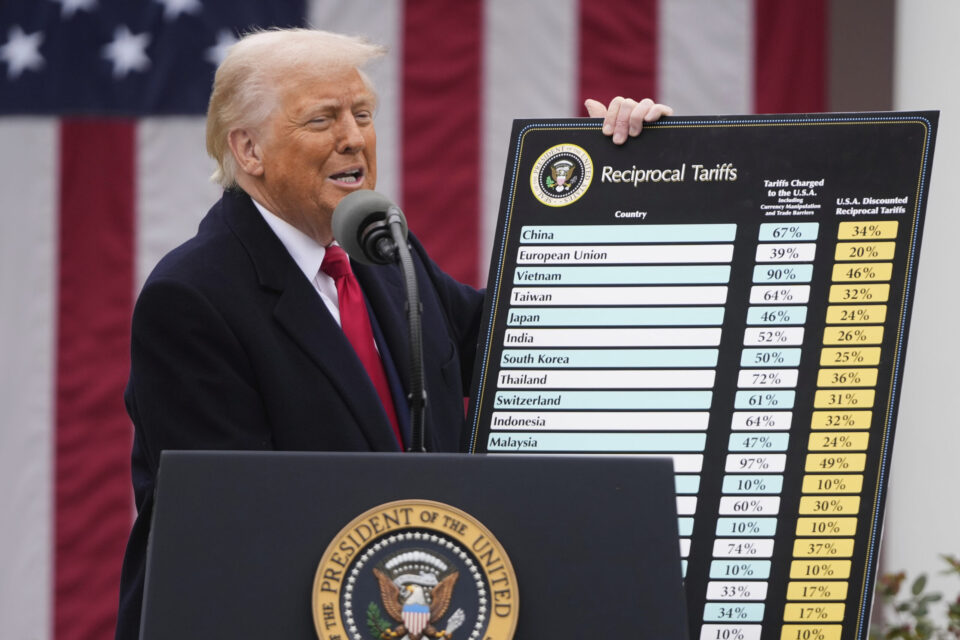
Then, in April, he declared a second national emergency, this one over the U.S. trade deficit — the fact that the U.S. was importing more than it exported. Declaring it “Liberation Day,” Trump unveiled a poster in the Rose Garden detailing his most sweeping tariffs yet on goods from more than 100 countries.
Those tariffs remained in place, with some tweaks, until earlier this year when the Supreme Court struck them down, ruling that Trump had needed congressional approval to impose them.
That left the federal government scrambling to figure out how to refund billions in duties it had collected over the prior year on more than 53 million imported shipments. U.S. Customs and Border Protection set up an online application system. But only the direct payers of the tariffs — called the “importers of record” — are eligible to apply, not the businesses and consumers who took a hit downstream.
The New York Federal Reserve Bank, which analyzed the prices of a broad swath of goods, found that 26% of the tariff costs were eaten by American customers; a study from Harvard Business School put the estimate at 43%. One study estimated that Trump’s tariffs cost typical American households about $1,000 last year.
The administration and Congress have not placed constraints on how companies use the tariff refunds, though there have been calls to do so. After the Supreme Court ruling, a group of Democratic senators wrote to the president, asking if he would require companies to pass along part of their payments to consumers and assign penalties to those that did not. Doing otherwise, said Sens. Elizabeth Warren, Cory Booker and Peter Welch, would render the refunds “a giveaway to giant corporations that amounts to theft from the middle class.”
Though Treasury Secretary Scott Bessent has denied that the tariffs resulted in significantly higher prices, he has acknowledged the fundamental unfairness of only importers of record getting the refund. “I got a feeling the American people won’t see it,” he said in February at an Economic Club of Dallas event.
Bessent has made the argument that it’s the Democrats who challenged the tariffs in court, not the administration that imposed the tariffs, who are responsible for the transfer of wealth from American consumers to companies.
“The Democratic attorney generals who filed a ridiculous lawsuit against this administration wanted the money to go back to the payer of record,” he said at a press conference. “If I hear another Democratic legislator make the inane remark, ‘The American people should get the money’ — the American people had the money in the U.S. Treasury and we were forced to give it back.”
In some cases, companies have said that they will be splitting at least some of their refund checks with their customers. ProPublica’s analysis shows these companies’ customers are generally other businesses, not average consumers. Among them is Varex Imaging Corp. in Utah, which sells X-ray imaging components for medical businesses and cargo screeners. Varex and firms like it have not elaborated on why they are passing along refunds, but trade experts suspect these business-to-business vendors have detailed contracts that itemize tariff costs.
Shipping companies, like UPS and FedEx, have set up online portals for customers seeking refunds. Though the firms are technically importers of record, they imported goods on behalf of businesses and individuals that paid them to ship products. The companies are itemizing how much customers paid in tariffs and reimbursing them.
A series of lawsuits are attempting to force companies that sell directly to consumers to share some of their refunds. Dozens of firms have been sued, including big-box stores Walmart and Target and apparel companies such as Nike and Lululemon. Apparel and leather costs were some of the hardest hit by Trump’s tariffs. Legal analysts have cast doubt on whether these lawsuits will succeed, though some trade experts have speculated that businesses that used the tariffs as cover to raise prices more than they needed to might settle to avoid embarrassing disclosures.
One of the companies facing a lawsuit is Stanley Black & Decker, the toolmaker that ProPublica found was using some of its refund on bonuses. The named plaintiff is a Wisconsin resident who bought a handheld blower, an impact wrench, a hedge trimmer and other tools from the company last year, but the lawsuit seeks to represent thousands of other customers as well.
“Unless restrained by this Court,” the complaint reads, the company “stands to recover the same tariff payments twice — once from consumers through tariff-inflated prices and again from the federal government through tariff refunds.”
On multiple occasions, the company has acknowledged publicly that it was raising prices because of the tariffs.
The month before the November 2024 election, as Trump was campaigning on dramatic new tariffs, the toolmaker’s then-CEO, Donald Allan Jr., told shareholders that Stanley Black & Decker was preparing for the possibility. “Obviously, coming out of the gate, there would be price increases associated with tariffs that we put into the market,” he said during an earnings call. Then, a few months after Trump unveiled his tariffs, Allan said his team was “remaining focused on executing our robust plan designed to mitigate tariffs” that he said included “targeted pricing actions to improve our gross margin.” Later that year, his successor as chief executive, Chris Nelson, described more price hikes: “We are implementing a second price increase during the fourth quarter to maintain our innovation and brand investments, given the pressures resulting from tariff-related cost increases.”
In its more recent disclosures, the company has been vague about how much of its refund was going to executives, simply saying that some of that gain “was partially offset by directly attributable costs for variable incentive compensation.” “Incentive compensation” is a term the toolmaker uses to describe bonuses.
The company has not responded to the allegations in the lawsuit brought by the Wisconsin resident and did not answer ProPublica’s questions about who is getting paid the bonuses, how much they’re worth and whether customers should be reimbursed.
Securities experts who reviewed the disclosures for ProPublica said it appeared the windfall boosted the company’s profits, which factor into formulas that help determine bonus pay for executives and other employees.
“It wasn’t the executive that triggered that extra profit, so why should their compensation go up?” Germain, the corporate law professor said. “This is one of many examples where these formulas don’t do what they should do.”
The company’s leaders, securities experts said, could have given money back to consumers or lowered prices. Retail giant Burlington Stores, formerly known as Burlington Coat Factory, appears to have done just that.
CEO Michael O’Sullivan recently said the company got $55 million in tariff refunds and “rather than taking a one-time boost to earnings” the company plans “to deliver even sharper values to our shoppers,”
“Over the last few years, the rising cost of living has made life difficult for many customers,” O’Sullivan said, adding that the coming discounts meant investors should expect the “direct impact of tariff refunds to be neutral.”
A company spokesperson confirmed to ProPublica that none of its tariff refund will be going to bonuses.
Not so for other companies.
Acushnet, the Massachusetts golf equipment company that includes the brand Titleist, disclosed an “incentive compensation expense of approximately $12.0 million” out of its refund. Acushnet declined to respond to questions from ProPublica.
TJX, the Massachusetts parent company of TJ Maxx and Marshalls, said it got back $331 million, but as a result, it “accrued incremental expenses of $112 million for year-end incentive compensation and discretionary bonuses for eligible Associates globally.”
The company declined to answer questions from ProPublica about how far down the chain of command the bonuses would go and how much of them would be reserved for top managers. “Given that this is an accrual, and we have not reached the end of our current fiscal year, we have not disclosed any breakout beyond this,” a spokesperson said. The company also declined to say whether it would lower prices or pay back customers with the rest of its refund, saying only that “the remaining amount will be used to support our future growth.”
ProPublica’s examination of tariff refunds was limited to publicly traded companies, which are required to disclose detailed financial information. None of the companies that said they are using the money for bonuses have ever said they planned to refund customers. How private companies are using their refunds is unclear because they aren’t normally required to disclose such information.
CONTRIBUTOR