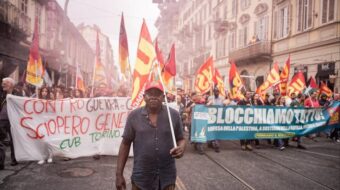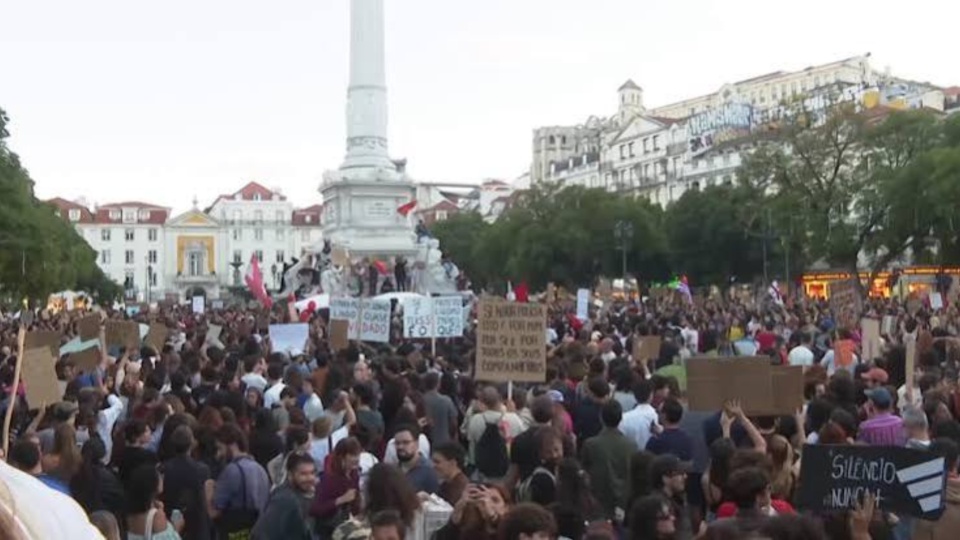
PORTO, Portugal—Tens of thousands of working people demonstrated across Portugal on Saturday, answering the call of the General Confederation of Portuguese Workers (CGTP-IN) for “Higher wages, better pensions, and public services” and “Against the rising cost of living—A new course for Portugal!”
In Porto, in the capital, Lisbon, and cities around the country, marches filled the streets. The massive mobilizations capped off a “Month of Action, Mobilization, and Struggle,” mirroring recent working-class led protests sweeping many countries in Europe, including France, Spain, Italy, Albania, and more.
The call to action resonated deeply across the Portuguese working class. The Trade, Office, and Service Workers Union (CESP) and the Performing Arts, Audiovisual, and Musicians Workers Union (CENA-STE) submitted strike notices for Saturday specifically to allow their workers to join the demonstrations. In Madeira, the Trade Union Association held a day of action in Funchal, while in the Algarve, union leaders met to prepare for the march and their upcoming congress.
The backdrop to the upsurge is a crisis of everyday living facing workers across the European Union. For instance, Portugal’s inflation hit 3.6% in September. Fuel costs have skyrocketed by 15% year-on-year, driven in part by escalating tensions and the U.S.-Israel war on Iran. Meanwhile, the housing crisis has reached catastrophic levels: House prices have more than doubled since 2017, and rents for new leases have nearly doubled, fueling one of Europe’s worst affordability crises.
According to the Portuguese Communist Party (PCP), this is the direct result of a system that prioritizes NATO war budgets and capitalist profits over human needs. “Buying is becoming increasingly difficult, many are paying more and more so that a few can accumulate wealth like never before,” said the party. Condemning the conservative government’s refusal to intervene, they said: “It’s not incompetence, it’s a political project.”
The CGTP-IN pointed out in their protest leaflets that in 2026 alone, just 18 major economic groups in banking, energy, telecommunications, and retail amassed a staggering 32.4 million euros in profit every single day.
“The vast majority struggle daily to pay bills, rent, or mortgage payments, to put fuel in their cars or food on the table,” the CGTP-IN said, “while the few profit more and more from increased exploitation.”
The youth wing of the CGTP-IN, Interjovem, is sounding the alarm on the economic reality facing the next generation. In their leaflets, they noted that half of young people up to age 25 have precarious employment, earning 20% less than those with permanent contracts, with 10.7% living in poverty.
The anger over the cost-of-living crisis has been most visibly expressed by working-class youth. In Porto, a youth-led tent encampment demanding affordable housing was brutally cleared by police last Monday which resulted in 37 injuries.
In a statement, Amnesty International said: “From evidence we have verified online and from interviewing protesters and witnesses at the scene, Amnesty International is concerned that the Portuguese police used excessive (and thus unlawful) force against peaceful protesters.”
But public outrage over the crackdown forced city officials to back down, allowing protesters to re-establish the encampment in Porto’s Praça D. João I on Saturday night.
Inspired by Spain’s Acampada movement, protesters also took over the central square in Lisbon with tents over the weekend. They are demanding rent caps and restrictions on real estate funds buying up hundreds of single-family homes.
In response to the upsurge, the PCP and CGTP-IN are putting forward a concrete program to address the crisis, proving that there is an alternative to the conservative government’s austerity agenda—which has systematically defunded and privatized the National Health Service (SNS) and weakened renters’ protections.
The CGTP-IN is demanding a 15% increase in the minimum wage, a reduction of the workweek to 35 hours without a loss of pay, increased funding for public health and social security, and immediate action to lower housing costs. In addition to the demands from the labor federation, Interjovem is also calling for an end to employer blackmail via temporary contracts, which particularly hurts young workers.
The PCP has taken up the call for price regulation, pointing out that the government refuses to touch the profit margins of the oil monopolies, banks, and supermarkets. The party is demanding a national minimum wage of 1,100 euros, a 5% increase in all pensions, a cap on the price of a gas cylinder at 20 euros, and state intervention to regulate fuel, food, and energy prices. The party also emphasized the need to defend the rights of young people.
CGTP-IN General Secretary Tiago Oliveira called on workers to continue the fight and to make November a month of action, which would culminate in a massive protest outside the Assembly of the Republic on Nov. 24, the day of the final vote on the national budget.
This article features reporting from Avante! and People’s World.
No paywalls at People’s World
We hope you appreciated this article. At People’s World, we believe news and information should be free and accessible to all, but we need your help. Our journalism is free of corporate influence and paywalls because we are totally reader-supported. Only you, our readers and supporters, make this possible. If you enjoy reading People’s World and the stories we bring you, please support our work by donating or becoming a monthly sustainer today. Thank you!
CONTRIBUTOR