
OAKLAND, Calif.—For decades, unions, lawmakers, and healthcare activists have fought for and lobbied for Medicare for All, a single payer health insurance plan that would cover every single person in the United States.
Now, taking advantage of the blue tsunami that swept MAGA out of power, a massive coalition of those groups and more has developed an actual strategy that they believe will result in translating their decades-long dream into the law of the land.
Led by National Nurses United, which has fought for Medicare for All for decades, a parade of supporters spent two hours at a national strategy call on the evening of Nov. 17 spelling out how it will be put before Congress and then followed up with specific steps. Over 600 people participated.
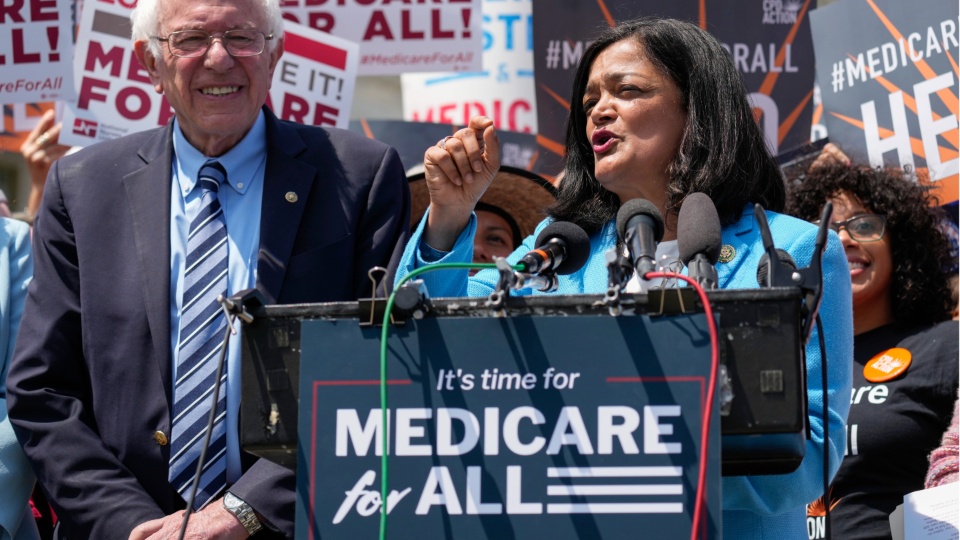
“It is absolutely criminal that in the richest country in the world, 90 million people are uninsured or underinsured, that there is $220 billion worth of medical debt,” and that it drives people into bankruptcy, Rep. Pramila Jayapal, D-Wash., lead House crafter of Medicare for All, told attendees.
The legislation’s lead Senate sponsor, Vermont Independent Bernie Sanders, emphasized the way to get Medicare for All is for a mass and constant bottom-up popular campaign.
Much of the program was devoted to distributing sign-up sheets and rollout plans and targeting lawmakers of both parties. Signups and backup material is available from NNU at Medicare4all.org.
Supporters are armed with augmented ranks on Capitol Hill, where they reported four of the newly elected members of the Democratic U.S. Senate majority and 32 of the new U.S. House Democrats made Medicare for All their top campaign theme.
“Even Victoria Broderick in Tennessee ran and won on Medicare for All,” one speaker noted. Broderick will be the sole Democrat in the heavily gerrymandered state’s nine-member House delegation next year, having upset a GOP incumbent by 272 votes out of around 195,000 cast.

The supporters’ first step is to gather even more congressional backers than ever before—the previous highs were 112 in the House and 16 senators—and then wage a large public campaign to pressure Congress to seriously consider the legislation.
But, being realistic, they know that while Medicare for All will be reintroduced and despite their campaign for it, the most they can get next year is congressional hearings and action, due to opposition from the radical right, the cash-flushed insurance lobby, and President Donald Trump.
That won’t stop them, however. They plan to unveil a revised and improved Medicare for All bill, with a four-year phase-in starting in 2029. They’ll roll it out probably in late February, stage a follow-up national week of action, and undertake intensive personal lobbying all next year and the year after.
Which means the scenario is to make health care the top issue in the 2028 election, especially for presidential contenders. They’ll seek commitments to support, lobby for ,and sign the measure—without compromises—and plan to elect a new president in 2028 who will do all that in 2029.
“We’re going to inject this issue into the presidential process,” said Robert Weissman, co-president of Public Citizen.
The need for Medicare for All is there, speakers said. Polls show the demand for it is there, too. Overall, more than 70% of Americans support the policy, including 90% of Democrats and 75% of independents.
As nurses, “We see the impact of our broken health care system every day, and we need to get this done,” said National Nurses United (NNU) Co-President Jamie Brown, RN, of Michigan.
“Voters said ‘no’ to the party of Medicare and Medicaid cuts, of ICE fear, and of billionaires,” added Brown. The voters flipped Congress to a 56-44 U.S. Senate Democratic majority and—as of now—a 257-172 majority in the U.S. House.
Sanders led off the parade of supporters by guaranteeing a Senate hearing and work sessions on Medicare for All next year.
That’s when he’ll retake the chair of the Senate Health, Education, Labor, and Pensions Committee, which handles health care laws, and make Medicare for All its first order of business. It’s even more urgent than before, Sanders and other speakers said.
“People get sick and die” because they can’t afford to go to the doctor, if they can find one,” Sanders said. “Working-class people die six years younger than the wealthy do.”
“Every day, we see struggling patients” who fight their illnesses and “the medical establishment,” exclaimed Dr. Diljeet Singh, a gynecological oncologist and president of the Physicians for a National Health Plan. “They would be free of deductibles, co-pays, and denials” by the insurers.
Medicare for All would put the private health insurance industry out of business by replacing it and its pharmacy benefit manager allies with single-payer, publicly-administered health care. Another speaker said single-payer would end the tens of thousands of deaths annually of patients whose insurance wouldn’t pay for their care.
Also gone, speakers said, would be the billions now funneled into insurance company pockets, freeing employers to offer workers that money during wage bargaining instead.
Realizing the threat, the insurance lobby has already rolled out an “alternative,” named “Medicare for America,” which features some cosmetic changes to health insurance and a weak “public option” as an alternative. “It doesn’t squeeze out the private insurance companies,” one speaker said.
“This is a fight over power” with the people on one side and the special interests, led by the lobby on the other, said Weissman. “We have to direct our energy at congressmembers, and we also have to expand the universe of people we talk to.”
“We’re going to see a lot of ugly 30-second ads” against Medicare for All, Sanders predicted. Though Sanders didn’t say so, such false advertising—the infamous “Harry and Louise” campaign ads—sank the 1993-94 Bill Clinton administration effort to reform U.S. health care.
Garnering public support and working from the bottom up is opposite of what occurred with the Clinton plan, crafted by academics and experts behind closed doors. This campaign is backed, speakers said, by the public opinion polls and focus groups where voters of all ages, races, genders, and party affiliations say the health care system is completely broken and needs drastic overhaul.
As Jayapal and Sanders envision the plan, a public health system would be phased in over four years.
In the first year, the eligibility age for traditional Medicare would be dropped to 55 and dental, hearing, and vision coverage would be added, along with coverage for all children.
Rep. Hakeem Jeffries, D-N.Y., presumed to be the House Speaker, and agenda-setter, in the next Congress, endorsed that first-year expansion on Nov. 17. He hasn’t committed to the rest.
The second year of Medicare for All would see other coverage phased in and the eligibility age drop to 45. The third year it would drop to 35. Starting in the fourth year, Medicare for All would become a reality, covering everyone.
No paywalls at People’s World
At People’s World, we believe news and information should be free and accessible to all, but we need your help. Our journalism is free of corporate influence and paywalls because we are totally reader-supported. Only you, our readers and supporters, make this possible. If you enjoy reading People’s World and the stories we bring you, please support our work by donating or becoming a monthly sustainer today. Thank you!
CONTRIBUTOR