BALTIMORE—African-Americans, a majority of the 1,179 delegates and guests at the AFL-CIO’s MLK commemoration in Baltimore, are among the most church-going groups in the U.S. They’re also more heavily pro-worker, pro-progressive, and pro-Democratic.
A panel at the gathering tackled ways in which that reality can be used to build a united front of action encompassing both labor and religious organizations. It was a topic suitable for the Martin Luther King commemoration, where four religious scholars—a Jewish rabbi, a Catholic priest, an Imam, and a Princeton professor—explored the complex relationship between faith and the dignity of work.
That relationship and its potential for fueling both civil rights and labor struggles was in evidence when The Rev. Dr. Martin Luther King Jr. led the civil rights movement and helped found, along with the Rev. Ralph David Abernathy, the Southern Christian Leadership Conference in January 1957.
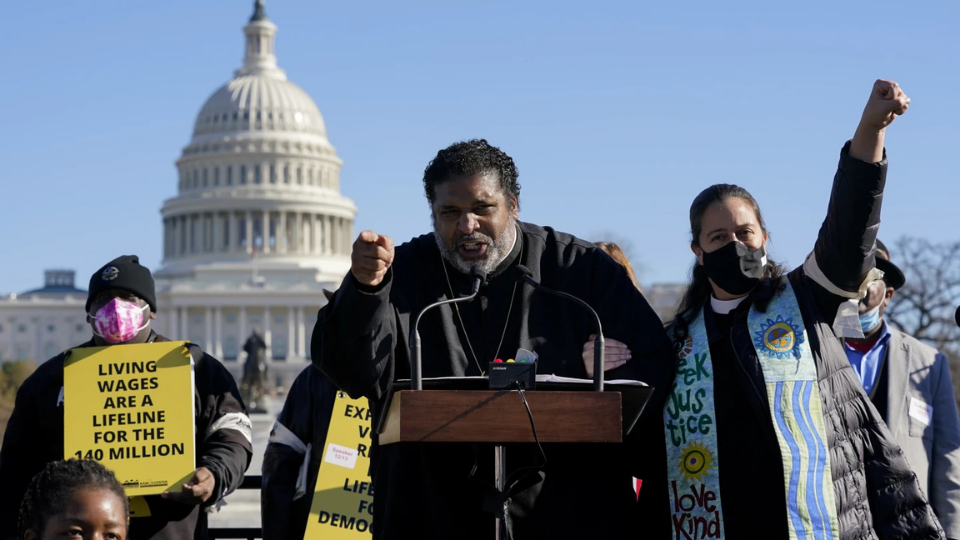
And the Revs. William Barber II and Liz Theoharis, co-chairs of the New Poor People’s Campaign, invoke religious themes and teachings, Jewish and Christian, in their campaign to convince society to lift up the poor among us. Barber, a North Carolinian, is African-American; Theoharis, a Wisconsin native, is white. Their platform planks include both a living wage and the unfettered right to organize.
Also involved are non-Orthodox Jews, especially the Reform movement, longtime allies of civil rights advocates, and progressive Methodists, Quakers, Episcopalians, current Pope Leo XIV, and his predecessor, Francis I.
Francis was an outspoken supporter of workers who often denounced capitalist excesses and repression, its practitioners and its political handmaidens. Just months into his pontificate, Leo has spent much of his time meeting with—and urging on—progressive Catholics. He started with a combination of Catholic labor leaders from his hometown, Chicago, escorted by their Cardinal, Blaise Cupich, and hasn’t stopped.
There is a negative side in the relationship between some religious organizations and the movements of labor and its allies, however. That negativity comes from the increased influence and intense religiosity of the all-white Southern Baptist Convention, whose leaders and followers believe in the literal interpretation of the Bible and are anti-abortion, anti-woman, anti-Black, and virtually all MAGA. More than 81% of extremely religious whites voted for Donald Trump. And they vote in large numbers, polls show. Megachurches are GOP bastions for all practical purposes, including pro-Republican exhortations. And MAGA and the SBC are hostile to worker rights.
They’re joined by fundamentalist sects throughout the country, plus ultra-Orthodox Jews. Those groups don’t accept the basic U.S. constitutional separation of religion and state. MAGAites distrust government and institutions—including unions—and believe “rugged individualism,” not collective action, gets people ahead.
All this is background to a discussion at the MLK conference of how religious faith can aid workers in their quest for dignity, respect, and rights on the job. Progressive religious leaders “are feeding people hope that we can have a dialogue together on the problems we face,” said Imam Earl El-Amin of the Muslim Community Cultural Center of Baltimore.
Such hopes can be dashed, especially by rising anti-Semitism and rising anti-Islamic hate.
“Last week, the oldest synagogue in Jackson, Miss., was burned,” said Rabbi Rachel Gartner of Georgetown University in D.C. A 17-year-old white man was filmed on the synagogue’s interior video camera breaking in, pouring gasoline everywhere, then lighting the fire. He confessed before his arrest, calling it “the synagogue of Satan.”
“White supremacist ideology has anti-Semitism at its core,” Rabbi Gartner commented.
“Tyrannies work in their own way, making us start to believe that we cannot work together,” the rabbi added, without naming names. “They believe we should be furious at each other, not curious about each other. Faith communities can play a powerful role when we do the hard work of softening” each other, Rabbi Gartner said.
But faith communities and their progressive allies must also come together to electorally combat religious hate, she noted. Because they did not do so in pre-Nazi Germany in its elections of 1930 and just afterwards, “The Nazis won power with only 33.1% of the vote.”
“When faith is detached from social theory, we get in trouble,” warned Princeton Professor of African-American History and Religion Eddie Glaude Jr. “There are corporate interests out to exploit working people. Our faith tradition should allow us to see our fellow human beings as in the image of God,” and to confront “a certain economic system of disposability of people.”
But breaking into the MAGA ranks will be tough for workers and their allies, Glaude warned. “Will white evangelicals accept Donald Trump’s assaults on immigrants and people of color?” he asked. “That will be the test.” He added later, “their despotism is not an accident.”
“Too many white evangelicals are not evangelical” and don’t follow Christ’s teachings, Glaude, who is Black, added. “Jesus quoted the prophet Isaiah, ‘The spirit of the Lord is upon me to bring good news to the poor.’
“We need to build a modern-day movement that cuts to the core of their hypocrisy,” Glaude declared. The Rev. Barber regularly denounces the hypocrisy in his Sunday sermons for the Poor People’s Campaign. He says such Christian “pastors” aren’t Christian.
“Sometimes people can surprise me,” by using faith to reach out to each other, admitted Wallis, a Mississippi native and founder of Georgetown University’s Center on Faith and Justice. “You have to be open to the beauty of another human being,” as Mississippi was not.
His one hope is the greater openness of young people towards progressive values and beliefs, even as surveys show they’re turning away from organized religion. The Pew surveys on religion and the public, for example, show the fastest growing “religious” group in the U.S. for the last several decades has been the “none”s.
But young people, including young workers “are very open to something larger than themselves,” Wallis elaborated. “What excites them is when they see people of faith putting faith into action.
“They want to act, and they want to see us acting beside them, because they know that when we are acting, we will bring their faith to life.”
We hope you appreciated this article. At People’s World, we believe news and information should be free and accessible to all, but we need your help. Our journalism is free of corporate influence and paywalls because we are totally reader-supported. Only you, our readers and supporters, make this possible. If you enjoy reading People’s World and the stories we bring you, please support our work by donating or becoming a monthly sustainer today. Thank you!
CONTRIBUTOR