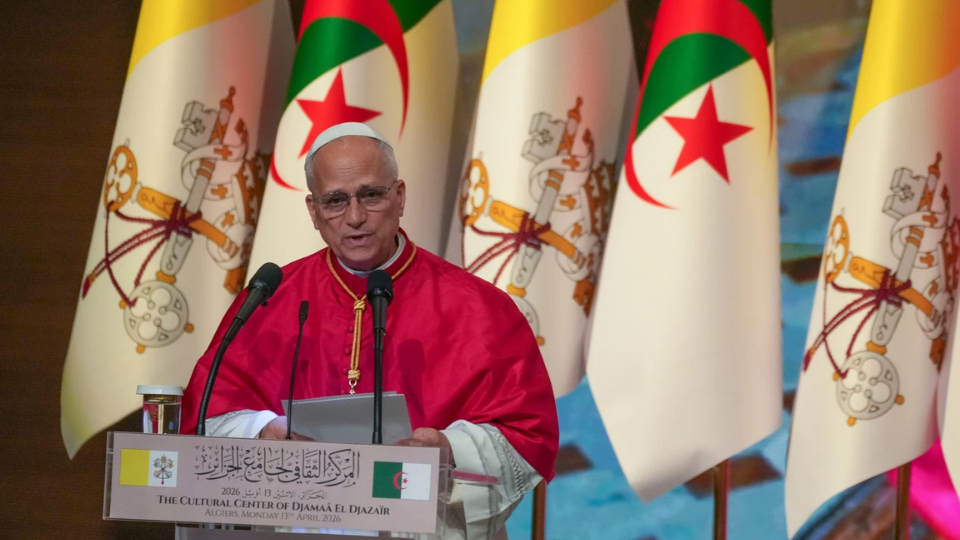
In an era defined by geopolitical fragmentation and a crisis of civilizational confidence, Algeria is quietly but decisively reasserting itself as one of the Mediterranean’s most consequential anchors of stability, memory, and intellectual continuity. The forthcoming visit of the head of the Catholic Church, Pope Leo XIV, from April 13 to 15, 2026—far from a routine diplomatic or religious engagement—has crystallized this reality with unusual clarity.
What is unfolding is not merely a visit. It is a recognition.
A recognition of Algeria’s unique ability to operate simultaneously across multiple registers: as a sovereign political actor, a stabilizing regional force, a custodian of deep historical memory, and a rare space where civilizational dialogue is not theoretical but lived. At a time when many states struggle to reconcile identity with openness, Algeria has crafted a model rooted in equilibrium—anchored in its historical depth and projected through a confident, independent diplomacy.
The decision to begin a major African papal journey in Algiers speaks volumes. It reflects an implicit acknowledgment that Algeria occupies a strategic and symbolic position within the global architecture of dialogue—between North and South, between Islam and Christianity, between Africa and Europe. Few nations can credibly claim such a multidimensional relevance; fewer still can sustain it with coherence.
This is where Algeria distinguishes itself.
From the capital, where high-level political engagements will take place, to Annaba—the ancient Hippo Regius—the visit unfolds across a geography that is as intellectually charged as it is historically grounded.
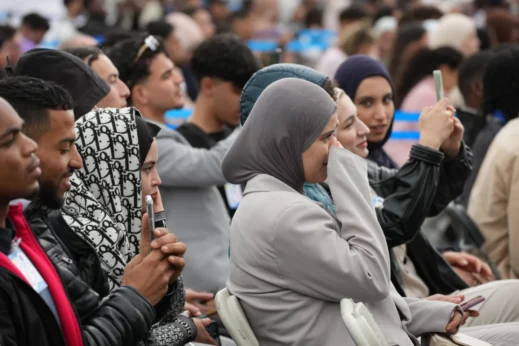
The visit will also include a highly symbolic stop at the Djamaa El Djazair, widely known as the Great Mosque of Algiers, a landmark that encapsulates Algeria’s synthesis of tradition and modernity. As the largest mosque in Africa and the third-largest in the world, after Masjid Al-Haram in Mecca and Masjid Al-Nabawi in Medina, the complex stands not only as an architectural achievement but as a strategic cultural statement. With its soaring 265-meter minaret—the tallest in the world—its vast prayer hall accommodating up to 120,000 worshippers, and its refined fusion of Andalusian aesthetics, geometric precision, and contemporary engineering, the mosque reflects a nation that has successfully translated its historical identity into a modern, forward-looking vision. Beyond its religious function, the site operates as a comprehensive intellectual and cultural hub, housing research centers, libraries, and institutions dedicated to knowledge production, thereby reinforcing Algeria’s positioning as a space where faith, scholarship, and civic life intersect.
The symbolism of the papal presence within such a setting is profound. It signals not merely a gesture of interreligious courtesy, but a deliberate affirmation that dialogue between civilizations can unfold within spaces deeply rooted in their own spiritual traditions. In a global context often marked by tensions surrounding identity and belief, Algeria offers a compelling alternative model—one in which sovereignty, religious authenticity, and openness coexist without contradiction.
Algeria’s constitutional order gives this symbolism an added institutional weight. The 2020 Constitution guarantees freedom of conscience and the free exercise of worship, exercised in accordance with the law, while also placing the protection of places of worship under the State’s impartial guarantee; at the same time, Article 2 affirms that Islam is the religion of the State. In that balance, Algeria presents a model of rooted identity and regulated openness, where respect for religious plurality is preserved within a clear legal and public-order framework.
Reconnecting with the visit’s trajectory, it is in Annaba that the itinerary takes on its deepest meaning. For it is here that Saint Augustine, one of the most influential thinkers in human history, lived, wrote, and shaped ideas that continue to structure global philosophical and theological thought.
That Augustine was not merely associated with North Africa but was a product of it—Born in 354 in Thagaste (present-day Souk Ahras), educated in Carthage, and intellectually matured in Hippo—repositions Algeria within the very foundations of global intellectual history. His theological and philosophical works, including Confessions, On the Trinity, and The City of God, are not detached abstractions; they are deeply rooted in the lived realities of a North African world marked by plurality, debate, and intellectual vitality.
In reclaiming this legacy, Algeria is not engaging in retrospective glorification. It is activating a civilizational continuity that remains profoundly relevant today. Augustine’s synthesis of philosophy, faith, and political reflection—crafted on Algerian soil—resonates in a contemporary world grappling with fragmentation and searching for frameworks of coexistence.
The Pope’s visit, therefore, becomes an encounter with this continuity. A return not only to a place, but to an intellectual origin.
Yet Algeria’s significance is not confined to its past. Its contemporary posture reflects a rare strategic clarity. In a region often destabilized by external interventions and internal fractures, Algeria has maintained a consistent doctrine of sovereignty, non-alignment, and regional mediation. It has positioned itself as a stabilizing force across the Sahel, a key actor in Mediterranean security, and a reliable partner in addressing transnational challenges such as migration and energy security.
This consistency has earned Algeria a form of credibility that cannot be manufactured—it is accumulated over time through restraint, coherence, and strategic independence.
At the same time, Algeria’s internal composition reinforces its external strength. It is a nation shaped by a rich synthesis of Arab identity, Amazigh heritage, Islamic tradition, and Mediterranean openness. This plurality is not a point of tension; it is a source of resilience. It allows Algeria to engage with multiple civilizational narratives without diluting its core identity.
In this sense, Algeria embodies something increasingly rare in global politics: a state that is deeply rooted without being closed, and open without being dependent.
The symbolism of the visit to sites such as the Maqam Echahid further underscores this synthesis. It anchors the engagement in Algeria’s modern history of struggle and sovereignty, reminding observers that the country’s openness to dialogue is inseparable from its hard-won independence. Algeria does not host the world from a position of vulnerability; it does so from a position of historical confidence.
Meanwhile, the Vatican’s engagement with Algeria reflects a broader recalibration toward Africa—not as a peripheral space, but as a central arena of global religious, demographic, and intellectual transformation. Within this shift, Algeria stands out as a uniquely strategic interlocutor: historically grounded, politically stable, and culturally complex.
The visit also amplifies Algeria’s growing soft power. Not through spectacle or projection, but through depth—through its ability to embody a narrative that is at once ancient and contemporary, local and universal. In an age where influence is often equated with visibility, Algeria demonstrates that enduring relevance is built on substance.
And it is precisely this substance that defines Algeria’s role today.
To stand in Annaba, overlooking the Mediterranean from the Basilica of Saint Augustine, is to confront a powerful historical truth: that the intellectual foundations of what is often termed “Western civilization” are inseparable from North African soil. That Algeria was not a passive recipient of ideas, but a generative force in their creation.
This realization carries profound implications. It challenges inherited geographies of knowledge and re-centers Algeria within the global narrative—not as an exception, but as a foundational actor.
The Pope’s visit brings this reality into sharp focus.
It affirms that Algeria is not merely a participant in contemporary international affairs, but a country whose historical depth, strategic clarity, and civilizational richness position it as a pivotal actor in shaping the future of dialogue between cultures, religions, and regions.
In a world searching for balance, Algeria offers something both rare and necessary: continuity without stagnation, openness without compromise, and identity without exclusion.
This is not simply a moment of visibility.
It is a moment of recognition—long overdue, and increasingly undeniable.
As with all op-eds and news analytical articles published by People’s World, the views expressed here are those of the author.
We hope you appreciated this article. At People’s World, we believe news and information should be free and accessible to all, but we need your help. Our journalism is free of corporate influence and paywalls because we are totally reader-supported. Only you, our readers and supporters, make this possible. If you enjoy reading People’s World and the stories we bring you, please support our work by donating or becoming a monthly sustainer today. Thank you!
CONTRIBUTOR