TORONTO—Legally, the working week in Japan is 40 hours, but good luck finding anyone who puts in less than 46 hours on the job. For workers in some industries, like construction, the double duty adds up to as much as 38 hours a month—the equivalent of a full extra week of labor.
And the real kicker? Most of that surplus work is unpaid—something Japanese employers call sabisu zangyo, or “service overtime.” It’s so bad that many workers are literally toiling themselves into an early grave. The Japanese have a term for that, too. It’s the phenomenon of karoshi—“death by overwork.”
Combined with decades of economic stagnation and limited opportunity at home, the lack of anything resembling a work/life balance is helping drive increasing numbers of Japanese youth to leave the country, with some observers starting to use the word “exodus” to describe what’s happening.
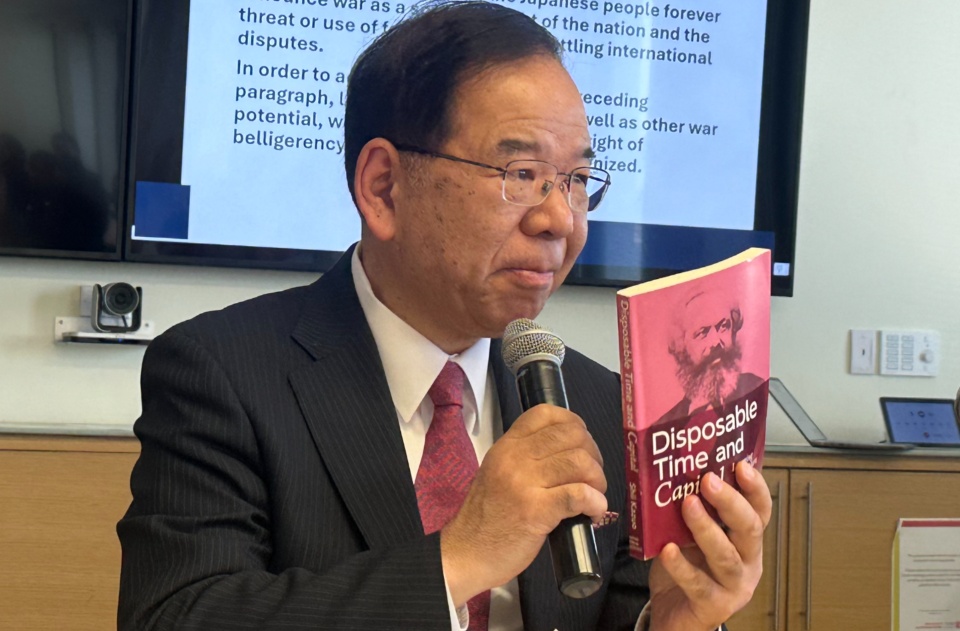
It’s no wonder then that the Japanese Communist Party (JCP) is laser-focused on the question. Shii Kazuo—the chair of the party’s Central Committee and a 33-year veteran of the Diet, Japan’s parliament—has made it the topic of his latest book, Disposable Time and Capital: Learning from Marx, which was recently published in English translation.
Karl Marx’s 1867 volume, Capital: A Critique of Political Economy, sometimes has a reputation for being full of dry calculations of fixed and variable capital ratios or hard-to-follow theorizations about the nature of commodities. But Shii believes such a view of that classic work misses the big picture.
At the heart of Marx’s analysis of capitalism, he argues, among all the explanations of how surplus value is produced and appropriated, is the demand that workers should have more command of their own time—and thus, of their lives.
Shii shared his thoughts in a wide-ranging conversation with students, activists, and journalists at an event hosted by the Department of Sociology at York University in Toronto on May 4. The seminar capped off a North American tour by a JCP delegation that started with a visit to the United Nations for the review conference of the nuclear Non-Proliferation Treaty and continued with a bilateral exchange with leaders of the Communist Party USA, a presentation to DSA members in Chicago, and various other meetings.

At York, Shii quoted Marx’s definition of post-capitalist society as one where “the full and free development of every individual forms the ruling principle.” But, he asked, “how can people develop their potential fully and freely when they don’t have enough free time to use as they wish?”
That’s the central question of his book, which is built around a concept Marx called “disposable time”—the time left over after workers have completed the labor necessary to sustain themselves and their families. Marx traced this idea back to an obscure 1821 pamphlet he discovered in the British Museum, in which the author argued that a nation’s true wealth lies not in gold or goods but in free time: “Wealth is disposable time, and nothing more.”
Time is money, money is time
Shii shows in his work how Marx built his entire vision of socialism around this insight. Under capitalism, workers produce far more than they need to survive, but the surplus—both the material goods and, crucially, the time—is captured by capitalists.
Marx charged, Shii wrote, that “the capitalist usurps the free time created by the workers for society, i.e. civilization,” meaning that what exploitation really steals is not just wages but the hours workers could have spent learning, creating, resting, and developing as full human beings.
This, Shii argues, is the moral core of Marx’s critique of capitalism: It is not merely an unjust distribution of money, but a theft of human life and human potential.

Shii then traces how Marx deepened this argument through his unpublished Economic Manuscripts, written in the 1850s and ’60s as preparation for Capital. In these notes, Marx put forward the proposition that “social development depends on the saving of time”—meaning that the less time a society must spend on basic material production, the more time it frees up for science, art, education, and the all-round development of its members.
This is not just a pleasant side benefit of socialism, Shii says; Marx treats it as the fundamental economic law of a future society. He argued that “free time transforms its possessor into another subject”—a person with genuine disposable time develops into a fuller, more capable human being, and that developed person then brings higher-quality labor back into production, creating a virtuous cycle of individual and social flourishing.
Freedom = More time for ourselves
Shii emphasizes that this dimension of the critique of capitalism hasn’t always been given its due by those who came after Marx. There’s been a lot of talk in the Marxist tradition about how material plentifulness will define socialism, but not enough attention was spent on the question of workers’ time. “Increasing the free time that people can use as they wish,” he told the crowd in Toronto, “is the central goal of the future society.”
His book culminates with Marx’s famous passage in Volume III of Capital, where he distinguishes between the “realm of necessity” and the “true realm of freedom.” The realm of necessity refers to the labor time all human societies must devote to material production—growing food, building shelter, meeting basic needs—which Marx saw as unavoidably constrained and externally driven, no matter how humanely organized.
The “true realm of freedom,” by contrast, begins only on the other side of that necessary labor: It is the time in which human beings develop for their own sake, with no external compulsion, pursuing knowledge, creativity, and connection as ends in themselves. Marx concluded this vision with a single sentence: “The shortening of the working day is its basic prerequisite.”
For Shii, this is why the fight for shorter working hours is not a narrow trade union demand but a civilizational one—it is the struggle to expand the space in which genuine human freedom can actually exist. A socialist society, in his reading, is not solely defined by who owns the factories and land, but by whether ordinary people have time to live as full human beings.

“Capitalists suck up so much of the free time of workers,” Shii told his Toronto audience. “If exploitation were abolished, disposable time would belong to everybody.” Communists, he said, need to be talking about socialism in these kinds of terms. “The realm of freedom is the time when humans are free of constraints and become the masters of our own lives, and things other than paid employment become the ends for human experience.” It would be “a world where capital no longer expropriates all our time.”
Japan needs its May Day moment
Having just spent May Day in Chicago—birthplace of the movement for the 8-hour day—Shii was eager to draw the connections between his study of Marx and the immediate needs of workers back home.
Japan hasn’t had its May Day moment yet, according to Shii, referring to the 1886 Haymarket struggle. Asked by People’s World why that’s the case, he was blunt in his assessment of the labor movement in his country. Japanese trade unions “lack a modern tradition of fighting to reduce working hours,” he said.
“You look at France with the Popular Front government of the 1930s that limited working hours. In Chicago, in 1886, the workers demanded it and won it. But in Japan, the unions aren’t showing that kind of strength.”
The Communist Party has good working relations with the main union federation in Japan, he said, but organized labor is not developing in a good direction right now. “The whole movement is shifting right,” he told People’s World, “and collaborating with capital.” That’s why the JCP sees “raising class consciousness and democratic management demands in the workplace among workers” as its key task.

Taking control of time is not a challenge for Japanese workers alone, though, Shii said. He cited a study released by Sen. Bernie Sanders showing that the adoption of artificial intelligence by corporations could rapidly annihilate 100 million jobs in the U.S. within the next decade.
“The countermeasure to that is an immediate reduction of the working week to 32 hours,” Shii advised. “AI can bring useful benefits to society with its increases in productivity, but it also has war applications and is part of companies’ effort to dispose of labor.” Turning again to Marx, he said, “When productivity increases, unemployment increases as capital tries to grow its industrial reserve army.”
So, when will capitalism’s breakup finally come? “The development of the working class as its own agent is key to the system’s demise”—in other words, it comes back to raising class consciousness. “That’s key to changing the world,” Shii said, “and in this sense, Capital is a message of transformation and struggle.”
We hope you appreciated this article. At People’s World, we believe news and information should be free and accessible to all, but we need your help. Our journalism is free of corporate influence and paywalls because we are totally reader-supported. Only you, our readers and supporters, make this possible. If you enjoy reading People’s World and the stories we bring you, please support our work by donating or becoming a monthly sustainer today. Thank you!
CONTRIBUTOR