BEIJING—While the press in the West spent the last week parsing the meeting in Beijing between U.S. President Donald Trump and Chinese President Xi Jinping, a different kind of diplomacy was taking shape on the rails and factory floors outside the capital.
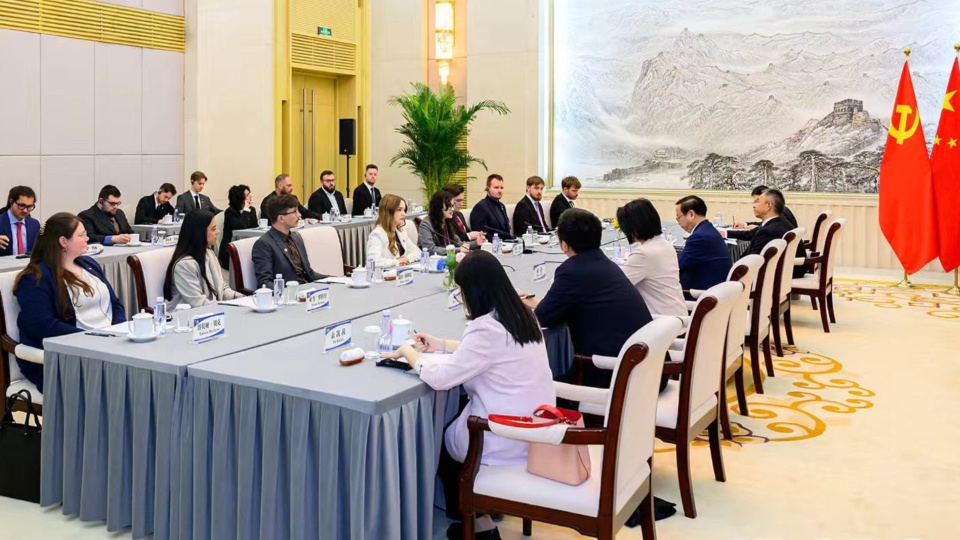
Traveling as a delegate of the Communist Party USA alongside 20 other young communists from 18 countries across Europe and North America, I spent two weeks abroad in a youth delegation organized by the International Department of the Communist Party of China (IDCPC). With an average age of just 27, and unlike the billionaires in Washington, our delegation didn’t come to trade diplomatic pleasantries and attempt to secure zero-sum corporate market access. We came to witness what they call “socialism with Chinese characteristics,” a living alternative to the decaying, financialized capitalism that currently grips the Western world.

Our journey unfolded against the high-stakes backdrop of the Trump-Xi summit—a critical juncture during which Washington’s bipartisan foreign policy establishment continued to beat the drums of a dangerous “new Cold War.” While the Trump administration enforces punishing tariff wars that squeeze workers in my city of Detroit with inflation and layoffs, China’s socialist project is demonstrating what becomes possible when a society is built around the needs of a multi-ethnic working class rather than the dictates of the billionaire class.
The spark and the prairie fire
Our delegation’s journey began in Beijing with a briefing from Jin Xin, Vice Minister and Director-General of the IDCPC General Office. He spoke with the calm assurance of a seasoned party veteran in a country with a century of revolutionary history. In his remarks, he laid bare the structural contrast between the two competing economic models:
“The far-right parties in the capitalist West can only offer unsustainable, short-term solutions to the problems facing their societies,” Jin told us. “Socialists, on the other hand, have a long-term plan and vision that is proven to work. This is our advantage.”
Jin highlighted the grim realities of the capitalist-imperialist system, pointing directly to U.S. and Israeli warmongering in the Middle East and military posturing against Cuba and Venezuela. Yet his message to our group of young communists was one of profound optimism, noting that global sentiment is shifting away from capitalism and towards socialism. He pointed to the surging affinity for socialist ideas among working-class youth internationally. Jin invoked the People’s Republic’s founder, Mao Zedong: “This is the single spark that can start a prairie fire.”

The long-term vision China’s leadership has for their society is a measurable, material reality totally unlike anything we’re used to in the U.S. For instance, since 2012, China has systematically lifted 90 million people out of extreme poverty. One of the main ways they accomplish this is by guaranteeing the “three basic needs” to all people: high-quality education, comprehensive healthcare, and secure housing.
Putting workers over AI profits
To see this in practice, our delegation traveled to Hebei Province. We stopped at Tayuanzhuang Village in Zhengding City, which in the late 1970s was a deeply impoverished rural community. Annual per capita income was a meager 400 yuan (less than $60 USD). In 1982, a young Xi Jinping began his grassroots political career here working alongside local farmers. Today, through state-backed cooperative agricultural development and heavily incentivized free housing infrastructure, the village’s collective income tops 10 million yuan (nearly $1.4 million USD) annually.
This commitment to human needs over corporate greed was on full display when we toured the cutting-edge manufacturing facilities here. At the Hebei Bocor Electric Technology plant—a state-of-the-art facility specializing in sheet metal and “human-machine cooperation”—we learned that management possesses the technology to fully automate the entire factory floor.
Under the capitalist mode of production, those machines would be deployed immediately to throw workers onto the unemployment line to pump up quarterly profit margins. But under China’s socialist market economy, the company explicitly does not fully automate, enforced by state intervention, to ensure that local workers remain employed at fair, stable wages.
A revolution in green development
The corporate media loves to paint China as a climate villain, constantly trashing the country of 1.4 billion people as the world’s worst air polluter. In telling that tale, however, they often peddle fuzzy math, diverting attention from numbers which show that per capita emissions have actually always been lower for China than for the major capitalist powers.

They also conveniently ignore the fact that the U.S. and E.U. outsourced their manufacturing plants here decades ago during the initial phase of China’s “Reform and Opening Up” to chase larger profit margins for Western capitalists. This process helped China develop its own productive forces and establish itself as the premier manufacturing hub for the entire world.
Despite those earlier rounds of outsourcing Western emissions, nowadays, the reality on the ground in China tells a different story. Guided by what they call “Xi Jinping Thought on Ecological Civilization,” China is currently executing the most aggressive green transition in human history. Here, the planet is treated as a valuable and essential productive force with economic, social, and cultural value.
In Shaanxi Province, we saw the fruits of this green development strategy. In Yulin City—an area historically ravaged by desertification—forest coverage has been painstakingly engineered, moving from a devastatingly low 0.9% in 1949 to a lush 34.8% today. China has also established massive ecological sanctuaries, including the 22,000-square-kilometer Giant Panda National Park, treating natural ecosystems as living organisms protected by strict state regulations.

According to a lecture given by Professor Hu Weihua of the CPC Party School in Shaanxi Province, by 2035, China is on track to scale its wind and solar output to 3,600 gigawatts—six times its 2020 target levels. But it’s the method of deployment that underscores the difference between here and what we’re used to in the U.S.
In China, when state-regulated green energy enterprises install massive solar panel arrays in rural provinces, they don’t seize the land from the people via eminent domain or corporate corruption and bullying. Instead, they either rent the land from local farmers at premium rates or purchase it while providing guaranteed, state-subsidized modern housing packages.
Tracing the revolutionary footsteps
Between rides on the country’s whisper-quiet autonomous metro systems and ultra-high-speed bullet trains, our delegation spent long hours tracing the historical roots of these contemporary accomplishments of the CPC. We walked the mountain pathways of Yan’an, the revolutionary city where Mao and the CPC Central Committee headquartered from 1937 to 1947 to organize the resistance against Japanese aggression.

We stood in the dwellings of Liangjiahe Village, where a young Xi Jinping spent seven years doing hard manual labor alongside local peasants. He was one of the “sent-down youth,” young people dispatched to the countryside during Mao’s Cultural Revolution, a time when the education system and the economy were in chaos. It was here that the now General Secretary solidified his understanding of the “mass line”—the core communist practice of consulting the masses, distilling their practical needs, and translating those needs into state policy.
As young communists from Europe and North America, these historical sites reminded us that socialism is an organized, step-by-step historical struggle that requires patience, humility, deep integration with the working class, and an unwavering commitment to developing the unity of the people.
Between seminars, our delegation also experienced the vibrant contemporary Chinese working-class and youth culture. We experimented with traditional remedies like acupuncture and cupping therapy at the Hebei University of Chinese Medicine (a welcome relief after days of intensive travel). We visited the Zhengding National Table Tennis Training Base, where we faced off against world-class youth athletes and reflected on the historic legacy of the 1971 “Ping Pong Diplomacy” that originally broke the imperialist blockade between the U.S and China. We tried all kinds of delicious food, sang karaoke together, and danced in the streets with locals.
Continuing the legacy of Edgar Snow
Standing at one of our tour stops, I came across a statue depicting Mao alongside Edgar Snow—the courageous American journalist who braved the Kuomintang blockades in the 1930s to tell the true story of the Chinese Revolution to Western readers in his seminal book, Red Star Over China.

In 2026, the corporate media machine is working overtime to construct a new wall of fear (see the recent Fox News segment on parking tickets) around China. They want the U.S. people to believe that a factory worker in Hebei Province, a student in Beijing, or a farmer in Shaanxi is their enemy. But the truth of the matter is that the U.S. working class’ foe isn’t China; it is the billionaire class here at home that closes our schools, de-industrializes our cities, and guts our public infrastructure in the service of maximizing corporate profits.
Working people and youth in Detroit, Chicago, Beijing, and Xi’an share a singular, interconnected desire for friendship, family, safe working conditions, a clean environment, and a peaceful world free from war. Breaking through the propaganda of the ruling class to witness the reality of socialist development in China was a transformative experience.
It would be too hard to capture everything in a single story, but I returned home with an unshakeable feeling of international solidarity and hope for a future that puts people and the planet before profits. People in the U.S. deserve to live a life of safety, without the worry of crippling medical expenses and credit card debt or the constant fear of unemployment. But as a new Chinese friend said to me before we left: “Where there is struggle, comrade, there is hope.”
We hope you appreciated this article. At People’s World, we believe news and information should be free and accessible to all, but we need your help. Our journalism is free of corporate influence and paywalls because we are totally reader-supported. Only you, our readers and supporters, make this possible. If you enjoy reading People’s World and the stories we bring you, please support our work by donating or becoming a monthly sustainer today. Thank you!
CONTRIBUTOR