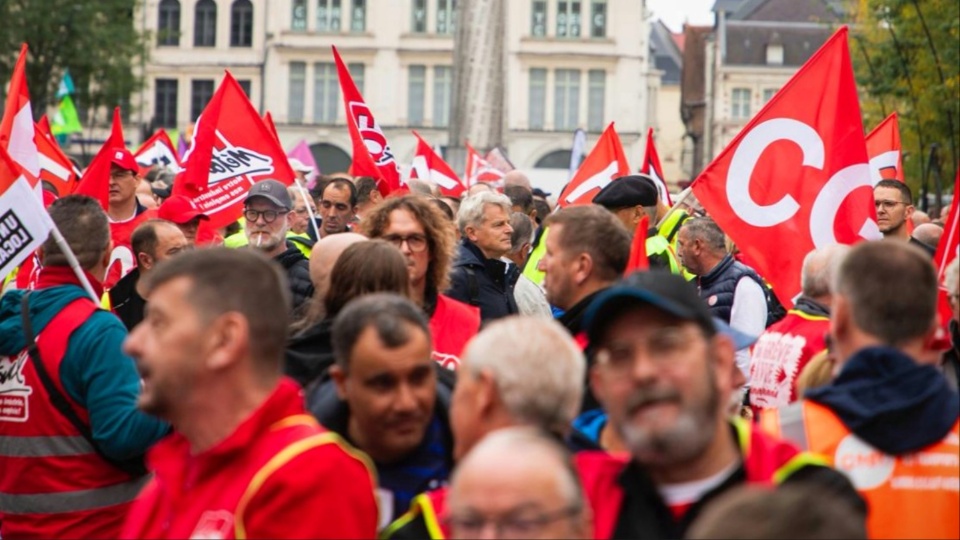
When French Communist Party leader Fabien Roussel campaigned for the mayoral seat in Saint-Amand-les-Eaux, he ran on a platform built around the concrete economic demands of working people: decent wages, accessible public services, affordable housing, and an end to the austerity squeeze that has drained municipal budgets for years.
His pitch, which he called the “antithesis of trickle-down economics,” aims to reconnect the Communist Party (PCF) with workers who have drifted toward abstention or to the far right. The first round of France’s 2026 municipal elections, held March 15, showed how urgent that effort has become and revealed how much ground remains to be fought over before the second round on March 22.
France’s 35,000 cities and towns, called “communes,” went to the polls Sunday, and the ballots that voters cast produced a fractured, polarized picture. Both the far-right Rassemblement national (National Rally, or RN) and the left—of which the PCF is but one faction—saw significant gains while President Emmanuel Macron’s centrist forces grew weaker.
The outcome has the neofascists of the RN looking ahead with anticipation to the 2027 presidential vote, while centrist forces approach it with dread. The left, meanwhile, remains deeply divided over whether the Trotskyist La France Insoumise (France Unbowed, or LFI) party of Jean-Luc Mélenchon belongs in the same coalition tent as the Socialist Party and the Communist Party.
The second round is set for Sunday, and with majorities firmly out of reach in the country’s largest cities, the next several days will be dominated by high-stakes alliance negotiations that may well preview the shape of next year’s presidential contest.
RN holds its bastions, but hits an urban ceiling
Low turnout was a boon for the RN, which celebrated early wins in its established strongholds. It came first in at least 75 communes, compared with just 11 in the last municipal vote in 2020.

In Perpignan, the largest RN-governed city, Louis Aliot secured re-election with over 50% of the vote, and RN mayors were returned outright in several other towns. In Hénin-Beaumont, the far-right stronghold where party leader Marine Le Pen holds the local parliamentary seat, the RN mayor was re-elected with 77% of the vote.
But the party’s strategy of projecting a “normalized” image for its reactionary politics has yet to translate into gains in cosmopolitan urban areas, leaving it strongest in rural France. Most of its gains came in towns of fewer than 10,000 residents, where local results often move in the opposite direction of national trends.
In Marseilles—a bellwether city where the RN has long been competitive—incumbent Socialist Mayor Benoît Payan narrowly led RN candidate Franck Allisio 36.7% to 35%, setting up a runoff that could hand France’s second-largest city to the extreme right for the first time.
Macron’s austerity gave the far right (and the left) plenty of ammunition in these elections. His 2023 pension reform, which raised the retirement age from 62 to 64, triggered mass protests and was widely seen as an attack on working-class living standards. French lawmakers ultimately adopted a social security budget that included a suspension of the pension reform as a concession to political pressure from below, but the damage to Macron’s standing hasn’t been repaired.
RN ran a campaign that criticized the Macron policies while portraying itself as the only party capable of bringing about a new political order. Housing costs, access to health care, and drug-related urban violence were central concerns at the local level, and the RN said it alone could bring the solutions that the established parties of the center and left are willing to pursue.
The claims resonated with some traditionally left-wing voters, but it was defections from Macron’s centrist bloc which gave the RN most of its new support. “The ship is sinking, as expected,” one of the president’s entourage anonymously told the press.
Communists indict Macron’s economy
Economic context was key for understanding the results. If the attempted pension assault wasn’t enough, state transfers to local governments have been cut repeatedly, and the general budget allocation to local authorities is not indexed to inflation and fell by another two billion euros over the past year. A housing crisis marked by acute shortages, rising costs, and bank lending hesitancy has made affordable housing a central concern of voters across the country.
These are the conditions the PCF ran on—and the conditions that drove voters toward the extremes of both left and right.

The Communists went into the balloting with control of 600 municipalities, making them the second largest left electoral force in the country, behind only the Socialist Party (PS). Though the number is impressive, it is far below the party’s highpoint in the mid-20th century, when it dominated thousands of municipalities. Challenges from the RN, in particular, have cut into its “red belt” industrial suburban strongholds around Paris.
Those gains by the racist and reactionary RN sharpened the PCF’s focus in the 2026 elections. Its strategy was consistent in region after region. In 90% of the cities where the left governed, the PCF worked to assemble unified first-round lists with the Socialists and the Greens (Les Écologistes). La France Insoumise, by contrast, opted to stand alone in many cities, dividing the left vote and creating an opening for the RN.
Before voters went to the polls, Pierre Lacaze, vice-president of the Occitanie region and head of the PCF’s elections campaign, predicted “a PCF/RN face-off,” which was exactly the situation in Saint-Amand-les-Eaux, where Roussel beat the neofascist candidate, 51% to 26%. A working-class industrial community in northern France, the city is precisely the kind of place that RN has targeted for years.
Roussel’s victory there was one of more than 200 first-round wins by Communist mayoral candidates. They weren’t simply chosen because they were the most plausible options to block the far right; voters liked the program that the PCF put on the table.
Strong public services, affordable rents, reduced inequality, and more cohesive communities were the main points of their campaign’s messaging. Hitting Macron’s recent reliance on heavier policing to contain dissent, for instance, Roussel said, “Stability doesn’t come from more repression, but from justice.”
He and the PCF emphasized that poverty, unemployment, and reduced services only generate insecurity and said that municipalities are the level where many of the root causes of these capitalist ailments can be addressed.
Turnout troubles and fractured unity
The Communist leader warned, though, that low voter participation rates across the country were a symptom of bigger problems. More than 44% of eligible people stayed home.
“The high level of abstention is a wake-up call, the symptom of a sick democracy,” Roussel said after the elections. “We call for building the broadest possible popular gatherings against the racist and xenophobic far right and to prevail everywhere against liberal policies”—i.e. those of Macron and the centrists—“that attack our public services and equality.”
In Paris, the PCF negotiated a joint first-round list with the Socialist Party and Les Écologistes, with the PS’s Emmanuel Grégoire heading the list and local PCF leader Ian Brossat among its leading partners. Grégoire came first in the capital with nearly 38% of the vote, not enough to win outright in the first round but well ahead of the Macron-aligned Rachida Dati at 25%.
The PS-PCF-Greens alliance in Paris reflected the durable working relationship between parties that share a commitment to practical left politics, labor rights, and public services. The three parties also share, however, a wariness of Mélenchon’s style of leadership and of the aims of La France Insoumise.
LFI chose to stand alone in numerous seats across the country, including in Communist and left-governed cities throughout Île-de-France. Many, like the PCF’s Lacaze, see the LFI’s strategy as one of deliberate division. The effort to stop right-wing extremism, he argued, is “made more difficult…by those who don’t want unity on the left, notably Jean-Luc Mélenchon.”
Lacaze believes that the LFI was effectively running presidential rallies disguised as a municipal campaign, cynically using the local elections as a means to build up Mélenchon’s profile for next year. That framing captures the fundamental difference between the two parties: The PCF is building local governance infrastructure while the LFI seems to be running a permanent presidential campaign.
LFI’s urban surge
The LFI had a strong first-round performance in major cities, significantly expanding its presence compared to 2020, reflecting a more serious bid for local power. LFI won Saint-Denis, the second-largest city in the Paris region and a long-time Communist stronghold, outright. It is also on track to take Roubaix, a symbol of France’s post-industrial north, in the second round.
Those results, however, come loaded with complications. The gains came despite a number of recent controversies for the LFI. One was the media fallout from the killing of a far-right activist in Lyon during a street fight between members of fascist and anti-fascist youth groups. Mélenchon refused to denounce the anti-fascist organization involved, La Jeune Garde (The Young Guard), over the actions of individuals—rightfully so from the perspective of many in the democratic movements but not in the eyes of the mainstream press.

More divisive, however, were accusations of antisemitism after Mélenchon’s intentional mispronunciation of sex trafficker Jeffrey Epstein’s last name to sound Jewish—he pronounced the “-stein” syllable in a manner similar to the name Einstein, mocking the media for using the “Ep-steen” pronunciation. The LFI leader claimed his remarks, made at a campaign rally, were an exercise in irony, but observers across the spectrum disagreed.
Former President François Hollande condemned Mélenchon’s comments, describing them as having an “antisemitic connotation” and reflecting a “worrying drift” in political discourse. Socialist Party leader Olivier Faure also publicly criticized Mélenchon, deepening intra-left tensions at the worst possible moment. Roussel of the PCF called the incident “shameful,” saying “antisemitism has no place in the Republic.”
The election results for Mélenchon’s group thus produced a paradox: LFI performed well enough to be necessary in beating the far right in several second-round races, yet it also alienated enough of the mainstream left that many PS, PCF, and Green candidates are reluctant to formalize alliances with it.
In Paris and Marseille, the mayoral candidates have rejected outright alliances with LFI, preferring to let left voters make their own choices rather than enter formal coalitions under the Mélenchon banner. In Toulouse, however, the Socialist candidate announced an alliance with LFI to attempt to defeat the incumbent center-right Macron-aligned mayor.
The New Popular Front’s unfinished business
The 2024 legislative elections saw the PS, PCF, LFI, and Les Écologistes unite as the New Popular Front to block the far right’s path to a parliamentary majority. That cooperation stopped the RN from governing, but it did not resolve the structural tensions within the left. The municipal elections have brought them back to the surface.
The sharp differences between the Socialists and Mélenchon’s LFI have been exacerbated by the recent controversies and will probably mean competing left-wing lists in the second round. For the PCF, the calculus is different from LFI’s.
The Communists have decades of experience governing alongside Socialists in municipal coalitions, managing public services, housing, and local infrastructure. Their brand of left politics is rooted in working class demands and stable local governance rather than national oppositional spectacle—which is precisely why Roussel can win in a northern working-class town without the drama that surrounds Mélenchon.
With the second round on March 22, and the 2027 presidential election now barely a year away, the first round sent a clear message: The left side of the political spectrum holds a plurality of French votes, but frustration with politics as usual is propelling the right forward, and sectarian elements of the left jeopardize the effort to build a united front to stop them.
For the PCF, holding its municipal base and demonstrating local governance credibility is part of a longer game—one in which Fabien Roussel’s election in Saint-Amand-les-Eaux is not just a personal win but proof that the left can win when it unites and mobilizes its working class base in the community.
We hope you appreciated this article. At People’s World, we believe news and information should be free and accessible to all, but we need your help. Our journalism is free of corporate influence and paywalls because we are totally reader-supported. Only you, our readers and supporters, make this possible. If you enjoy reading People’s World and the stories we bring you, please support our work by donating or becoming a monthly sustainer today. Thank you!
CONTRIBUTOR