WASHINGTON—As final ranked-choice voting tabulations came in early Sunday evening, all winners were projected in D.C.’s Democratic Primary, and the results signaled a clear end to the reign of the moderate “Green Team” machine politics of the Fenty-Bowser era.
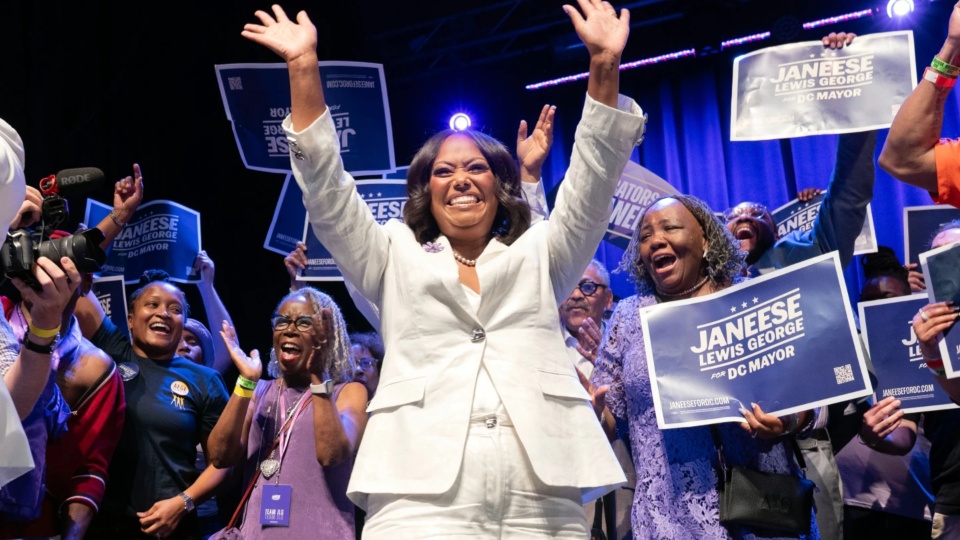
Janeese Lewis George—current Ward 4 councilmember, native Washingtonian, a Black woman, and Democratic Socialists of America (DSA) member—won the Democratic nomination for mayor with over 50% of the first-round vote. Given the Democratic Party’s domination of D.C. electoral politics, this means she is essentially guaranteed to become mayor in the November election. There is no Republican running, though there are independent and third-party candidates on the ballot.
Lewis George’s campaign was able to win nearly all eight wards and build a mass all-people’s multiracial and multigenerational coalition that won on a message of affordability and fighting against the fascist Trump policies affecting district resident—including job loss, immigration enforcement, and the military occupation.
Her win marks an end to the post-Control Board austerity era that was led by big business interests and resulted in major displacement of Black residents and an affordability crisis for working families. The policies of Mayors Tony Williams, Adrian Fenty, and Muriel Bowser all benefited the rich of D.C. and created an embedded class of real estate developer interests that have been driving costs up.
Lewis George represents a younger generation of leadership inspired by the campaigns and politics of Bernie Sanders, Alexandria Ocasio-Cortez, Ilhan Omar, Rashida Tlaib, Summer Lee, Cori Bush, Zohran Mamdani, and other progressives who have been winning local and national office since the first Trump administration.
Also, her victory was undeterred by the attack that she was “soft on crime,” which was deployed by her closest opponent, Kenyan McDuffie, who was supported by current Mayor Bowser. Nor did Lewis George give pause when President Donald Trump threatened to take over D.C. if she was to win.
New House delegate
For the first time in over 30 years, D.C. will be getting a new non-voting delegate in the House of Representatives. At-large Councilmember Robert White won the Democratic race to succeed Democratic Del. Eleanor Holmes Norton, who has occupied that seat since 1991. White overwhelmingly defeated his conservative opponent, Brooke Pinto.
A DMV native, White was the champion for the 2023 D.C. Council resolution calling on the federal government to remove Cuba from the state sponsors of terrorism list and for a return to the Obama-era normalization of relations between the two countries.

His coalition is confident that he will fight vigorously against Republican attacks on D.C. Home Rule and continue to champion D.C. Statehood like his predecessor.
Republicans in Congress have been chipping away at Home Rule the past few years, especially in 2025. Part of this was introducing legislation to remove D.C.’s ability to elect its own Attorney General. Voters overwhelmingly rejected this prospect and re-elected the current sitting attorney general, Brian Schwalb.
Schwalb has been a fervent opponent of big monopolies in the District and around the country, going after exploitative businesses like Ticketmaster for its hidden fee schemes. He has also become a major thorn in the side of slumlords in D.C., who have allowed their buildings to become destitute and poorly managed in order to force working-class residents out to replace them with wealthier tenants. Schwalb has also sued the Trump administration for its ongoing military occupation in the District, an issue that is still being appealed and litigated in the courts.
Council races
D.C. Shadow Representative Oye Owolewa—a Nigerian immigrant, a Black Muslim, a pharmacist, and DSA member—won the Democratic At-Large seat, replacing longtime moderate councilwoman Anita Bonds. Oye won largely on being a person who “shows up,” whether it be at rallies against the Trump government, for budget priorities like the Healthcare Alliance program for immigrants, or even being one of the few local elected political officials supporting the Target boycott picket line.
Part of his campaign for D.C. Council included a broad coalition campaign to block the construction of a new ICE headquarters in the middle of a predominantly Black neighborhood at the old St. Elizabeth’s campus in Southeast D.C. “ICE HQ out of D.C.” is an ongoing campaign.
In Ward 1, a contentious campaign took place with former DSA leader and tenant organizer Aparna Raj taking home the victory. With dozens of labor unions backing her, she won on a campaign similar to that of Lewis George while also directly addressing needs of the residents of Ward 1—including the need to lower utility bills, deal with the rat epidemic, and end the collaboration between D.C. police and the federal immigration agents terrorizing the ward’s large immigrant population.
Raj defeated two other self-proclaimed progressives, both advisory neighborhood commissioners, in the race backed by the outgoing councilwoman and an anti-socialist coalition. An attack mailer sent out the last week of the campaign questioned Raj’s “uncommitted” vote in the 2024 presidential primary, which signified her critique of the Biden administration’s support of the Israeli genocide in Gaza.

Outgoing Ward 1 Councilwoman Brianne Nadeau is a supporter of Israeli Prime Minister Netanyahu’s policies and was one of the primary reasons why the D.C. government was unable to pass a resolution denouncing the U.S. supply of arms and resources for the war in Gaza.
The champion behind paid family leave and the domestic workers bill of rights, Elissa Silverman, returns to the council after being defeated by Kenyan McDuffie a few years ago.
Progressive bloc
A large progressive bloc will now exist in the D.C. government, opening the possibility that major change can come to D.C.—so long as these mass all-people’s coalitions maintain their alliances and deepen their relationships in order to govern.
The coalition of community and labor organizations—such as Free D.C. (a pro-democracy organization), Metropolitan Washington Council AFL-CIO, Jews United for Justice, D.C. Sierra Club, D.C. Working Families Party to name a few—was unified in endorsing this progressive group of candidates, something that has not always been the case and demonstrated their understanding of how important change is needed in D.C.
The D.C. Working Families Party, which had been dormant for several years, took this election as an opportunity to reorganize and demonstrate how important independent politics is in the District. Labor played a critical role as well, with a strong cadre of staff and volunteers canvassing, phonebanking, and texting union households. Every article by mainstream media written about Janeese Lewis George’s campaign took note of this support and her recognition of the importance of the working class to her policies.
Also, this was the first election in D.C. to use ranked-choice voting, and while mail-in ballots are still being counted, according to Fair Vote, “roughly 30,000 more voters had their votes counted for one of the finalists.”
Now, the hard work begins.
With many councilmembers transitioning to different offices, special elections and appointments will open up come early 2027. On the question of appointments, an effort to reform the local D.C. Democratic Party through running a slate to replace state committee members took place. The Free D.C. slate, led by members and leaders within the Free D.C. Project, were able to win a majority of seats, defeating the moderate and establishment Democrats that have maintained the status quo for many decades. The Free D.C. slate will now have a major say in the appointment for replacing outgoing At-large Councilmember Robert White.
The task of this left-center and labor-community coalition that formed behind particularly the Lewis George, White, and Raj campaigns is to build broad mobilizations around their promises to ensure that they become reality. This includes reigning in the monopoly of Pepco on utility bills and capping rates, ending the collaboration between D.C. police and the occupying federal agents, investing in our youth to end childhood poverty and crime, lowering the unemployment rate by bringing more jobs to the District, and much more.
Longer term, formalizing the progressive-left bloc in the D.C. Council is on the agenda. This would require an attempt by the D.C. Working Families Party to gain ballot access and run a candidate in the general election for one of the non-majority party at-large seats, or even for a ward seat to replace a sitting moderate or conservative Democrat like Pinto in Ward 2 or Wendell Felder in Ward 7.
The WFP and other left and progressive forces also need to fend off attacks from the Trump government and develop an offensive strategy to strengthen Home Rule and gain statehood. This will include transforming local neighborhood commissions into political projects to mobilize neighborhoods in defense of their communities and to fight for their interests at every level of the city. It will also include building a broader base of support and being a leading force in the District for improving the lives of working families.
Like Chicago, New York, and Seattle, D.C. joins the national movement that is electing progressive, labor, and socialist mayors. But, unlike those major metropolitan cities, D.C. has fewer rights and no voting representation on Capitol Hill.
Major challenges face the working class of D.C.: Will it allow the Republicans to threaten Home Rule and undermine the will of voters? With Trump’s threats around the midterms, what is to say that he will not test out his threats on D.C.? The people of Washington have a special role in the fight to block the fascist advance against democracy. The country is counting on them.
We hope you appreciated this article. At People’s World, we believe news and information should be free and accessible to all, but we need your help. Our journalism is free of corporate influence and paywalls because we are totally reader-supported. Only you, our readers and supporters, make this possible. If you enjoy reading People’s World and the stories we bring you, please support our work by donating or becoming a monthly sustainer today. Thank you!
CONTRIBUTOR