At first glance, Massachusetts primaries seemed to favor incumbents, but a closer look shows deep-set divisions in the voter base and campaign strategies from challengers that failed to meet the historic moment.
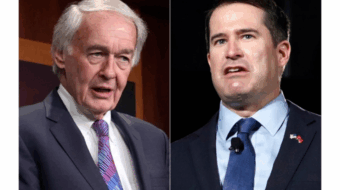
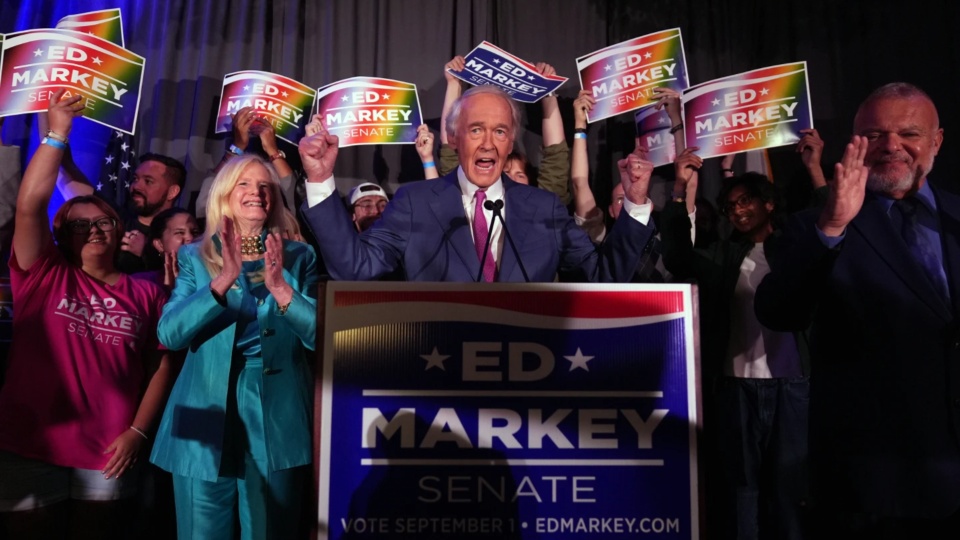
Incumbent Democratic U.S. Sen. Ed Markey easily dispatched outgoing House Rep. Seth Moulton. Though a moderate through the early days of his 50-year political career, Markey has shifted under pressure from progressive mass movements, and today serves as one of the Senate’s most consistent votes for peace, labor unions, trans rights, and universal healthcare.
By contrast, Moulton, who ran unsuccessfully for House speaker and president before turning his eye to the Senate, attempted to rebrand as a progressive and downplay a series of transphobic statements he made in 2024. Furious at the U.S.-backed genocide in Gaza, ICE terrorism, and attacks on trans people, Democratic primary voters saw through the act.
Markey will continue on to the general election to face Republican John Deaton, along with a slew of minor-party candidates, including Joe Tache of the Party for Socialism and Liberation, who notched not insignificant support in a late August poll.
Deaton has run a campaign focused on a platform of far-right DOGE-style austerity, juxtaposing his campaign promises to the welfare policies of the Massachusetts state legislature, which he characterizes as out-of-control government spending.
He has been a close adherent and supporter of State Auditor Diana DiZoglio’s transparency campaign targeting the state legislature, filing a lawsuit in February of this year alongside her in an attempt to compel the state House and Senate to comply with an expansive audit and to clear the way for far-right funding of that audit through a third-party agency.
While uncontested in her own primary, DiZoglio intervened extensively in other races, across previously established political lines, in an attempt to build the legislative bench for the state’s audit movement. Backed by reactionary elements while courting sections of labor and progressive organizations, DiZoglio likely intends to build momentum for her second proposed ballot question to amend the state’s public records law. Her supporters have appealed to the decisive result of 2024’s ballot Question 1, citing the 72% of “Yes” votes as a mandate to impose sweeping changes to the state’s political process.
Current polling predicts Deaton taking roughly 30% of the vote in the general election to Markey’s 50%.
Tache’s campaign has taken very few positions on state issues, instead urging voters to break from both parties and “vote socialist.” Similar to Deaton and Moulton, he’s attacked Markey for his age and Democratic Party allegiances. Before the Democratic primary, Tache’s campaign suggested he would receive a greater vote share in the general election should Moulton prevail over Markey—implying a preference for Moulton.
Tache’s rhetoric fits closely with the campaign in support of Question 3, a measure that will appear on the 2026 state ballot in November. It would replace partisan political primaries with non-partisan general primaries and, if passed, experts warn it would almost exclusively open the door for far-right candidates to sneak into elected positions in Massachusetts.
Moulton and DiZoglio have both expressed support for Question 3. The Massachusetts AFL-CIO, several of its major constituent unions, and various progressive organizations, however, have taken a leading role opposing it.
Among the contested federal House primaries, first-time candidate Jeromie Whalen fielded the strongest campaign, winning about 46% of the vote against 14-term incumbent and ranking member of the House’s Ways and Means Committee Richard Neal (D-MA-01). While pitched as a grassroots effort, Whalen was recruited to run by sections of the state’s Democratic machine opposed to Neal’s continued tenure.
Whalen’s campaign criss-crossed the district, turning every labor event, parade, and Democratic town committee meeting into a campaign stop. With much of the district’s population concentrated in racially and ethnically diverse cities, the approach favored turnout in predominantly white, rural areas. His campaign lacked answers for dealing with mass voter apathy or Neal’s massive corporate donor base and conservative allies.
Even still, with a growing bench of local and state Democratic officials disfavored in Neal’s approach to political patronage, and an array of nonprofit and progressive organizations lacking a federal official responsive to their interests, the stage was set for a broad anti-incumbent operation. Neal’s vacillating reaction to ICE abductions galvanized the opposition, for which Whalen was the only serious option.
In the state legislature, only one incumbent lost their seat (pending a recount) in a primary; most seats saw no primary challengers. Only a handful of seats will be contested in the general election.
Mixed results in Western Mass.
Athough the Massachusetts primaries generally favored incumbent candidates, the dynamic made for contradictory results in Western Massachusetts. District 8 of the Governor’s Council, a powerful institution responsible for vetting the governor’s judicial nominees, saw a partial rematch of 2022’s four-way primary, with Springfield City Councilor Michael Fenton challenging incumbent Tara Jacobs.
Jacobs’ narrow upset victory in the 2022 primary and continued vocal opposition to corruption and political patronage incensed sheriffs, district attorneys, and other key power brokers in Neal’s coalition. Despite being outspent 5-to-1 by Fenton and facing furious public condemnations by the law enforcement establishment in Hampden and Berkshire counties, Jacobs won re-nomination by more than 23,000 votes, an order of magnitude greater than her roughly 2,300-vote margin in 2022.
Jacobs, who cross-endorsed with Whalen, received substantial support from progressive sections of the Democratic organizing base in Hampshire county. District 8 of the Governor’s Council spans all of MA-01, but also includes all of Hampshire and Franklin counties. For his part, Whalen won nearly all towns in Hampshire county, as well as rural northwestern towns outside of the expensive New York Capital District media market.
Though that progressive organizing base contributed to the decisive victory for Jacobs, the enduring racial segregation between Hampshire and Hampden counties, known colloquially as the “Tofu Curtain,” loomed large over Whalen’s campaign and those of labor-backed downballot contenders. The Springfield metropolitan area is home to a majority of Black Western Massachusetts residents, as well as one of the country’s largest Puerto Rican diaspora communities.
The Spanish language is ubiquitous in neighborhoods across central Hampden county, but Whalen’s media presence and literature were almost exclusively in English. The campaign routinely fielded canvasses in Holyoke and Springfield with dozens of volunteers, relying on a core of young organizers often hailing from other parts of the district or the Amherst area.
Whalen’s consistent presence at regional chamber of commerce events and maverick endorsements did little to impress many labor leaders. The state AFL-CIO endorsed Neal, even as the Massachusetts Teachers Association backed Whalen. (In addition to his support for educators’ unions in general, Whalen himself is a teacher and MTA member at Northampton High School.)
Most strikingly, Whalen prevailed in South Hadley, the town where he lives, by a 2-to-1 margin—the same margin by which the town rejected the $3.5 million Proposition 2½ override that’s necessary to stave off drastic cuts to public schools and services. The town rejected a similar set of proposals earlier this year, fomenting a spiraling budget crisis for the public sector.
Though driven by South Hadley’s Republican town committee, the “no” result suggests a complex and ideologically disparate opposition to the incumbent: Whalen himself made a point of appearing in local conservative media.
Paths forward, or backward
The primaries underscored deep divisions in both the Democratic Party and its voter base, while the party’s leadership struggles to contend with the general economic crisis and an all-out assault from the Trump administration. The audit movement continues to gain traction, opening a path to power for far-right elements, while labor and progressive forces increasingly fall behind its developments.
Moulton failed to galvanize voters along the lines of these stress fractures, and the state party was able to shore up institutional power behind Markey by leaning into progressive commitments. Whalen’s campaign was a demonstration of many elements of the party grappling to reinvent themselves while maintaining institutional lines—and failing to meet the moment. Neal returned to his allies in monopoly capital, law enforcement, and other reactionary elements, while continuing to suppress voter turnout to eke out a slim victory.
Even so, progressive victories offered glimpses of new poles of alignment across the state, and the state’s electorate forged a broad, if disorganized, unity in defense of civil rights. With Democratic primaries deciding most electoral outcomes in Massachusetts, the state’s emerging coalitions will turn to November’s ballot questions to wrest control of the post-election political terrain.
We hope you appreciated this article. At People’s World, we believe news and information should be free and accessible to all, but we need your help. Our journalism is free of corporate influence and paywalls because we are totally reader-supported. Only you, our readers and supporters, make this possible. If you enjoy reading People’s World and the stories we bring you, please support our work by donating or becoming a monthly sustainer today. Thank you!
CONTRIBUTOR