Editor’s Note: Jamal Zaqout is a longtime political leader and activist from Palestine. Born in the al-Shatiʿ refugee camp in Gaza City to a family forced from their home by the 1948 Nakba, he has been arrested several times by Israeli occupation authorities over the years. In 1988, Israel deported him on charges of helping lead the first intifada, or national uprising. He returned to the Gaza Strip in 1994 and has since held a number of positions of leadership in the Palestinian Authority. In the article below, Zaqout assesses the Gaza ceasefire agreement and lays out a vision of what it will take to move from the current moment to true sovereignty and peace for his people. This article originally appeared in the Arabic-language Marxist newspaper Al-Ittihad. The translated text has been slightly edited for improved clarity.
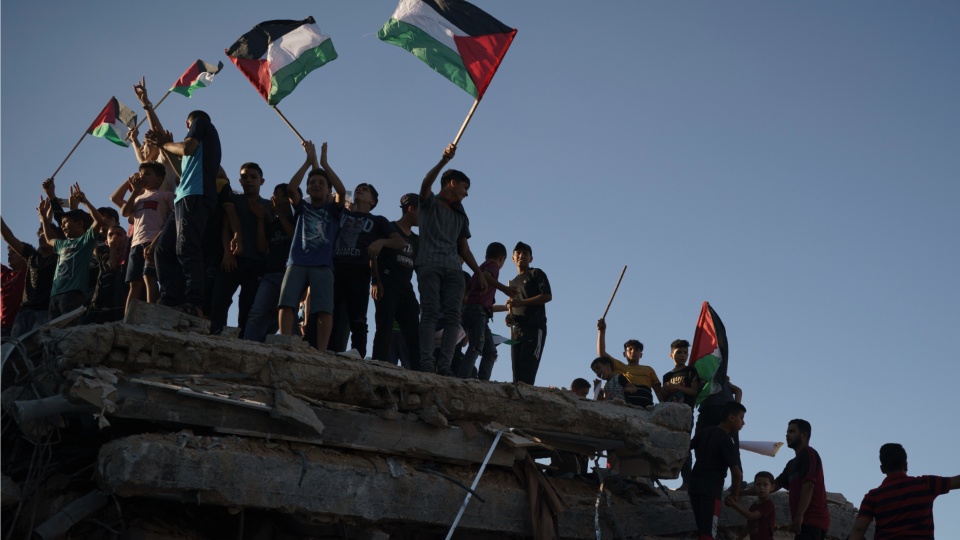
The ceasefire agreement brokered by the Trump administration no longer marks the end of the tragedy in Gaza, but rather the beginning of a more complex and sensitive phase, one in which the interests of regional and international powers intersect, while Israel attempts to establish new political and security realities that ensure its continued control without bearing the consequences of its occupation.
At the heart of this scene is the central question: What can the Palestinians do to curb Israel’s colonial and aggressive plans, protect the unity of our people, and prevent Tel Aviv from further fragmenting us?
The Israeli war government is treating the ceasefire as an opportunity to consolidate what it failed to achieve militarily by imposing the equation of “calm in exchange for Israeli security.” It seeks to transform Gaza into an entity isolated from the rest of Palestine. The new hostages in this situation are the aid, shelter, reconstruction, and nationhood that Palestinians need—all of which are held captive by Israel.
Meanwhile, Israel continues to confine the Palestinian Authority to a marginal administrative role in the West Bank, deepening the geographic and political separation between the Gaza Strip and the West Bank, including East Jerusalem.
Israel’s declared and actual goal is to impose permanent “security guardianship,” under international or regional cover, while continuing its settlement activity and annexation policy. This will guarantee the burial of the idea of an independent Palestinian state and the right of return.
As for Hamas, while it may surrender official political power in Gaza, it is also seeking to prevent the abolition of its role. It is prepared to accept arrangements that allow it to withdraw from public governance in exchange for maintaining an indirect role in controlling the Gaza Strip. It may seek to retain its weapons as a symbol of national dignity and prestige. This approach is unsustainable without a comprehensive national agreement of all Palestinians that redefines the security and political function of arms.
Hamas did well to accept that such issues of a national nature must be decided by all Palestinians. But can merely formulating such a position without agreeing on an executive national framework—i.e., on a unified national Palestinian government—really make the Palestinian side into an influential player capable of defending the vision of statehood and monitoring its implementation?
It has become imperative to liberate society from the narrow factional considerations that stand in the way of the future of the cause, while also acknowledging the sacrifices of all in the course of the national struggle and the heavy price paid by the Palestinian people in this process.
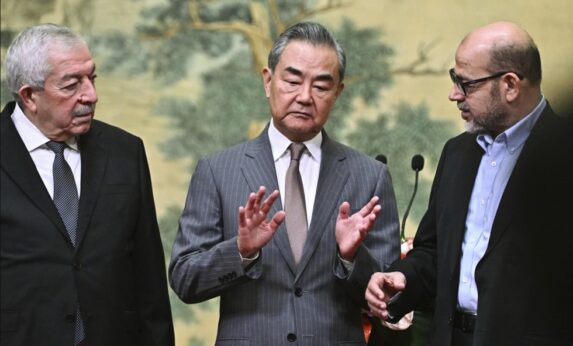
The return of Palestinian governance to Gaza requires consensus
The Palestinian Authority faces an existential test; it cannot regain its old role in the Gaza Strip without a comprehensive national consensus and institutional mechanisms and governance capable of managing the next phase and thwarting Israeli schemes.
What is required is the formulation of a unified national project based on the unity of decision-making and institutions, as stipulated in the Beijing National Consensus Declaration, in which all the Palestinian factions agreed last year to form a national unity government.
This project paves the way for restoring confidence internally and internationally, including the holding of general elections within an agreed-upon timeframe and mobilizing international support for these elections as a prelude to exercising the right to Palestinian self-determination.
Mediators are working to ensure compliance with the declaration of an end to the war. However, their ability to ensure implementation of the ceasefire is limited without an international umbrella, a binding oversight mechanism, and, most importantly, without a unified Palestinian government that would regain control over security, arms, and reconstruction issues. Achieving the latter is centered on winning real national independence and not separating the Gaza Strip from the rest of Palestine.
The U.S. administration, led by Trump, makes no secret of its bias toward Israel and treats the Palestine issue as a security matter for Israel rather than a matter of oppression of the Palestinians. However, the administration is aware that the continuation of the conflict threatens regional stability and its own interests.
Fair or not, having negotiations with the U.S. requires Palestinians to talk a discourse of interest, not grievance—formulating a practical approach that links regional stability to a comprehensive political solution. What is required is to unify Palestinian national discourse and integrate it into the equations of American public opinion via Congress, decision-making centers, and the media.
Europe is another vital arena for Palestinian action. Popular sympathy is no longer merely a moral issue; it has begun to morph into political positions for some governments and parliaments. The challenge is to transform funding and reconstruction into tools of political pressure, linking European support to ending the occupation, halting settlement activity, and recognizing the State of Palestine. Legal and human rights discourse is key to Palestinian diplomacy at both the official and popular levels, including leveraging European pressure on Washington in the context of their shifting interests.
The war has revealed the infeasibility of the other Arab countries’ “normalization in exchange for stability” arrangement with Israel. Any Arab approach toward Israel that is not based on a clear commitment to the Arab Peace Initiative and the centrality of ending the occupation will entrench Israeli hegemony and undermine the prospects for peace.
Therefore, a collective Arab position is needed that returns to the position that normalization of relations with Israeli troops has all left Palestine. Any progress in relations with the Israeli state must be conditional on a clear withdrawal and a timetable for ending the occupation..
What is required of us Palestinians?
First: Rebuilding the Palestinian political system on the basis of a comprehensive national consensus in accordance with the Beijing Declaration, expediting the formation of a national unity government. We must establish a National Council that defines the political and security framework and redefines the functions of the resistance within the framework of collective decision-making—all of us together must decide what resistance will look like, not one faction alone.
Second: Activating the international accountability process through the International Criminal Court and the International Court of Justice, along with an organized human rights and media campaign linking war crimes in Gaza to the need to end the occupation in the West Bank.
Third: Strengthening partnerships with international solidarity forces to transform popular sympathy into sustainable political and institutional pressure on Western governments.
The priority is to provide practical guarantees, including: permanent international monitoring of the ceasefire and violations, with binding public reports; the establishment of a multilateral civil protection force under UN supervision or an Arab-European partnership; and linking any international cooperation with Israel to its commitment to international law and the cessation of its occupation practices.
The war has proven that the Palestinians, despite the devastation, hold the moral initiative. This legitimacy must be transformed into a political vision that addresses Washington in the language of self-interest, Europe in the language of law and justice, the Arabs in the language of collective commitment, and the people of the world in the language of partnership and dignity.
Only when Palestinian national action is unified and politics are conducted in the spirit of collective interests can the ceasefire be transformed into a path that paves the way toward freedom and statehood.
Al-Ittihad
We hope you appreciated this article. At People’s World, we believe news and information should be free and accessible to all, but we need your help. Our journalism is free of corporate influence and paywalls because we are totally reader-supported. Only you, our readers and supporters, make this possible. If you enjoy reading People’s World and the stories we bring you, please support our work by donating or becoming a monthly sustainer today. Thank you!
CONTRIBUTOR