ST. PAUL, Minn.—In scathing language about abuse of power, the chief U.S. District Court Judge in Minnesota, Patrick Schiltz, threw out subpoenas the Donald Trump regime served on top officials for alleged obstruction of ICE anti-immigrant sweeps during Operation Metro Surge.
In his ruling, Judge Schiltz also called the subpoenas part of a coordinated, and unconstitutional Trump campaign against “sanctuary cities” which shelter and protect undocumented people from the violent and vicious ICE (Immigration and Customs Enforcement) and Border Patrol agents.
Those agents, as part of Operation Metro Surge in the Twin Cities, shot and killed U.S. citizens Renee Good and Alex Pretti, a Veterans Administration nurse and union (AFGE) member, who were witnessing the surge and trying to protect victims. The judge cited the shootings and other ICE atrocities in the Twin Cities in his decision.
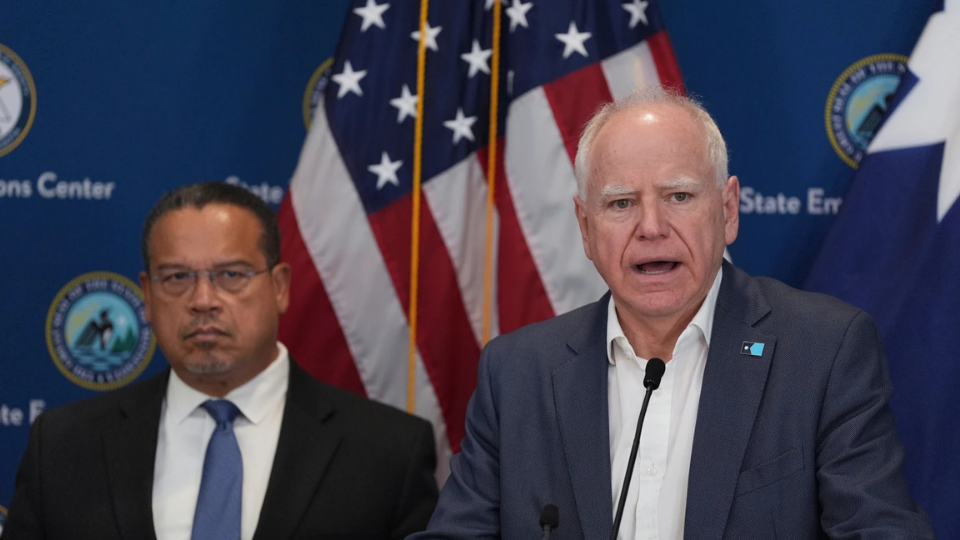
The Trump regime sought the subpoenas from a closed grand jury against Gov. Tim Walz, Attorney General Keith Ellison, Minneapolis Mayor Jacob Frey, St. Paul Mayor Kaohly Her, all DFL-Minn., and the Hennepin (Minneapolis) and Ramsey (St. Paul) county boards. It got them, but Ellison, a leading progressive, appealed, and Judge Schiltz ruled for him, issuing an order banning any retaliation.
Judge Schiltz, named to the bench by GOP President George W. Bush, also took the unusual step of disclosing the grand jury’s proceedings, too.
The judge slammed the Trump Justice Department for seeking the subpoenas. He said they violated the U.S. Constitution’s 1st Amendment’s protection of freedom of speech, and the 10th Amendment’s delegation of powers to the states. He called the subpoenas an unconstitutional attempt to force Minnesota into enforcing federal law—and retaliating against state and local officials for not doing so.
Judge Schiltz, who was also a law clerk for the late Supreme Court Justice Antonin Scalia, a conservative icon, gave the DOJ two weeks to appeal his ruling. When it didn’t, he made the ruling and the details public on June 22.
Judge Schiltz’s ruling, along with prior federal court rulings tossing out Trump charges against anti-ICE (Immigration and Customs Enforcement) protesters, comes just after Trump’s Justice Department got another grand jury to indict 15 more protesters. It called them “antifa” and alleged they conspired to violently block ICE. Judges tossed almost all prior indictments and banned re-indictments. “Antifa” does not exist as an organization and is a designation used by right-wingers whenever they want to accuse protesters against Trump’s policy of being “terrorists.”
“This past winter, the Trump administration tried to break Minnesotans’ solidarity and basic sense of decency by flooding our state with armed agents. They failed. Now they are trying to break us in the courtroom. They will fail again,” state AFL-CIO President Bernie Burnham predicted when the first batch of indictments came down in January. That statement would apply to the subpoenas against Walz, Ellison, the mayors, and other officials, too.
Minnesota’s resistance to Trump drew international notice, so much so that the AFL-CIO, at its convention in Minneapolis—a week before the judge’s ruling—gave the Minnesotans its annual Meany-Kirkland Human Rights Award.
“The facts are clear: the Trump administration is targeting me because I’m standing up for the people of Minnesota,” Ellison said in a statement. “In America, we settle our political differences at the ballot box, and it should disturb every American that Donald Trump is weaponizing the criminal justice system against people he disagrees with. No matter how much Donald Trump threatens, targets, and attacks me, I will never stop working to protect Minnesotans from Trump’s abuses of power.”
Judge Schiltz pulled no punches in his 29-page ruling. While grand juries, directed by prosecutors, could, as the saying goes, “indict a ham sandwich,” their powers are not unlimited, the judge said.
“A court may quash a grand jury subpoena if compliance would be unreasonable or oppressive,” Judge Schiltz wrote. “In addition, grand juries may not select targets of investigation out of malice or an intent to harass,” he added, citing rulings in another case involving Trump. “A subpoena may be quashed if its dominant purpose is improper, even if it was issued partly for valid reasons.”
“Initiating a criminal investigation in order to harass political opponents or to coerce them into taking official action—particularly official action the federal government cannot directly require those political opponents to take—is a blatantly unlawful and unethical use of the grand-jury process.”
“If prosecutors are forbidden from meddling with an official’s duties, they cannot use criminal investigations to pressure him into enacting their preferred policies. The only question, then, is whether the challenged subpoenas were issued for one of these forbidden purposes. The court has no doubt that they were.”
“On the one hand, the evidence the challenged subpoenas were issued for unlawful reasons is overwhelming. On the other hand, the (Justice) Department has struggled—without success—to identify a single plausible investigatory justification for the subpoenas.”
Judge Schiltz also called the Minnesota subpoenas part of a coordinated Trump regime campaign against the state for its refusal to kowtow to his wishes. He cited fiery Trump tweets on the president’s Truth Social platform, threatening “retaliation,” and statements by then-Trump Attorney General Pam Bondi prejudging the case.
And he cited “an official White House article ‘Warning ‘Minnesota’s Sanctuary…Consequences,’ and expressly linking ‘the enhanced enforcement operations in Minnesota’ with ‘the conduct of state and local officials who refuse to partner with the Trump administration.’”
“This campaign played out against the backdrop of the Trump administration’s well-established history of using criminal investigations to retaliate against and pressure the president’s political and personal adversaries,” Judge Schiltz said.
Judges, in Minnesota and elsewhere, have often ruled against such retribution.
Schiltz and other Minnesota judges said the administration repeatedly defies court orders to release immigration detainees. Judges also ordered the Trump administration to ensure detained migrants—and anyone else—at the Henry Whipple Building, the state headquarters of ICE, have access to their lawyers and the freedom of worship.
Walz said DOJ’s subpoenas, which the judge tossed, are another example of Trump investigating his political opponents.
“We are seeing daily reminders of this administration’s lawlessness–in Minnesota and around the country. We all must continue to seek justice and uphold the rule of law,” Walz said.
The Trump administration has also used government agencies to go after Sen. Mark Kelly, D-Ariz., a military veteran and former astronaut, then-Federal Reserve Chair Jerome Powell, former FBI Director James Comey, and New York Attorney General Letitia James (D), among others. All failed.
And Trump fired National Labor Relations Board member Gwynne Wilcox, the labor board’s first-ever African-American woman chair, on the grounds that she didn’t rule for businesses. She appealed, and the lower courts split. Her case will be affected by a U.S. Supreme Court ruling in a pending case, where Trump fired Federal Reserve Board member Lisa Cook.
Most of Trump’s retribution pursuits have failed, but not before causing court costs and angst among the targets. “We are seeing daily reminders of this administration’s lawlessness–in Minnesota and around the country. We all must continue to seek justice and uphold the rule of law,” Gov. Walz said.
Minneapolis Mayor Frey, in a statement, said no one should be punished for questioning the actions of elected officials, and that “no community should be expected to accept harmful policies without objection.
“This Department of Justice investigation was never about justice, law, and order, but the absence of it. Subpoenaing political opponents because they spoke on behalf of their constituents violates the core tenets of our democracy and human decency.”
We hope you appreciated this article. At People’s World, we believe news and information should be free and accessible to all, but we need your help. Our journalism is free of corporate influence and paywalls because we are totally reader-supported. Only you, our readers and supporters, make this possible. If you enjoy reading People’s World and the stories we bring you, please support our work by donating or becoming a monthly sustainer today. Thank you!
CONTRIBUTOR