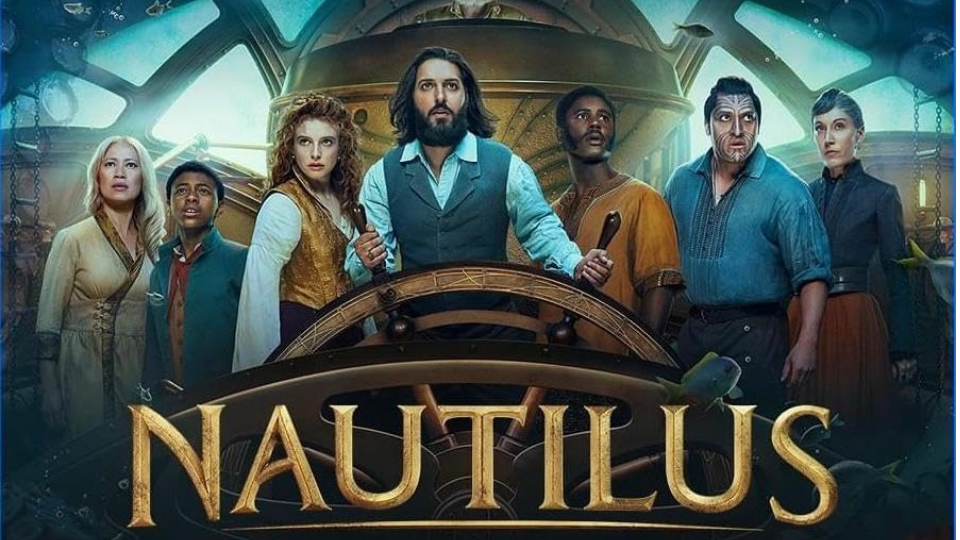
Nautilus, a reimagining of Jules Verne’s 20,000 Leagues Under the Sea, is a triumph of a series where, in this retelling, the villains are the thinly disguised British East India Bay Company and the heroes are a group of multicultural misfits escaped from a company prison in 19th-century Bombay. It’s a rugged road as the designers of this first submarine steal it from the company and then are pursued to the ends of the earth, literally from the South Seas to Antarctica, by a 19th-century version of the Dark Star, a company armored vessel named the Dreadnaught, recalling an early naval arms race between England and Germany that led to World War I.
It’s these kinds of allusions that make the series so powerful, and rather than straying from the Verne original, the series instead returns the anti-imperialist thrust of both 20,000 Leagues and its sequel, The Mysterious Island. both feature the Nautilus captain Nemo’s actual identity as the Indian Prince Dakkar, in both novel and series out to avenge the death of his wife and daughter, which in the series is just one of the atrocities committed against Nemo and his crew by in Nemo’s time the largest corporation on earth and much more powerful than the British government. The crimes of the company are legion and well-documented. Two Indians have watched their village burn. Nemo, while studying in England, returns to find his wife and child slaughtered, and a former company official has set up his own dominion on a South Sea Island, instituting what is in effect slavery. The company is also the villain in Taboo with Tom Hardy, and now, as it instantly summons cruel and ruthless behavior lays a strong claim to be the representational 19th-century equivalent of the Hollywood Nazis. 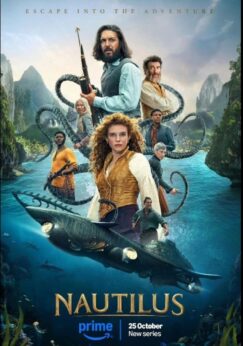
The most famous prior version, also by Disney, starred a brooding, downcast James Mason as a conflicted Nemo destroyed by his pursuit of vengeance. One of the many improvements that this current version effects is that slowly Nemo is able to let go of his blood lust, and this is accomplished by his acknowledgment and devotion to his ragtag crew. These include a British upper-class woman, Humility, a budding scientist who wants to escape the masculinist prison of a forced marriage to Mr. Pitt, a company board member who deserves his appellation, as he proves himself to be a ruthless representative of the company whose quest for domination includes both Humility and India itself. Also along on the submarine are her French former anarchist maid Loti who strikes up a relationship with a Maori sailor, Soyin, a Chinese woman thrown in the Bombay prison and the two Indians one of which refuses at first to betray his fellows when offered a chance to save his family because that would involve “trusting the word of an Englishman,” a prescient admonition that reminds us of the betrayed promises of Trump and the West whose claim to be negotiating with Iran was a pretext to lull the country into quiescence in order for both Israel and the U.S. to bomb its facilities and kill its commanders and scientists.
The Guardian, whose constituency should be a prime audience for this series, gave it a negative review based on its ill-defined secondary characters. It’s these characters who man the sub and flesh out Prince Dakkar’s claims against the company. They are not well-developed until later in the series, but from the moment they tell their stories, they become far more than archetypes.
The second season, with the company sidelined, was going to be Prince Dakkar and this crew taking on the might of the British navy as the empire attempts to build a submarine of their own to hasten their pursuit.
Alas, this is not to be. Disney studios spent $300 million on the 10-episode series and then, rather than release the series on its streaming service Disney +, instead scrapped it as part of its attempt to cut $3 billion from its films and series, choosing to take the tax write down that would accrue by wiping the series off its books, not to mention the cost of publicity to release the series in the American market. The scrapping, though, was not as bad as Warner/Discovery, which shelved its $80 million film Batgirl, with a black actress playing the lead character.

Disney sold the series first in France, then the U.K. and Australia, where it was the biggest budget series ever filmed in that country and then shipped it off to AMC and its streaming service AMC+ in the U.S. which last year also became the refuge of Warners already-shot-and-edited fourth season of Boon Joon-ho’s Snowpiercer, the two series being together two of the most politically aware series in the current landscape, 20,000 leagues ahead of the leading nominees for this year’s Emmys, the pretentious Apple+ Severance, a “work-washing” series which in the guise of workplace awareness simply covers up the complaints of that company’s employees and The Penguin, an over bloated, pun intended, voyage into the despair of Batman’s The Dark Knight while suggesting in a much diluted fashion the earlier HBO series The Sopranos which set the tone for the streaming onslaught.
Streaming was supposed to be a goldmine, but increasingly the vein is running dry because the viewers, largely due to austerity and job layoffs, are not able to guarantee the overinflated profits their shareholders demand. In a time of cutbacks, politically charged series are always FIFO, first in, first out.
We hope you appreciated this article. At People’s World, we believe news and information should be free and accessible to all, but we need your help. Our journalism is free of corporate influence and paywalls because we are totally reader-supported. Only you, our readers and supporters, make this possible. If you enjoy reading People’s World and the stories we bring you, please support our work by donating or becoming a monthly sustainer today. Thank you!
CONTRIBUTOR