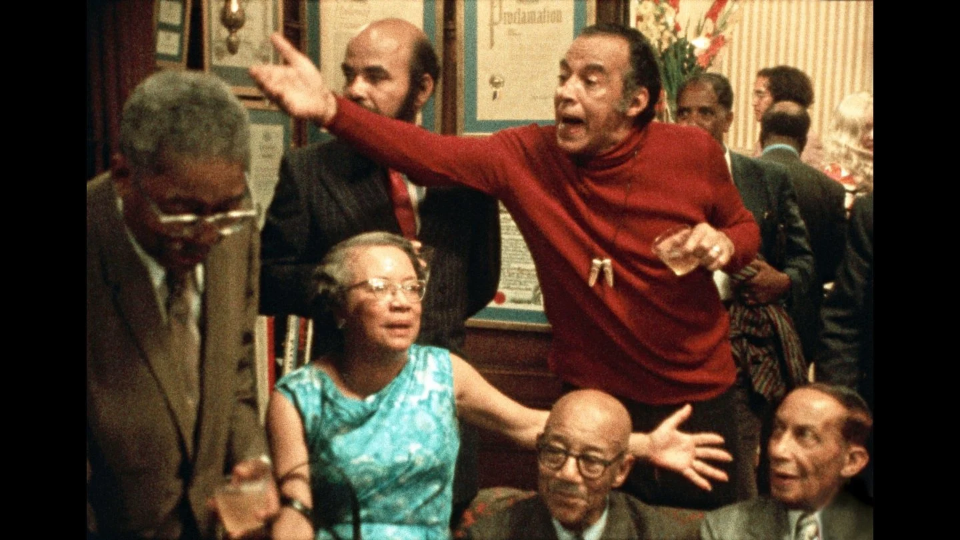
In 1972, Harlem-born documentarian William Greaves filmed a historic gathering of many still-living talents who had experienced the Harlem Renaissance, which had transpired about 50 years earlier. The Harlem Renaissance was a Black awakening in the arts, politics, fashion, etc., during circa the 1920s/1930s that, decades before the “Black Power” and “Black is Beautiful” movements, heralded the advent of “the New Negro.” It was so named because this rebirth was centered in that famous, predominantly African American Uptown enclave in Manhattan.
Greaves invited the senior citizen survivors to attend a cocktail party and reminisce at pianist/composer Duke Ellington’s townhouse in Harlem in 1972 as a crew (including his son David) captured their recollections, cinéma-vérité style, on celluloid with 16mm cameras. The reunion’s invitees—many of whom hadn’t seen one another for half a century—included African American luminaries such as: Jazz and ragtime pianist and composer Eubie Blake; artist/author/songwriter Romare Bearden; painter Aaron Douglas; poet/novelist/librarian Arna Bontemps; writer/ painter Richard Bruce Nugent; photographer James Van Der Zee; historian John Henrik Clarke; Harvard scholar Nathan Huggins; author/playwright Countee Cullen’s widow, Ida Mae Cullen; and others. (Ellington was too sick to attend the shindig at his own place, but his music is included in the soundtrack of what is now Once Upon a Time in Harlem, with his songs such as, appropriately, “Black Beauty.”) 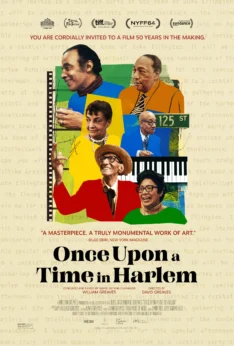
The participants verbally bring alive a moment of fertile ferment for African Americans, painting a vivid portrait of a bygone illustrious era. Along with remembrances and repartee on the culture front about figures such as author Zora Neale Hurston, the partygoers also discuss the era’s politics, ranging from the Black nationalist Marcus Garvey to the socialist Hubert Harrison, whom labor organizer A. Philip Randolph had dubbed “the father of Harlem radicalism.” One partygoer, Barbados-born Richard B. Moore, is repeatedly identified in onscreen titles as “Prominent Socialist.”
According to press notes, William “Greaves’s position in the history of cinema still goes woefully understated. He merits comparison to only the most revolutionary, influential and galvanizing of film artists in the middle and latter half of the 20th century: Roberto Rossellini, when (in 1962) he renounced conventionally scripted cinema in favor of educational television focused on the long histories of Western civilization; Frederick Wiseman and his mosaic-like, Proustian time project, observing the day-to-day lives of workers and citizens inside (usually American, usually public) institutions; and filmmakers such as Jean-Luc Godard, Bill Gunn, Barbara Loden, Maurice Pialat, and Peter Watkins, who habitually blend the nonfictional and fictional, confusing the two deliberately for audiences, in order to get closer to the truth of any given sociopolitical and emotional situation – without being fixed at either pole in the manner dictated by Hollywood-derived conventions.”
Greaves never completed turning the raw footage of the legendary cocktail party into a finished film. His son David—who, as mentioned, was present at the 1972 soiree as one of its cameramen—along with his daughter, Liani, is responsible for finally, more than 50 years later, editing together and bringing the raw material to the big screen, with David and Liani earning (along with the late William) co-director credits (Liani is also credited as a producer). Press notes state that among David’s memories of some of the shoot’s “more indelible moments, [is] when [actor] Leigh Whipper, then 96 years old, recites a lengthy film monologue from his 1943 Warner Bros. film Mission to Moscow.” Fortunately, instead of merely being a private Greaves family affair, this multi-generational cultural gem is now being shared by audiences far and wide.
Once Upon a Time in Harlem won the eighth annual Library of Congress Lavine/Ken Burns Prize, received $200,000, and earned two nominations at Cannes, along with other noms at various film festivals. According to press notes, the little screen’s greatest living documentarian, Ken Burns, gushed: “I was won over from the moment the camera started rolling. It’s literally the best party I have ever been to, a festive time travel through the memory of these extraordinary individuals. Once Upon a Time in Harlem is a celebration of the Harlem Renaissance but just as important—and riveting—it’s an intimate conversation about the meaning of art and life and how we share ideas across generations. We are all indebted to William Greaves for curating and capturing this moment and to David Greaves for bringing to life what his father so lovingly started more than 50 years ago.”
In the Oct. 19 edition of The New Yorker, critic Richard Brody raved that Once Upon a Time in Harlem “is among the greatest of documentaries.” It is also a relic of a more straightforward style of nonfiction filmmaking, before directors such as Errol Morris and Michael Moore embellished the documentary art form, adding filmic flourishes, cinematic bells and whistles, charismatic onscreen narrators, and the like. This 100-minute historical chronicle of African American intellectuals and artistes is a must-see for those interested in Black history and culture, as well as those fascinated by the arts.
Once Upon a Time in Harlem opened in New York on October 16 and opens in Los Angeles at AMC Century City 15 on October 22.
The trailer can be viewed here.
No paywalls at People’s World
We hope you appreciated this article. At People’s World, we believe news and information should be free and accessible to all, but we need your help. Our journalism is free of corporate influence and paywalls because we are totally reader-supported. Only you, our readers and supporters, make this possible. If you enjoy reading People’s World and the stories we bring you, please support our work by donating or becoming a monthly sustainer today. Thank you!
CONTRIBUTOR