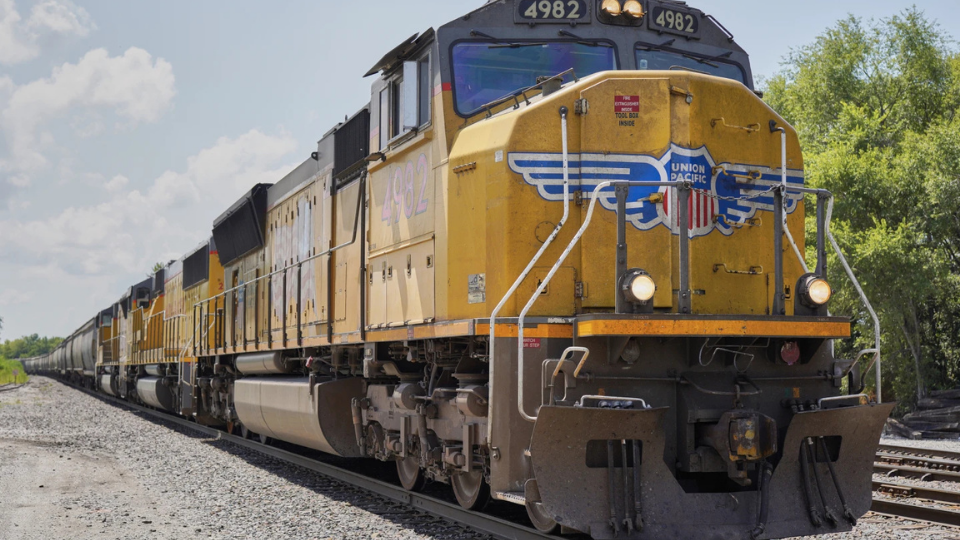
WASHINGTON—Railroad workers are picking up steam against the planned $85 billion corporate deal to let the Union Pacific Railroad gobble up the Norfolk Southern. Corporate execs say the deal would promote “efficiency” and profits. But they’re silent about its impact on the 40% of the nation’s 115,000 freight rail workers whom the two roads employ.
The opposition to the mega-deal takes two forms. Railroad Workers United (RWU), the rank-and-file organization that includes members from all 14 rail crafts, castigates the deal itself.
And both RWU and railroad union leaders denounce anti-worker GOP President Donald Trump for arbitrarily firing independent federal Surface Transportation Board member Robert Primus—the sole STB member to oppose the last big merger, of the Canadian Pacific and the Kansas City Southern railroads.
The union chiefs say Primus’s firing before the end of his term is to grease the skids for Trump’s corporate backers in both railroad suites and at Wall Street banks, by removing the sole potential foe. Primus himself, fired in a late-night Trump official’s tweet, is suing to keep his STB seat.
The megadeal is important not just to rail workers, but to consumers and shippers. It would create the U.S.’s first completely transcontinental railroad and reduce the number of big, Class I freight railroads to five.
The resulting lack of competition leads to oligopoly and potential price-fixing, reminiscent of the Gilded Age and running through the 1920s. That drove up prices for consumers and put rail customers at the mercy, or lack of it, of the big freight firms.
RWU blasted the megadeal in mid-August, as soon as it was announced. When Trump canned Primus, it only worsened an already bad situation.
“In no other countries outside of North America do huge rail corporations not just run the trains, but own the tracks, yards, signals, shops, and other infrastructure,” RWU General Secretary Nick Worst said when the Union Pacific deal was unveiled.
“Allowing a handful of privately held, extremely wealthy and powerful corporations, unaccountable to no one but the shareholders, is not in the interest of railroad workers, passengers, shippers, trackside communities, nor the nation as a whole.”
RWU “has grave concerns of what such mega-mergers might mean for rail workers and their conditions of employment, said trustee Ron Kaminkow, who worked in train and engine service at Conrail and went through its carve-up in 1999. That left Kaminkow at Norfolk Southern. “None of us will ever forget it…A complete and total ‘melt-down’ on Day One,” he says.
Union Pacific’s devouring of Norfolk Southern, especially without Primus there to raise red flags and demand honest answers, would be more of the same, RWU says.
“In a brazen assault on democratic principle, President Trump summarily fired Primus… just as the Surface Transportation Board readies to rule on the mammoth Union Pacific–Norfolk Southern merger.
“He was removed not for inefficiency or malfeasance, but for daring to stand for fair competition and consumer interests, a principle too radical for the ‘America First’ cabal.
“Primus, a staunchly independent public servant and the lone dissenter in the CPKC merger, rightly denounces this action”—being canned—“as ‘deeply troubling and legally invalid,’ and pledges to fight it with every legal recourse he has.
“Unions and workers’ advocates are already crying foul, denouncing this as a naked act of political interference to grease the skids for corporate railroad consolidation. Make no mistake.. this isn’t governance, it’s gate-keeping for the cartels, and it jeopardizes the freight rail network that sustains our industries, our jobs, and our communities.”
Rail union chiefs concentrated on the Primus firing. Transport Workers President John Samuelsen, whose union represents Norfolk Southern workers, leads the charge. He, too, fears the impact on workers of rail carrier corporate oligopoly.
“Anything that empowers the freight rail carriers makes them more profitable and just increases the levels of power they can press is dangerous for workers, and actually dangerous for everybody,” Samuelsen says.
“They’re already an incredibly difficult employer to deal with. And if they’re twice as big, they’ll be twice as difficult to deal with, and they’re going to move to reduce headcount.”
“The powerful capitalists who controlled the nation’s railroads in the latter 19th century—Gould, Harriman, Hill, Vanderbilt and others—did not get the name ‘Robber Barons’ for nothing,” RWU reminded readers, comparing current rail oligarchs to them.
“Such concentrations of wealth and power among a handful of men were not a good idea then, and it is not a good idea today,” says RWU organizer Matt Weaver of Genoa, Ohio. “They had a stranglehold on the economy and the rail workforce.
“Further corporate rail mergers today will do little for rail development but simply line the pockets of Wall Street investors at Rail Labor’s and everyone else’s expense.”
We hope you appreciated this article. At People’s World, we believe news and information should be free and accessible to all, but we need your help. Our journalism is free of corporate influence and paywalls because we are totally reader-supported. Only you, our readers and supporters, make this possible. If you enjoy reading People’s World and the stories we bring you, please support our work by donating or becoming a monthly sustainer today. Thank you!
CONTRIBUTOR