

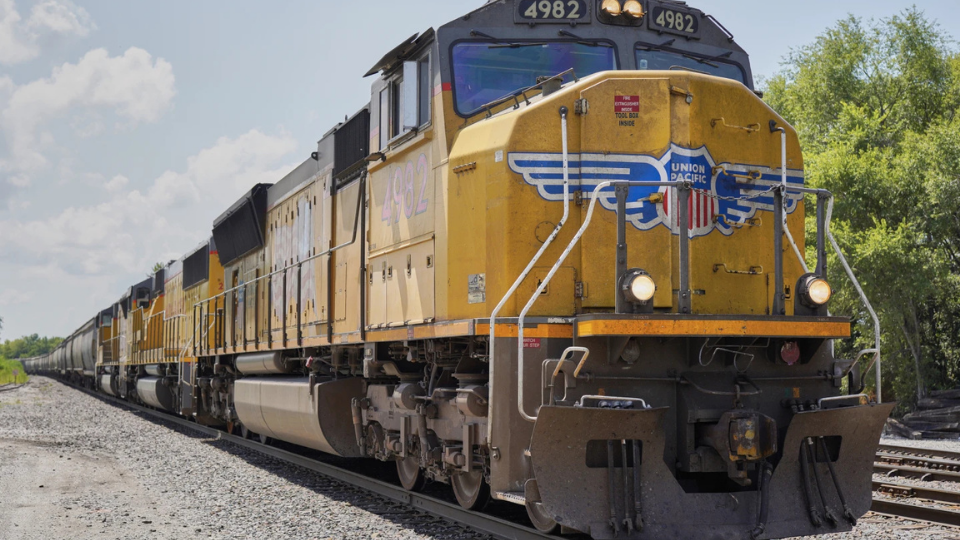
WASHINGTON—Backing criticism from the Transport Workers Union, data in Occupational Safety and Health Administration. (OSHA) records show the Union Pacific Railroad has broken job safety and health standards more than 200 times in the last several decades.
And that’s not counting the latest case, on August 6, where OSHA fined the firm $300,000, including back pay and interest, for illegally firing an engineer-turned-whistleblower who suffered a work-related injury on the job, sought medical care for it and reported it.
That case and the rail carrier’s overall record led the Wall Street Journal to call Union Pacific “a serial violator” of the Occupational Safety and Health Act—and justifies the Transport Workers’ opposition to Union Pacific’s planned $85 billion purchase of the Norfolk Southern Railway.
The deal would create the nation’s first-ever coast-to-coast freight railroad and employ an estimated 40,000 of the nation’s 115,000 freight rail workers, most of them unionized.
Though the actual words “serial violator” were not in OSHA’s announcement, the agency’s statement added Union Pacific would have to show it could meet “fair working conditions for its employees” to win federal approval of the purchase/merger.
Besides, Norfolk Southern has its own safety issues, in East Palestine, Ohio, from the February 2023 derailment, fire, and release of toxic fumes from tank cars there.
Not specific about injury
OSHA was not specific about the engineer/whistleblower’s injury and did not name him, but its statement came from its Dallas office. Such whistleblower firings are illegal.
Other agencies, such as the Justice Department, the Surface Transportation Board, and the Federal Trade Commission, will have a say in whether Union Pacific’s bid will succeed.
Extant records show the violations, including Union Pacific firing another whistleblower more than two decades ago. Its safety and health violations over decades will become part of the debate over the merger, as will this illegal firing and OSHA fine. Transport Workers President John Samuelsen made sure of that.
“Union Pacific has a shameful safety record and was caught by the federal government trying to meddle in a safety audit,” said Samuelsen, whose union represents the Norfolk Southern workers. “There is no world where Union Pacific should be controlling a coast-to-coast rail network,” he added when the proposed purchase was unveiled several weeks ago.
Now it’s been caught in an even worse crime. OSHA is the lead agency in the entire federal government that enforces laws protecting whistleblowers.
“A supersized Union Pacific would be catastrophic for TWU rail workers, shippers, and the safety of millions of Americans who live and work near freight rail lines,” Samuelsen added.
TWU Rail Division Director John Feltz pointed out that when other big freight railroads recalled laid-off workers after the official end of the coronavirus pandemic—which slashed a lot of rail traffic—“Union Pacific cut railroad jobs.
“They are not to be trusted by railroad workers nationwide and the TWU will fight any attempt to ram through a merger that Wall Street might like but is bad for railroad workers and the safety of everyone.” said Feltz.
“This is going to be a long, drawn-out process where many groups will have a say,” Feltz predicted. “We expect the Surface Transportation Board, Federal Railroad Administration, key lawmakers, other railroads, and shippers to stand with organized labor and oppose this deal.”
That leaves the question of whether OSHA can make this fine or future ones stick. Budget cuts in the so-called “reconciliation” law Congress passed and GOP President Donald Trump signed make that dubious. That law keeps OSHA’s dollars at present levels. Afterwards is different.
Writing in Confined Space, his newsletter/blog on job safety and health issues, Jordan Barab, a former Deputy OSHA Administrator during the Democratic Obama administration, noted the Trump regime wants to cut OSHA’s overall budget by about $50 million (7.9%) to $582 million in the fiscal year starting October 1.
Its enforcement budget would decline by 9.7% ($24 million) to $219 million. The number of inspectors would drop from 1292 to 1124 and inspections would decline by 30%, to 24,929. At its height, during the Reagan administration, OSHA inspected 60,000 workplaces yearly.
We hope you appreciated this article. At People’s World, we believe news and information should be free and accessible to all, but we need your help. Our journalism is free of corporate influence and paywalls because we are totally reader-supported. Only you, our readers and supporters, make this possible. If you enjoy reading People’s World and the stories we bring you, please support our work by donating or becoming a monthly sustainer today. Thank you!
CONTRIBUTOR


MOST POPULAR TODAY

Europe refuses war script: Spain’s rebuke exposes limits of U.S.–Israeli escalation in Iran

Strategic retreat or strategic pivot? The state of the Target boycott

Israeli military attempts to kill war correspondent Steve Sweeney

Trump’s Postmaster General says USPS may shut down in a year
Trump refuses to pay screeners unless Congress approves his voter repression