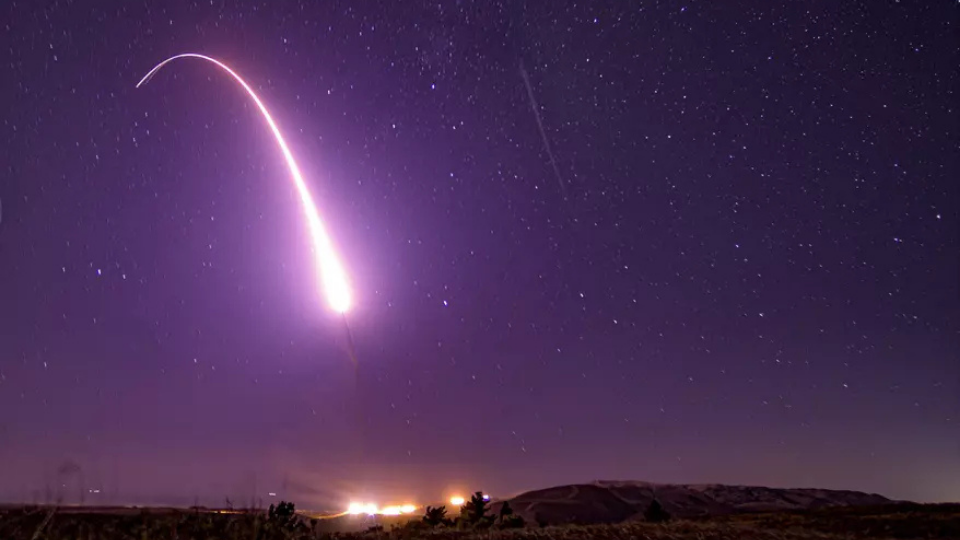
CHICAGO—A top nuclear weapons analyst in Chicago, where the Atomic Age was born, is warning of a Donald Trump War Department nuclear missile and warhead development plan which will produce an explosion in the number of so-called small “theater” nuclear weapons.
In War Department thinking, that would give the president more incentive to threaten or even begin a nuclear war by supposedly removing the possibility of full-scale Armageddon, which would destroy the whole world. The possible U.S. start would, in turn, deter enemies, specifically China and Russia, from opening a nuclear war with the U.S.
Or so the Trump-backing officials say. When Pentagon planners, however, created table-top simulated war games that begin with such “small theater” nuclear weapons, the war escalated to a global nuclear conflagration 95% of the time.
The warnings come from veteran nuclear analyst Joe Cirincione in the Bulletin of the Atomic Scientists. They are the creators and updaters of the annual Doomsday Clock calculation of ultimate threats to the planet Earth—especially but not solely nuclear threats. They also come to a lesser degree from the Arms Control Association. Both cite a top Trump War Department official, Elbridge Colby.
“A new nuclear policy is taking shape in secret, crafted by a small group of Pentagon officials, that will give President Donald Trump more ways to start a nuclear war,” Cirincione wrote in the Bulletin on September 11. “This secrecy is an authoritarian model of governance.”
“Little is known about the strategic nuclear review now under way in the Trump administration, but officials’ comments suggest it may bring back one of the most dangerous policies of the Cold War: The proliferation of battlefield nuclear weapons and their early use in a conventional war,” he elaborated.
Cirincione and the arms control group in turn rely on scattered details of the Trump scheme revealed in an August 2026 speech in Omaha, Neb., by Colby, Trump’s War Department Undersecretary for Policy. Omaha is the headquarters of one of the main U.S. nuclear-armed combat commands, the Strategic Air Command.
The Arms Control Association noted that Colby reiterated current Republican advocacy of first use of nuclear weapons in cases where U.S. conventional forces are undermanned and outgunned in either defending U.S. territory or an ally. The most likely scenario Colby mentioned: China attacks Taiwan.
The military’s aim is “to erase the distinction between” conventional and nuclear weapons, thus giving the president “more flexibility” in using nuclear weapons, Colby said.
Left unsaid: The 80-year-old Trump has been bellicose in nuclear saber-rattling against Russia and China and, defying his own MAGA supporters, launched a war on Iran. He didn’t threaten to drop a nuclear bomb on Iran, but he did say in April that “a whole civilization will die tonight” there.
Trump also provides billions of dollars in military aid to Ukraine and to Israel for its military oppression and war on Gaza. Left unsaid: Israel, too, has nuclear weapons—fabricated by its own military-industrial-complex, but using U.S. military aid money for planes and parts.
But there was even more detail in the infamous Project 2025, crafted by the extreme radical right Heritage Foundation. Trump adopted Project 2025 as his de facto campaign platform in his 2024 presidential run.
Other analysts point out that in the first 18 months of his second presidential term, beginning on Jan. 20, 2025, Trump achieved many goals of Project 2025’s extreme concentration of power in the White House, via compliant congressional GOP majorities and the GOP-named U.S. Supreme Court bloc.
Now, apparently, it’s time for more nuclear missiles and warheads, too.
Cirincione’s and the arms control group’s alarm bells are important for several reasons:
- Major nuclear arms control treaties have lapsed in recent years and Trump has not bothered to renew them. The last of them, the 25-year-old New Start treaty, expired February 5.
New Start cut the number of warheads on planes, in subs and perched on ICBMs by 90%. It did not cover the smaller “theater” nuclear warheads the Pentagon is eyeing and the War Department is contracting for with the U.S. military-industrial-complex.
- Trump’s bellicose boasting that the U.S. and Israel destroyed Iran’s nuclear development capability. That turned out to be false and Israel went back in another attack. This year, Trump threatened Iran with annihilation—a prospect which would literally explode the entire Middle East.
- Trump’s saber-rattling, building on shrill warnings in Project 2025, of rapid expansion of the Russian and especially Chinese nuclear arsenals. Colby envisions the need for the U.S. to arm to fight both powers simultaneously.
Trump envisions a return to the era of the late 1950s and early 1960s, when the U.S. had an estimated 14,000 nuclear warheads perched atop ICBM and intermediate-range missiles, stowed in the silos on land, torpedo tubes in submarines and the bays of Air Force bombers and—though not then generally known—in bazooka-like launchers of “small” nuclear missiles. Individual soldiers could carry them.
The warheads had half the wallop of the A-bomb which destroyed Hiroshima in August 1945. The Trump War Department has started distributing contracts to duplicate those missile bazookas.
Trump alone is not solely responsible for the current warhead buildup. Democratic President Joe Biden, whose single term of January 2021-January 2025 was in between Trump’s first and second terms, began a 10-year $2 trillion nuclear warhead modernization program in fiscal 2022, which ran from Oct. 1, 2021-Sept. 30, 2022. Initial cost that first year: $70 billion.
The stated aim is to completely replace the nation’s aging arsenal of 1,400 nuclear warheads. New Start capped the warhead totals for the U.S. and Russia., which had reached five digits each. Other nuclear nations, including Britain, France, China, India, Pakistan, Israel and—if Trump has his way—Saudi Arabia, were not part of New Start.
Which means Trump is picking up Biden’s pace, and ordering smaller but still lethal warheads. That alarms the analysts and follows the Heritage Foundation’s recommendations of stocking enough missiles and warheads to fight nuclear wars with China and Russia simultaneously.
Heritage also advocates resuming nuclear testing, including at the atomic range in the Nevada desert—close to both Las Vegas and Los Angeles. Heritage doesn’t mention the danger that radiation from tests descends on both, or on areas to the east.
Later studies showed radiation from atomic tests in Nevada and Los Alamos in New Mexico drifted eastwards on prevailing winds until by three weeks later, the entire nation except for the eastern tip of Maine was exposed to low levels of atomic radioactivity. So were southern Canada and northern Mexico.
The warheads also need plutonium “pits” and that’s part of Biden’s and Trump’s plans. That $2 trillion includes $1.7 trillion for new “pits.” The Union of Concerned Scientists says they’re “technically unnecessary and politically destabilizing” because “there are thousands of leftover pits from disassembled nuclear weapons.”
During the Cold War, “military services eager to acquire what they [then] believed were the weapons of the future, coupled with corporations eager to develop them, led to the rapid production of atomic munitions for every conceivable military purpose,” Cirincione wrote.
The Navy had nuclear torpedoes on subs. The Army had nuclear artillery and short- and intermediate-range nuclear missiles, including one silo and its missile on Chicago’s South Side. The Air Force got air-dropped bombs and expensive bombers. The Pentagon then pointed them all at what was then the USSR. It assumed there would be a war in Europe.
But that wasn’t the only threatened use. During the Cuban missile crisis of 1962, Air Force Chief of Staff Gen. Curtis LeMay advocated “DefCon2” readying U.S. nuclear missiles for retaliation should an attack on the U.S. or its allies occur. “DefCon3” would mean an order to shoot.
The available descriptions the analysts use for Trump’s plans sound eerily similar to those “bazooka” missiles—and they’re in addition to the 10 years’ worth of regular nuclear warheads Biden OKd.
“Although the United States has long maintained so-called tactical nuclear weapons for battlefield use, including the air-dropped B-61 bomb and nuclear-tipped cruise missiles, new weapons must be added, proponents claim to close supposed ‘deterrence gaps’ and reduce a president’s fear of ‘going nuclear,’” Cirincione quoted Trump Undersecretary Colby as saying.
And that in turn would scare any foes, Colby said, since they know the president could start small and threaten to end big when it comes to using nuclear weapons. So they’d be more afraid of confrontation, he reasoned.
And if that sounds familiar, too, it should. Colby even used the Reagan-era phrase used to justify the weapons buildup after 1981, “peace through strength.”
“What’s new is old. If the Trump administration and their supporters succeed in reviving and implementing discredited Cold War doctrines, the United States may be condemned to repeat the massive, wasteful, unnecessary, and truly terrifying nuclear arms race of the 1980s,” Cirincione wrote.
“It is not too late, however, to begin a determined campaign to expose the dangers of this nuclear consensus, confront those supporting it and shine a spotlight on the funding analysts and their institutes get from nuclear weapon corporations.”
Foes of the nuclear re-armament can then “provide members of the new Congress next year with analysis and arguments, develop new expert and advocacy policies that can guide a post-Trump administration, and to train a new generation of experts who can join that administration without capitulating to the entrenched nuclear bureaucracy,” he concludes.
We hope you appreciated this article. At People’s World, we believe news and information should be free and accessible to all, but we need your help. Our journalism is free of corporate influence and paywalls because we are totally reader-supported. Only you, our readers and supporters, make this possible. If you enjoy reading People’s World and the stories we bring you, please support our work by donating or becoming a monthly sustainer today. Thank you!
CONTRIBUTOR