NEW YORK—Faced with rising costs and struggling to make ends meet, caregivers in New York’s Consumer-Directed Personal Assistance Program (CDPAP)—most of whom care for relatives—filed on September 23 for a federally run union representation election. They seek to unionize with SEIU1199 United Healthcare Workers East.
If the union wins, it would represent nearly 190,000 workers. Some 70,000 filed union recognition election cards with the Manhattan regional office of the National Labor Relations Board. If all of the caregivers vote, it would be the largest union election in U.S. history.
Key issues in the organizing drive are “ insurance coverage disruptions, administrative hurdles, and other issues since CDPAP transitioned to a single fiscal intermediary: Public Partnerships LLC (PPL).
But even before the vote was scheduled, the anti-union GOP Trump regime tried to throw a wrench into the works. In June, Trump’s Justice Department sued the state Department of Health and Public Partnerships LLC, the Alpharetta, Ga., financial services firm the state agency picked to run the program, for massive Medicaid fraud.
The Trump Justice Department seeks an injunction to undo the deal, which saw the Health Department merge dozens of local programs that paid the workers into one big CDPAP program, which Public Partnerships would run, Hospital and Home Care News reported. The Justice Department also charged the state agency with a sham “open bidding” process before its choice.
CDPAP caregivers give older adults and people with disabilities who qualify for Medicaid and need assistance at home the ability to choose, train and direct their own caregivers. SEIU1199 represents 450,000 other health care workers in New York State.
The CDPAP workers could then more effectively advocate for higher pay and improvements to care as demand for care skyrockets and as Medicaid—which funds CDPAP—is under attack by the Trump regime and its congressional Republican followers.
The Trump-GOP so-called “Big, Beautiful Bill,” which Congress passed last year on party-line votes, cut more than $800 billion in the next 10 years from Medicaid. Though the cuts don’t start until after the November 3 election, some health care agencies and hospitals nationwide are already firing staffers and closing buildings in anticipation of a drop in Medicaid revenues. Medicaid and Medicare combine to account for almost half of a typical health care institution’s revenues.
Under federal labor law, the National Labor Relations Board must schedule a union representation vote once 30% of workers in a bargaining unit sign election authorization cards. United Health Care Workers East turned in cards from approximately 36% of CDPAP workers. But between that and the election date, employers often try various methods to strong-arm the workers into opposing the union.
Bosses challenge the composition, size, and “community of interest” of members of the bargaining unit, argue the workers are “independent contractors,” and thus can’t legally unionize, and import union-busters to harangue, threaten, and lie to workers about the future if they vote union.
But an 1199SEIU survey of more than 31,000 of the CDPAP workers who signed cards showed its workers are among the millions of overworked, underpaid and exploited workers—along with port truck drivers, adjunct professors, Amazon workers and college and university teaching assistants, among others—who are fed up with corporate greed.
The survey reported that nearly 64% of the CDPAP workers were just getting by or finding it difficult to get by financially over the past year; 62% said the hardest part of being a caregiver was not getting paid enough to make ends meet, and 66% said the most important thing in a union contract for them was higher pay.
For generations, women and family members have been home caregivers, largely out of public view, and their labor has too often been treated as less than real work, the union said. The original 1938 Fair Labor Standards Act, which established the minimum wage and overtime pay, exempted the home caregivers —most of them even then women of color—to appease Southern racist senators whom FDR needed to pass the legislation. For the same reason, farm workers were excluded, too.
Due to that lingering racism, which the Supreme Court upheld on a 5-4 party-line vote almost a decade ago, health care in general and the caregivers in particular have been among the lowest-paid workers in the U.S. ever since. But the Bureau of Labor Statistics projects the U.S. will need nearly 850,000 more home care workers by 2035 as the aging population explodes in size. That will be more new jobs than any other occupation in the nation.
1199 SEIU United Healthcare Workers East President Yvonne Armstrong said, “These are essential workers doing work families cannot live without, yet they are struggling to put food on their own tables. They are watching the cost of groceries, rent, gas, and health care climb while their pay falls behind. Someone who is a lifeline for another person should not have to choose which bill goes unpaid, or question whether they can afford to keep doing this work.
“Programs like CDPAP cannot be a sustainable answer to our care crisis if the workers providing that care cannot sustain themselves. Caregivers are organizing because they are ready to change that. They are ready to fight for the wages, benefits, and economic security they deserve, and they are demanding a voice in shaping the future of care work. What they are building in New York can set a new standard for how we view care and the people who provide it across this country.”
Before this SEIU organizing drive, the largest union organizing drives in one industry were by the then-fledgling United Auto Workers, aided by organizers and money from the then-numerous and powerful Mine Workers. UAW organized 137,000 workers at General Motors in 1940 and 80,000 workers at Ford in 1941. In 1999, 74,000 Los Angeles County home care workers unionized with SEIU.
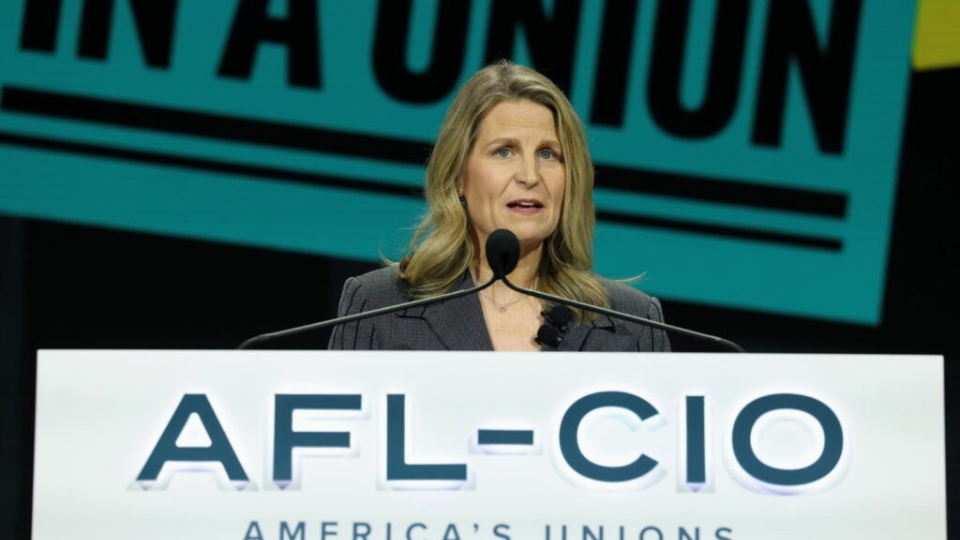
Commenting on 1199’s cards demanding the vote, AFL-CIO President Liz Shuler called caregiving “one of the most important jobs in our economy.
“This is deeply human work that cannot be automated away. Caregivers make it possible for older adults and people with disabilities to live with dignity and independence, yet too often the people doing this essential work have little say in the decisions that shape their jobs and their futures.
“Caregivers have a fundamental right to organize. They deserve the same thing every worker deserves: A collective voice and the power to fight for a better future for themselves, their families, and the people who depend on them.”
“Being a CDPAP caregiver can be a lonely and frustrating experience,” reads a statement on the 1199 SEIU website. “That’s why we’re creating a community of home care workers so we can come together, talk about the issues affecting us, and take action to improve our industry.”
The Justice Department lawsuit isn’t the only complicating factor in the organizing drive. In July, a federal judge preliminarily approved a $162 million class action settlement to approximately 200,000 CDPAP workers. The same month, the employer, Public Partnerships, sought to dismiss the Department of Justice’s lawsuit over Public Partnerships’s administration of CDPAP. It rejected the Trump government’s fraud allegations as politically motivated retaliation against deep-blue New York state.
PPL previously told Home Health Care News the company has a long history of rooting out fraud, waste, and abuse in state Medicaid programs and has saved New York taxpayers more than $1 billion.
No paywalls at People’s World
We hope you appreciated this article. At People’s World, we believe news and information should be free and accessible to all, but we need your help. Our journalism is free of corporate influence and paywalls because we are totally reader-supported. Only you, our readers and supporters, make this possible. If you enjoy reading People’s World and the stories we bring you, please support our work by donating or becoming a monthly sustainer today. Thank you!
CONTRIBUTOR