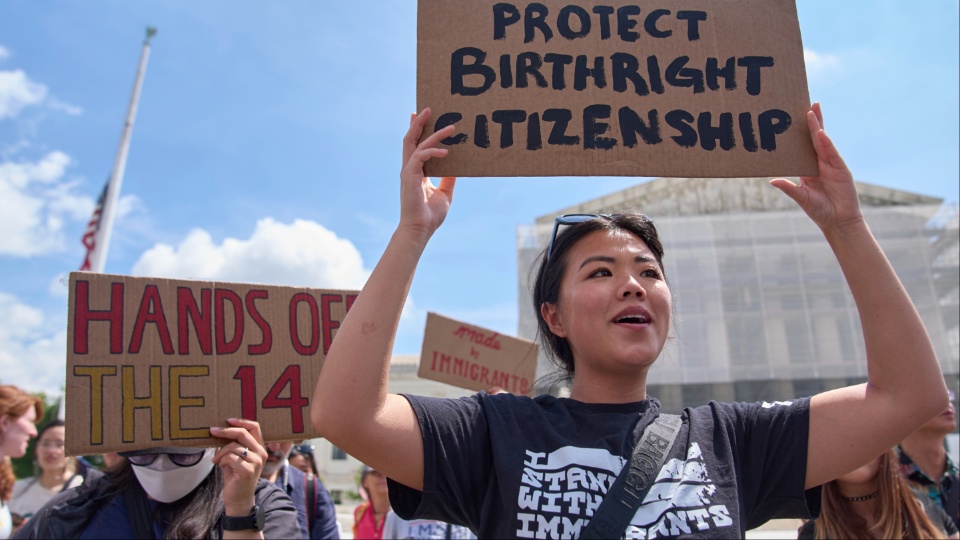
WASHINGTON—President Trump suffered a resounding defeat by the Supreme Court in one of their landmark rulings issued Tuesday that preserves birthright citizenship. In the ruling, 6 justices against 3 declared the executive order he issued on Jan. 20, 2025, limiting birthright citizenship was unconstitutional.
Had it become law, millions born without one parent being a citizen or permanent legal resident, and all people born of parents who had entered the country without documents, would have been excluded from citizenship. Since the implementation of the 14th Amendment after the Civil War, everyone born in the U.S. is automatically a citizen.
The defeat suffered by Trump on this issue follows several other serious defeats before the Supreme Court recently, including a ruling that declared many of his tariffs were illegal and another that he could not fire Lisa Cook from the Federal Reserve Board.
In this case, two justices Trump named—Amy Coney Barrett and Brett Kavanaugh—joined the court’s three progressives in saying the president could not defy the Constitution’s 14th Amendment and its absolute guarantee. So did Chief Justice John Roberts, who wrote the majority opinion.
“Nothing in the amendment has changed,” Roberts declared.
The first sentence of Section 1 of the 14th Amendment reads: “All persons born or naturalized in the United States, and subject to the jurisdiction thereof, are citizens of the United States and of the State wherein they reside.”
That prompted Barrett to ask Trump’s Solicitor General during oral arguments, “Will parents have to bring papers into their babies’ hospital rooms?”
Three justices, Clarence Thomas, Samuel Alito, and Neil Gorsuch, stood with Trump all the way, claiming his Jan. 20 executive order was both legal and constitutional.
Another who opposed the Trump executive order, Kavanaugh, agreed with the majority that the order violated the law but not the Constitution itself. That logic leaves the door open for Congress to change the law, something Trump already vowed to pursue. It also keeps an alternative interpretation of the Constitution alive to which conservatives can cling.
Celebration tempered by caution
Several progressive and labor groups hailed the ruling, including the AFL-CIO, though many warned Trump and his followers would not give up the fight.
“The Supreme Court upheld one of the fundamental promises of our Constitution: That every child born in the United States is a citizen of the United States,” AFL-CIO President Liz Shuler’s statement said.
Technically, there is one small exception: Children born here whose parents are foreign diplomats, though Shuler didn’t mention that.
She mentioned Trump’s war against immigrants by inference, in calling for the legalization of undocumented people through comprehensive immigration reform and a path to citizenship. Organized labor will continue to campaign for that goal, she vowed.
“This decision rejects the Trump administration’s latest attempt to divide working people and attack the immigrant families who are part of the fabric of our communities, our workplaces, and our unions,” Shuler said.
“At a time when working people are facing relentless attacks on their fundamental freedoms, the court made clear that constitutional rights cannot simply be erased by executive order.”
“It’s not immigrants who stand between workers and a good job—it’s the bosses who exploit workers. When politicians target immigrant communities, they are targeting all of us.”
The crowd outside the court broke into massive cheers and hugs Tuesday morning when word came of the decision. Labor’s allies cheered, too. But Democracy Forward pointed out the real vote was 5-4, due to Kavanaugh’s concurring opinion being based on a different rationale.
Rocio Saenz, SEIU’s Secretary-Treasurer and the child of immigrants, sounded that same warning. So did Becky Pringle, the Philadelphia science teacher who heads the National Education Association. So did Labor’s Council for Latin American Advancement, the AFL-CIO’s constituency group for Latino workers.
“Today’s decision offers a moment of relief for many first-generation Americans and immigrant communities. However, we have to have an honest conversation about what this case says about the current state of our country,” Saenz said.
“President Trump tried to rewrite the Constitution to exclude the babies of immigrants,” an estimated 300,000 yearly, according to other sources. “He doesn’t care about the content of character, just race and economic status.
“This case should have never made it this far. None of this is happening by accident. This administration has aggressively tried to purge immigrants and their families from our country, rewrite history by attacking Black, brown, Asian American, and Pacific-Islander, Indigenous, and immigrant communities, and chip away at the rights of all Americans.”
NEA President Pringle, too, sounded the same cheer-but-caution combination. She warned of further fights with the MAGA right to come. “We see through their attempts to turn us against each other based on where we were born or the language we speak,” Pringle said of the Trump administration and the MAGA movement.
The LCLAA called on Congress and elected leaders to act now. “Reject policies rooted in hate, fear, exclusion, and scapegoating, and advance solutions that protect working families, uphold constitutional rights, and recognize immigrants as the backbone of our economy and an indispensable part of our nation’s future,” the constituency group declared.
United We Dream, the top organization of the “Dreamers”—migrants brought here as children whom Trump also wants to throw out of the country—declared the court’s decision “should slam the door shut on further attempts to take a political hacksaw to the Constitution.”
Other decisions of the day
The Supreme Court’s other two rulings on the last day of its term cheered Trump.
One of them blew yet another hole in campaign finance law, allowing donors to dominate campaigns monetarily, overcoming the voices of voters with campaign cash. That decision said parties could funnel unlimited amounts of money to candidates, making it untraceable to individual and corporate donors.
In 2022, several GOP donors challenged the limit as a violation of the Constitution’s 1st Amendment guarantee of freedom of speech. Later, then-Sen. J.D. Vance, R-Ohio, now Trump’s VP, joined them.
The Republicans cited prior High Court rulings picking apart restrictions on the role of big money in politics and said limits “harmed our political system by leading donors to send their funds elsewhere,” such as super PACs, which can raise unlimited funds but do not coordinate with candidates.
The court’s GOP-named majority agreed.
“We have come to a point at which campaign finance regulations reviewed by the Supreme Court are almost presumptively unconstitutional,” said Steve Vladeck, CNN Supreme Court analyst and professor at Georgetown University Law Center. “It’s very difficult to imagine that the justices agreed to take up this case to buck that trend, rather than continue it.”
One of the other significant decisions being celebrated by the White House was one upholding the legality of state bans on transgender athletes playing in girls’ or women’s sports.
That ruling allows the state of West Virginia, from which the suit came, and other states across the country that have similar rules, to continue banning transgender athletes from joining in women’ s sports events.
In a 6-3 decision on party lines, the conservative justices asserted that laws prohibiting transgender women and girls from participating in sports programs at publicly-funded schools do not violate constitutionally-protected rights.
Notably, the ruling does not require any state to categorically bar transgender girls from participating on girls’ sports teams, or transgender boys from participating on boys’ sports teams.
The majority opinion holds that schools can determine eligibility for women’s and girls’ sports teams based on biological sex. It also holds that West Virginia did not violate Title IX, which bars educational programs that receive federal funding from discriminating based on sex.
We hope you appreciated this article. At People’s World, we believe news and information should be free and accessible to all, but we need your help. Our journalism is free of corporate influence and paywalls because we are totally reader-supported. Only you, our readers and supporters, make this possible. If you enjoy reading People’s World and the stories we bring you, please support our work by donating or becoming a monthly sustainer today. Thank you!
CONTRIBUTOR