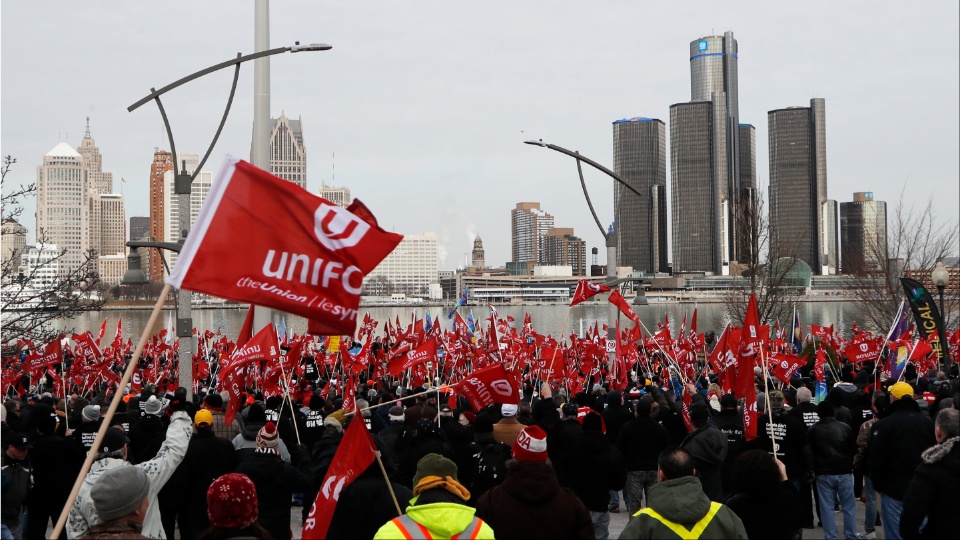
TORONTO—Auto workers in Canada were among the first—and worst—affected by Donald Trump’s tariff war. The sector, which directly employs around 125,000 workers in the country, was hit with thousands of layoffs on the first day of the tariff announcement and has since seen wave after wave of losses, cancellations, and delays.
At an Aug. 15 meeting of the union’s auto sector, Unifor President Lana Payne bluntly outlined the stakes: “This is the fight of our lives, [and] we may need to be prepared to lay it all on the line. There is so much at stake right now and at risk.
“We’re up against a U.S. president who has been very clear about he wants—he wants auto jobs and is willing to use extortion and threats on a daily basis to get them. And it is us—collectively—that is standing in his way.”
The union, which represents about 22,000 workers in auto assembly and another 28,700 in truck, bus, transit, and specialty vehicles, says the impact of tariffs is already apparent at auto plants across the province of Ontario.
Stellantis has delayed planned electric vehicle retooling at its Brampton assembly plant. Workers at its Windsor plant—just across the river from Detroit—have seen production slowdowns and postponement of plans to add a third shift. General Motors has also announced job and production cuts at its Oshawa and Ingersoll.
Trevor Longpre, Local 199 General Motors Plant Chair at the St. Catharine Propulsion Plant and GM Master Bargaining Committee Chair, warned that, “If these tariffs are not dealt with, the Canadian and North American auto industry will never look the same. We need to look at this as a crisis—maybe the biggest industrial crisis we will face in our lifetimes. And everything is at stake.”
In response to Trump’s economic assault, Unifor is urging the Canadian federal government to “establish a permanent resolve that is based on zero tariffs, for the Canadian auto industry.” Specifically, the union is calling on Ottawa to continue its counter tariffs on vehicles built in the U.S., ensure that automakers in Canada who benefit from tariff exemptions maintain their workforce and investment commitments in this country, and use the $2 billion federal Strategic Response Fund to keep the auto sector afloat during the dispute.
In addition, Unifor is launching a new phase of its “Protect Canadian Jobs” campaign this fall, with rallies planned in key auto industry centers. Payne said the union is working to unite auto workers and members from different industries in this fight.
However, lacking from Unifor’s statements is anything about nationalizing the auto sector in Canada. This is notable, given that the current layoffs are not isolated incidents and are part of a decades-long assault by corporations on workers’ jobs and livelihoods.
Furthermore, federal and provincial governments have repeatedly shoveled public money to the auto corporations as a way to “secure” investment and jobs in Canada, only to have those same companies renege on these commitments.
General Motors received $10.5 billion in federal and provincial bailouts in 2009, and while the public took a loss of nearly $3 billion at the end of that agreement, GM demanded massive concessions from workers and retirees.
In recent years, federal and provincial governments have also handed public money over to monopoly coffers to fund the Electric Vehicle (EV) transition, but with no guarantees, no ownership, and no long-term plan for workers or communities. The Ontario provincial government and the federal parliament have both handed billions in subsidies to GM, Stellantis, Volkswagen, Honda, and Ford, with $28 billion going to Volkswagen and Stellantis alone.
Rather than calling on governments to continue facilitating this theft of public funds by endlessly bailing out the huge monopolies, working people need to press for auto to be taken out of corporate hands and put under public ownership and democratic control.
A nationalized auto sector could be a central pillar of a necessary green transition by producing electric passenger vehicles, light industrial vehicles, and mass transit while also meeting climate goals. Combined with strong plant closure legislation that requires corporations to justify closing or moving plants and to repay every dollar of public subsidies before closure, this represents an industrial strategy that can meet multiple needs of working people.
Surely that is in labor’s interest.
People’s Voice
We hope you appreciated this article. At People’s World, we believe news and information should be free and accessible to all, but we need your help. Our journalism is free of corporate influence and paywalls because we are totally reader-supported. Only you, our readers and supporters, make this possible. If you enjoy reading People’s World and the stories we bring you, please support our work by donating or becoming a monthly sustainer today. Thank you!
CONTRIBUTOR