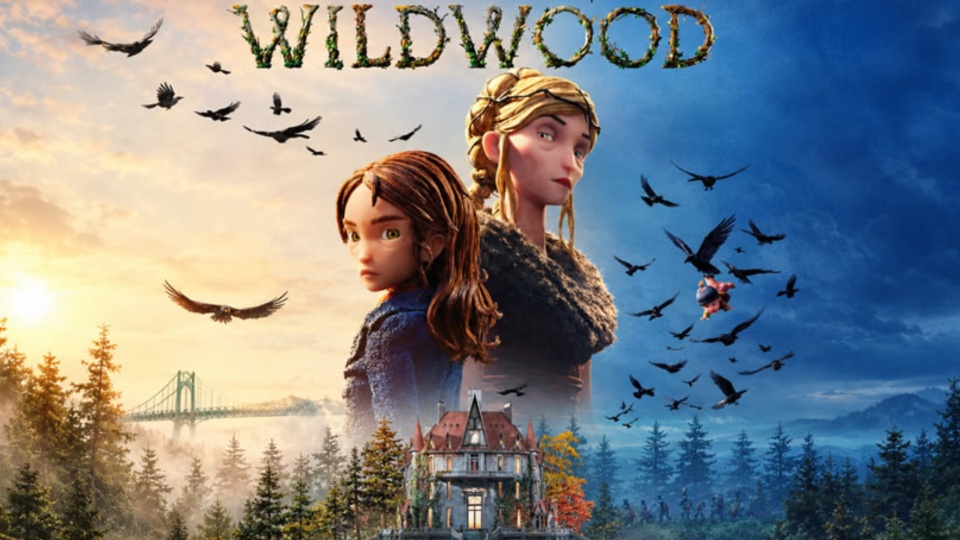
Every so often, an animated film comes along that, by sheer creative force, demands to be taken seriously. Simply put, Wildwood is a triumph of the medium.
It is the sixth film from the legendary Laika Studios and their first to be rated PG-13. Directed by Travis Knight and written by Chris Butler, Wildwood is based on a novel of the same name by Colin Meloy and Carson Ellis.
As an Oregonian, I was delighted to hear that Laika’s next movie would take place in Portland. Residents of the Rose City have long been fervent fans of the stop-motion animation studio—after all, their headquarters are only a short drive away, in Hillsboro.
I remember visiting a 2017-18 exhibit at the Portland Art Museum that showcased props, sets, and puppets from their first four films: Coraline, ParaNorman, Box Trolls, and Kubo. I was amazed back then at the level of detail that went into every costume and background and wondered what kind of raw passion and work ethic was required to be a stop-motion animator.

Only a year later in 2019, Laika would release Missing Link, a box-office bomb which lost the company a reported $101 million. But the studio rallied, and seven years later, we finally have another feature-length film. Wildwood slightly outperformed predictions for its opening weekend (10/23-10/25), earning a modest $12 million.
With high expectations and a seasonal craft beer in hand, I settled into my seat at the Bagdad Theater. Portlanders are showing up for Wildwood; the theater was packed, even a week after the premiere.
The story follows Prue McKeel (Peyton Elizabeth Lee), a young girl living in Portland with her parents and baby brother. The opening sequence is a love letter to the city, with Prue biking past Powell’s Books, getting a drink of water at a Benson Bubbler, and grabbing a doughnut at Voodoo. Even though I knew I was being pandered to (real Portlanders all agree that Voodoo is for tourists), I couldn’t help smiling at the cherry blossoms on the waterfront, the coffeeshops, and yes, even the Uni-piper.
Aesthetically, the film is a dream, almost too gorgeous to be real. Have you ever eaten a piece of cake so delicious, a fresh piece of bread so crisp and fluffy that it felt like a crime? Watching Wildwood, one gets the sense that animation this beautiful simply shouldn’t exist. Every strand of hair, every leaf fluttering in the wind gives the impression of a hundred thousand passionate hours poured into the project. The characters are beautifully expressive, and the sets and costumes are intricately detailed. The scale of the action is breathtaking, especially the final battle. Truthfully, I was a bit overstimulated. In order to catch every single aesthetic touch, one would have to watch the movie at half speed.

My only nitpick of the film is its pacing. There are a lot of moving parts to the story that feel unexplored (such as the Ivy). It seemed like there was quite a bit of lore from the source material that had to be crammed into a very short amount of time, and this resulted in a couple of exposition dumps. It does remind us that Prue and Curtis have entered a completely alien world, but it also creates a lot of confusion and stumbling from scene to scene. However, this could just be a result of the adaptation from book to movie.
Analysis
(Spoiler alert! Skip to the bottom of this section if you haven’t seen the film yet!)
Wildwood is rich with themes of family and loss. Alexandra’s unbridled grief over the death of her son is a reflection of Prue’s parents’ wish to conceive. The former wants to reclaim what was taken from her, while the latter wants something which they never had. Both are willing to go to extreme lengths to acquire what they want, even if their moral codes are compromised.
The film concludes that there’s a fine line between fighting and letting go. In defeat, Alexandra reaps the consequences of going overboard, and in victory, Prue’s parents realize they should have held on tighter. When you decide to fight for something, it’s all or nothing, so you need to be sure you make the right choice. Even though she stumbles, Prue embodies this ideal. She instantly makes up her mind to save Mac or die trying. It’s Prue’s spirit that ultimately brings together the whole Wildwood to prevent Alexandra from unleashing the Ivy.
The unification of North Wood, the Avians, and the Bandits introduces themes of resistance and radical solidarity. Faced with an existential threat, the three groups put aside their differences to fight a common enemy. The woodland creatures were more than willing to take up the sword for the good of all, especially the Northwooders, who are mostly peasants and farmers, not warriors.

The Bandits are also an interesting bunch: Initially they are billed as ruffians and thugs, a force to be feared, but later it’s revealed that their ancestors were the original inhabitants of the Impassable Wilderness. They are not racially homogenous, but the Bandits are still primarily people of color. Iphigenia and the North Wood sages are also indigenous-coded, which brings up the question of “fantasy” settler colonialism.
The Impassable Wilderness is more multicultural and diverse than early Oregon, but they still have a class hierarchy. The citizens of South Wood are clearly the privileged people of the woodland. They live under the protection of Pittock Mansion, where the Governor’s word is law. The Bandits, the Avians, and the Sages have all been subordinated by the Southwooders, who live a comfortable life in their “developed” society, and have no need or desire to participate in the fight against Alexandra. They benefit from the status quo as-is, why would they fight?
This postcolonial angle is one aspect of Wildwood’s worldbuilding I would have liked to see a bit more of. I especially didn’t like the Bandits’ acceptance of their negative reputation. Rejecting the word “bandit” altogether would have left more room for showing off their unique culture, but instead they embrace the pejorative term.
After the final celebration scene, the audience is left to imagine on our own the new society that will be built from the ashes. We could hope for some indigenous reparations, maybe some land reform, but realistically I think the Southwooders would elect a new Governor to replace the “bad apple.” The Bandit/Avian/Northwooder bloc would remain underclass citizens but would establish new political networks and productive forces. The struggle against the old class system would likely continue until progress makes it completely obsolete.
In the last half of the film, it is revealed that the Ivy is a primal natural power, and by trying to harness it, the Ancients destroyed themselves. This narrative trope is usually connected to technology, but there is some crossover of meaning. Whether natural or artificial, it’s something that humans fail to control. The environmental themes are fairly obvious: It’s telling us not to become greedy and exploit the Earth, or else we will reap the consequences. If we mind our manners and make peace with nature, we will find balance.
One last piece I wish to analyze is Curtis’ character arc. In the beginning he stutters nervously, scared to even talk to Prue. He’d rather roleplay as a hero in D&D than go on a real adventure—definitely not the stereotypical picture of masculinity! However, throughout the journey, Curtis experiences shock after shock: He is captured, jailed, and given an order to kill a wounded old man, which he refuses.

By the time the final battle arrives, Curtis has made many new friends. His confidence has grown. During the battle, he kills a coyote in order to save Prue. He’s horrified, yet it’s his crowning heroic moment. His morals collided with circumstance, and he had to make another choice. Let Prue die? Or kill another living creature?
In that moment, he became a warrior. Not because he wanted to kill someone, but because the situation demanded it. The choice wasn’t glamorous at all, but it was necessary. A traditional Hollywood man might grit his teeth and then dive back into the fray, but Curtis drops his sword and starts crying. It’s proof that he has a kind heart and that violence is always difficult for those who feel deeply for others.
Conclusion
Wildwood is a magical thrill ride full of heart. The unbelievable level of hard work and passion that went into this movie is evident in every frame. This one will go down in history as one of Laika’s best.
In our current media landscape, where sequels, remakes, and big budget spectacle seems to dominate, moviegoers have been yearning to support projects with this kind of soul. The stakes in the film industry have never been higher. With the rise of generative AI, people have become jaded and suspicious of any movie with heavy visual effects. In a field defined by artistic skill, nothing is more disappointing than finding out an artist you liked used AI instead of creating something unique.
Thankfully, Laika is one of the most unique studios in the game today. Every artistic choice in their films is made by a person, not an AI. Costumes, backgrounds, sets, and puppets are all lovingly assembled by hand and given life with movie magic.
It is also nice to see a positive portrayal of my city. Portland has gotten a lot of bad press in the last decade, but if you’ve been here, you’ll know that the mainstream narrative is incredibly distorted. There are protests and homeless people here, it’s true, but it’s the same with every other major city in the U.S. The reason Portland is a target for the far right is because they hate anything they can’t control. They hate our politics—which in general are more liberal but still contain socialist, leftist, and anti-fascist currents—but they equally despise our naked bike rides, drag brunches, and lesbian square dance clubs.
It’s not often that a film compels me to go see it in its opening week, but it’s for all of these reasons that I knew I couldn’t miss Wildwood. Our biggest power as consumers is our wallets. If we want higher standards for movies, we need to spend like it. So please, go see it. Go see it twice. Bring your family. Rent out the whole theater. Wildwood is a shining example of creativity that challenges the status quo and declares that yes, the touch of a human artist still matters.
No paywalls at People’s World
At People’s World, we believe news and information should be free and accessible to all, but we need your help. Our journalism is free of corporate influence and paywalls because we are totally reader-supported. Only you, our readers and supporters, make this possible. If you enjoy reading People’s World and the stories we bring you, please support our work by donating or becoming a monthly sustainer today. Thank you!
CONTRIBUTOR