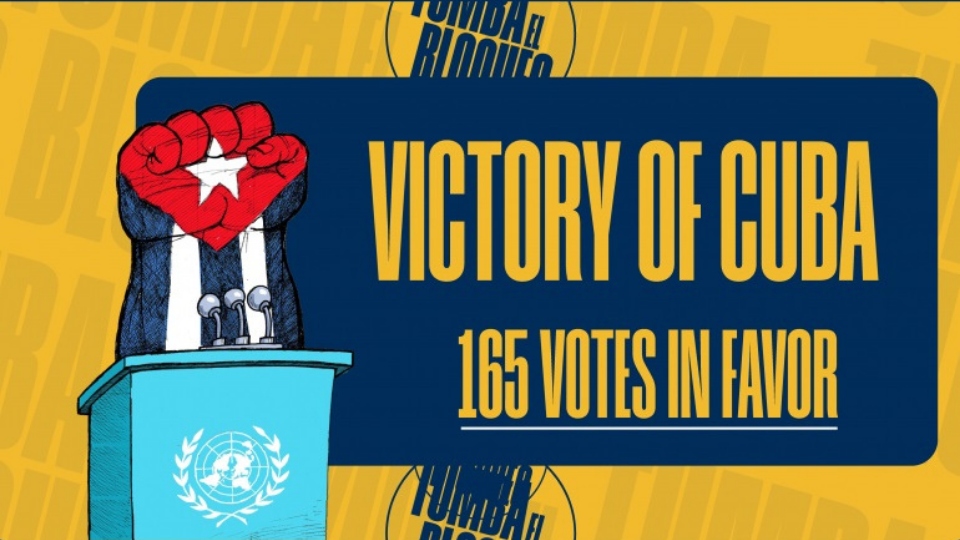
The U.N. General Assembly voted overwhelmingly Wednesday to condemn the U.S. economic embargo of Cuba for the 33rd year in a row. The vote in the 193-member world body was 165-7, with 12 abstentions. This was a change from last year, with more countries ruled by autocratic dictators joining the U.S. in backing the embargo.
Last year, it was 187-2, with “no” votes from the U.S. and Israel and one abstention. This year, Argentina, Ukraine, and Hungary were among the countries that joined the Trump administration in opposing the measure.
In an interview with The Associated Press on Monday, Cuban Foreign Minister Bruno Rodríguez said the U.S. mounted a pressure campaign to influence the vote. Rodríguez said his government had heard from other countries, mainly in Europe, that the U.S. State Department was encouraging them to vote against the resolution.
While not legally binding, General Assembly resolutions reflect world opinion. “We cannot underestimate the importance, the impact, of the powerful message year after year by the General Assembly, which is the most democratic, representative body of the international community,” Rodríguez told AP. “It is not binding, but it is powerful.”
Communist Parties, social movement leaders, progressive organizations, trade unions, and leftist publications all came together in Havana, Cuba, for one week recently to participate in events convened by the Communist Party of Cuba and discuss critical issues facing the world and political movements today. At both the Third Meeting of Theoretical Publications of Left Parties and Movements and the first-ever Granma Rebelde Festival, representatives from over 38 countries, including the Communist Party USA, engaged in panel discussions and book presentations focused on the rise of reactionary right-wing and neo-fascist forces around the world.
Participants focused on how to better coordinate the creation and dissemination of narratives of resistance and social change among the world’s progressive forces for socialism, peace, and national sovereignty.
Miguel Díaz-Canel, First Secretary of the Communist Party of Cuba’s Central Committee and the President of the Republic, was present at several of the activities. Addressing the auditorium of conference participants, Díaz-Canel expressed his belief “that in these exchanges, we can maintain a holistic debate from the left on all the issues we face today, because this is not only an academic space, but also a political and ethical one, and above all, a deeply revolutionary space committed to socialist construction and the will to change the world we live in.”
Further, he stated that “today, to think is to fight, to publish is to resist, and to communicate is to liberate, and we must all be committed to this battle.” This is why, he argues, that “international solidarity is very important…because sovereignty in a world like this is not only territorial, it is also symbolic, cultural, spiritual. And we must all defend ourselves, and we must all unite in the struggle against global capitalism.”
In an exclusive interview with People’s World, the head of the Communication Office of the Central Committee of the Communist Party of Cuba, Adrián Fonseca Quesada, said the purpose of these two events was to “convene journalists and communicators to seek cohesion, integration, articulation, and fight against hegemonic power.” In a world context in which “the owners of the large transnational communication companies have limited the impact of our messages” the progressive forces of the world must have “the capacity to convey the truth of our people, of the people that today are increasingly under siege,” he said, noting the intensification of the blockade against Cuba, the increasingly severe threats against Venezuela and Nicaragua, as well as the genocide against Palestinians.
While the conference of theoretical publications took place at the University of the Communist Party of Cuba Ñico Lopez and consisted of academic panels, keynote lectures, and book talks, the Granma Rebelde Festival—which celebrates the 60-year anniversary of the revolutionary newspapers Granma and Juventud Rebelde—took those conversations to the streets and into the communities during the weekend.
“The debate would be of little use if we were unable to disseminate its ideas outside of these spaces,” declared Luis Morlote Rivas, director of Cuba Socialista, the theoretical journal of the Communist Party of Cuba, in his closing remarks at the university auditorium a few hours before the opening of the festival later in the evening.
“Media is nothing without its audience. We owe ourselves to the public, and we also need people to tell us how to improve, how to get closer to reflecting the public agenda. To articulate our agenda, both political and public, we have to be close to the people, close to our audiences,” Fonseca Quesada added.
The festival was named for the two major national newspapers but also highlights “two symbols of the struggle in this country for independence and social justice: the yacht and the army that made those dreams come true,” said Yuniasky Crespo Baquero, the new head of the Ideological Department of the Central Committee of the Party, in her remarks during the festival’s inauguration.
Indeed, cherishing and continuing the legacies of struggle in Cuba was an important reason for bringing the events to fruition. Since their founding, which “broke the bonds of the bourgeois press and spawned a new one, of the people,” Granma, the official newspaper of the Party’s Central Committee, and Juventud Rebelde of the youth league, have throughout decades used their voices to recount “the popular resistance to imperialism and have become platforms in defense of the most just causes of humanity,” Crespo Baquero proclaimed.
Another critical motivation for these events is the upcoming centenary of Fidel Castro, and in particular his “unitary, integrationist thought,” said Fonseca Quesada. “We are willing to maintain the dream of the revolution, and now we are willing to look for that free Latin America and not be the backyard of any power, much less the United States,” he stated.
Today, U.S. bombings of innocent working-class fishermen in the Caribbean, the ongoing genocide in Palestine, and the right-wing and neo-fascist power grabs taking over countries across the world call for “fighting against everything that divides us,” as comrades repeated on a few occasions. Given the gravity of the situation, it was stressed that we urgently need to build an analysis of fascism to combat its growth throughout the world.
Conference discussants likewise cautioned against division and fixating on our differences, instead pointing to the necessity of unity if we are to meet the tasks before us.
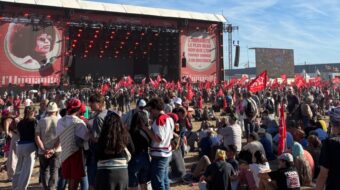
The Secretary of Organization of the Central Committee, Roberto Morales Ojeda, emphasized the critical nature of the global moment, denouncing U.S. imperialism’s role in the genocide in Gaza and its attacks on Venezuela as based upon the same logics of chauvinism, disregard for international law, and imperialism. While speaking to more than 50,000 Havana residents, as well as the many international delegates present, gathered in front of the statue dedicated to Simón Bolívar on one of city’s central avenues, Morales Ojeda expressed solidarity with Venezuela against U.S. aggression saying: “if they ask us why Cuba, a small country, besieged and blockaded for more than 60 years, raises its voice so strongly for the Bolivarian Revolution, the answer was given by the eternal Caguairán [Fidel Castro] when he forged a fraternal bond with Commander Chávez: ‘One brother, one homeland, Cuba and Venezuela’.”
At the conference in the party school, the panel “Geopolitics and International Relations: Analysis of Global Tensions and Their Impact on the Left” brought together delegates from Turkey, China, and Venezuela. Chen Yiming, the general director of the Bureau for Latin America and the Caribbean of the People’s Daily, spoke about the need to counter the hegemony of neoliberalism in today’s unequal global communication networks and highlighted the common challenge to build a new international media ecosystem based on truth, diversity, and mutual understanding.
“We live in an era of accelerated change and redefined order. Although the countries of the Global South are increasing in both economic and political strength, the global communication landscape continues to be characterized by information asymmetries and unbalanced narratives,” Yiming said, adding that “All the mediums of communication of the South need to unify so we can be heard.”
In other panels like “Political Communication in the Era of the Algorithm” and “Revolutionary Theory in the Face of New Challenges and Fascism of a New Type,” the idea of building more theoretical and informational unity across social struggles emerged as a central call to action of many of the discussants.
Members of the Communist Party of Cuba’s Central Committee cited Gramsci’s concepts of hegemony and social transformation on multiple occasions. “The old world is dying, and the new world struggles to be born: now is the time of monsters,” echoed Abel Prieto, tagging Trump, Rubio, Bukele, Milei, and others as our era’s monsters, and insisting it is against these forces that our movements must build unity to defeat.
Prieto spoke not only of communication, but of education, and stressed the need to reach workers and oppressed people of the world who were being manipulated by the far right’s strategic use of media to disinform, confuse, and distract. Moreover, the Mexican professor Fernando Buen Abad mentioned how sometimes communities in struggle in different locales across the region and world are unaware of their simultaneous and shared struggles, emphasizing the need for a communication front as well as spaces of theorization and self-criticism.
Vasuki Umanath from the Communist Party of India (Marxist) provided an analysis rooted in Dimitrov’s understanding of fascism as the “open terrorist dictatorship of the most reactionary, most chauvinistic and most imperialist elements of finance capital.” She noted that emerging neofascist developments transcend borders, as the new fascists do not stop at dominating politics, but also seek to attain cultural hegemony across nations.
Attacks on the rights of women and attempts to control the reproductive sphere of the economy, alongside attacks on religious, ethnic, and racial minorities, constitute a shared feature across the various neofascist movements. She contextualized these qualities within the framing of the Hindu nationalist Modi government, with its anti-Muslim, anti-woman, and casteist programs.
She argued that if we are to successfully combat these fascist threats, the struggle against the social oppression of women and other oppressed groups cannot be seen as a separate fight from class struggle.
Tim Joye from the Workers’ Party of Belgium spoke about the developing right wing in his country, detailing how NATO militarization directed at encircling Russia is resulting in mass austerity at the expense of workers’ social rights. With large cuts to healthcare and social security in order to foot the bill for an increased military budget, Joye emphasized how this capitulated to the growing power of fascists like Trump on the international scale.
The president of the Communist Party of Spain, José Luis Centella Gomez, pointed to the development of a new Cold War in the wake of fascist ascendancy. Centella highlighted how neoliberalism empowers fascism and emphasized how the fight against fascism is also the fight against imperialism and the fight for peace.
In taking on the task before us, Centella discussed electoral battles as important to defeating the right-wing since this is also a mechanism of fascist takeover and proposed urgently building movements based on the broad coalition of workers, environmentalists, and feminists, uniting “all social and political forces who are willing to fight for life.”
The cultural programming throughout the conference and the festival promoted fighting for a new and better world by including youth as central. La Colmenita, a children’s theater group, performed music, dance, and poetry and brought to light Africa’s heritage in Cuba, the values of inclusion, creativity, and collectivity taught by the revolution, and the history of Cuba’s fight for independence. Both the theoretical conference and the popular festival were full of cultural programming and boasted of an intergenerational community.
Rodney R. Jimenez Muñoz, a journalism student at the University of Havana and a reporter for the Cuban News Agency, said he came to the festival to “accompany my media outlet, and share with all the workers and co-workers and others who I know from other outlets… to support each other.” He mentioned that it was a great opportunity to connect with international outlets as well, noting that their presence creates an inclusive and productive space with wide representation.
Editorial de la Mujer (Women’s Editorial), the first media platform specialized in communication with a gender perspective in Cuba, had programming on all days of the festival, including workshops led by the Feminist Network of the University of Havana, presentations on the history of their community work and magazine publications, as well as information sessions on their ongoing campaigns in adolescent education and women’s economic empowerment.
The week’s activities at both the conference and the festival all centered around a key question facing our movement today: how do we build transnational solidarity and communication in a world where the right wing possesses a monopoly on communication? It has never been more urgent for the international Left to provide effective counter-narratives to combat the growing campaigns of disinformation and propaganda pushed by the growing fascist tide around the world.
Attendees and participants put forth analyses and strategies to navigate these dark times, centering our conversations on lessons learned from the development of media from the socialist world. The consensus was largely the need to develop a flexible media strategy for the Left, one that refuses to cede the ground of mainstream social media to the right wing, but also emphasizes the need to develop our own platforms.
Combining the governing experience of the socialist countries and the theoretical insights of the broader Left, new platforms have the potential to solidify and experiment with constructing an effective counter-narrative that can mobilize our class across national lines in a time of fascist threats.
The week ended with a pledge not to just follow through on the proposals of the conferences, but also a commitment to meet again the following year and continue the work of building a consistent avenue through which the transnational Left can coordinate our work. Spaces such as these are critical for building unity of action among the different sectors of the Left.
The closing panels and remarks emphasized the need for building the progressive, working-class cultures we wish to see transform the world in the here and now. Echoing the address of President Díaz-Canel, who argued that “as left-wing publications, we have a real historical responsibility in this battle for truth. And we have to educate our citizens in media literacy with critical thinking, enabling them to dismantle this manipulation and recognize the revolutionary word as a tool of liberation.” It was underscored that Left movements must take up this banner of resisting right-wing cultural colonization and hegemony if we are to build the better world we emphasize is possible.
We hope you appreciated this article. At People’s World, we believe news and information should be free and accessible to all, but we need your help. Our journalism is free of corporate influence and paywalls because we are totally reader-supported. Only you, our readers and supporters, make this possible. If you enjoy reading People’s World and the stories we bring you, please support our work by donating or becoming a monthly sustainer today. Thank you!
CONTRIBUTOR