WASHINGTON—Over the last several months, the capital city has been blanketed by canvassers, election signs, and purple beanies signifying support for mayoral candidate Janeese Lewis George. While her contest is dominating the election spotlight, the race for D.C. Council in Ward 1 offers a residents an opportunity to push back against the Trump administration’s encroachments on the District
Ward 1 is one of the city’s most diverse communities, providing a home for not only many immigrant families but also Howard University and its thousands of students. That diversity has also made it a target for the federal government. From increased policing heightened ICE enforcement, and municipal budget cuts, Ward 1 has felt the pressure more than most. Because of its unique situation, the race for the council is a referendum—residents have to choose the candidate they think is most capable of defending them.

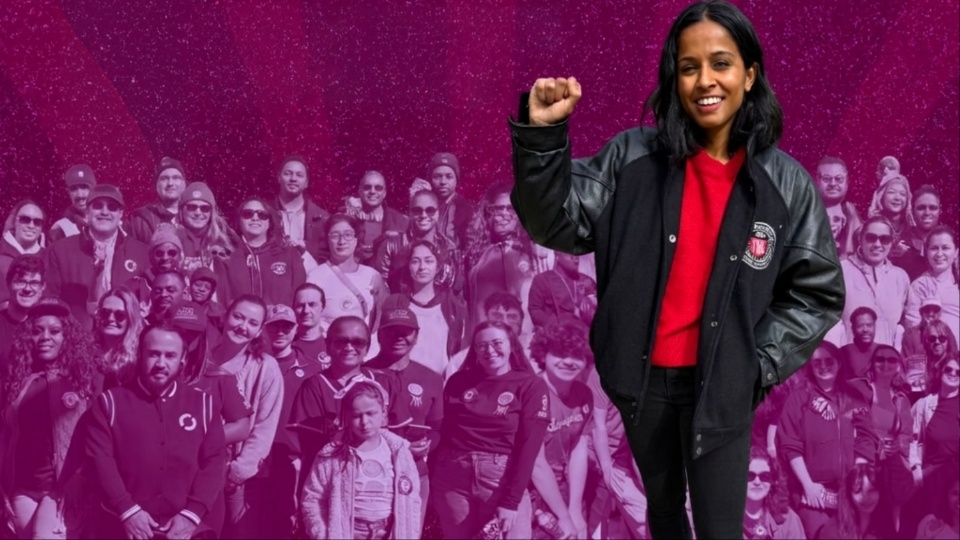
Endorsed by the Working Families Party, dozens of unions, and progressive organizations in the city, Aparna Raj stands out among her fellow candidates. She has been deeply involved in organizing, including within the labor and renters movements in D.C. A leader in the Democratic Socialists of America and a longtime tenant organizer, Raj hopes to bring a more progressive energy to the council.
The following interview with Raj covers her platform, priorities, and hopes for Ward 1. The primary election is on June 16.
How will you meet the needs of the people in D.C while navigating the constraints and challenges posed by the current federal government?
History has shown us that in times of authoritarianism, there are two choices: collaboration or resistance. While I believe that we have to be strategic, I will never accept the idea that we have to sacrifice some of our own for a hypothetical promise of maintaining Home Rule. I will fight to protect all of our residents, to pass legislation that meets the needs of people.
I will organize with and for our community, including working in coordination with local groups such as Free D.C. to have a unified strategy across organizers and councilmembers to protect immigrant communities, defend D.C., and advocate for statehood. I will fight to protect the rights, safety, and autonomy of the people of D.C., and will stand up to the Trump administration’s attacks on these things and its attempts at exerting ever-increasing control over D.C.
What is the most immediate issue in D.C that you want to tackle if you win?
While I see protecting immigrant communities and stopping rent hikes as the most immediate priorities to help make D.C. more affordable and easier to live in, I’m also running for free childcare for every family.
With the average D.C. family paying more than $22,000 on childcare per child, every year, it can amount to a second rent or mortgage. When talking to federal workers who have been laid off, I found that some people were able to stay in D.C. because their children were old enough to attend D.C.’s free pre-K programs, while that others were forced to leave D.C. because their children were too young for pre-K and early childhood education was too expensive for them.
By passing a 2% business activity tax, we can raise more than enough money to make childcare free for every family and make sure that nobody is forced to leave D.C. or leave a job they love because costs are too high. D.C. paved the way with free pre-K, and we can do it again with early childhood education.
Ward 1 has been a target of ICE, along with a heightened police presence in general. What will you do to make immigrant and Black communities feel safe and protected in their own neighborhoods?
I will work to end Metro Police Department collaboration with ICE, close loopholes in the Sanctuary Values Act, and establish an Immigrant Defense Fund to ensure that immigrants facing deportation are served by a lawyer.
I have been on the streets alongside organizers since the start of the federal occupation in August 2025 and witnessed firsthand the terror families experience when taking their children to school or leaving for work. I will fight to defend District residents from these attacks by being on the frontlines alongside organizers doing ICE watch, using my office as a hub to better and expand and coordinate mutual aid efforts.

And outside of the immediate threats of ICE, I will push back against the overpolicing and surveillance of Black residents to make sure everyone feels safe. We know that the safest communities are the ones with the most resources, so that means investing in housing, education, wages, and the things people need to survive, as well as improving our emergency response system in D.C., with things like community responder programs and violence interruption—proven tools that have been shown to bring down violence and crime in other cities while limiting interactions with police and incarceration.
We also need to resist efforts by Trump and Jeanine Pirro to try to scapegoat our Black and brown youth. We know youth curfews don’t work and just criminalize our young people. We need to make sure that teens have real third spaces and programming they want, instead of just trying to erase them from public life.
Housing prices, especially in Ward 1, have exploded in the last half decade. What concrete steps will you take to expand affordable housing in the ward and across the city?
Housing is a basic human need, but for too long, D.C. has put developer profits over the needs of the people who live here. As a tenant organizer and a renter myself, I have seen firsthand how bad the housing crisis has gotten. People are struggling to find a place to live, they’re forced to live in terrible conditions, or they’re pushed out of Ward 1 or D.C. entirely because rent is getting too expensive.
We need more housing, and family-sized housing especially, in Ward 1, so I will encourage the development of more housing, especially workforce and permanently affordable housing.
One of my other top priorities is to expand rent stabilization, stopping unjust rent hikes that are pushing working class people out of the homes and neighborhoods they love. Right now, no buildings that have been built in the last 50 years are rent stabilized. And as older buildings are replaced by new construction, fewer and fewer tenants have access to these protections. I’ve also seen buildings like the Woodner, which have rent control, be threatened with 20% rent hikes, due to loopholes in our existing law.
I will fight for rent control for residents in all multifamily buildings and will seek to close those loopholes that landlords often use to get around rent stabilization.
We’re also seeing the real estate and developer lobby try to claw back the tenant protections that make D.C. what it is. I will fight to restore the Tenant Opportunity to Purchase Act back to a universal right available to all renters, as it was originally passed in 1980. TOPA is one of the best tools we have to preserve affordable housing, and it puts power back in the hands of tenants to have a say in what happens to their homes.
And ultimately, I will fight for a Green New Deal for Social Housing of publicly-owned, tenant-controlled, mixed-income housing, so that housing can truly be for people and not for profit.
What is your plan to create and expand quality job opportunities for Ward 1 residents?
D.C. is struggling through an economic crisis. As a union member, I have seen the stability that having a union has given me, and I know that unions are the most important way to give working people more power on the job and in D.C.
I plan to invest in workforce development pipelines tied directly to good-paying, union jobs. I will also make sure that public dollars only go towards good union jobs—conducting an audit on where our public dollars go to end contracts with companies found to engage in union-busting or wage theft, and fighting for wage floors, registered apprenticeships, project labor agreements, and labor peace agreements on all publicly-supported projects.
And I will always use my platform as a councilmember to uplift workers’ rights concerns, show up on picket lines, and support workers organizing for more. And with federal workers laid off, I will also push for targeted employment opportunities to ensure former federal workers are prioritized in local hiring. We cannot afford to lose this talent or to have people leave D.C. Instead, we should ensure these workers can continue contributing to the District’s future and success.
Last winter, it took the city a while to get snow cleared out of the streets. Many people in Ward 1 have also reported an increase of rats in their neighborhood. What is your strategy in improving government services, and how will you go about doing so, especially with government funding in the city for these programs being limited?
Whether it’s designing big housing policy or having responsive constituent services, local government is about improving people’s quality of life. I plan to be an organizer in office, and that means walking the Ward frequently and having well-coordinated, proactive constituent services.
I will reach out to Ward 1’s communities and engage tenant unions, labor unions, volunteer networks, religious centers, and other community groups to hear what their most pressing issues are and talk through how we can fix them. I’ll make sure my office has clear, consistent communication with Ward 1 residents around what we are doing to address these issues, as well as our plans and updates during unique circumstances, like the response to the major snowstorm last winter.
I also plan to build my office into a hub for organizing across our many communities, working with my staff to ensure that volunteers across Ward 1 are well coordinated, whether they are doing community defense, shoveling snow, or doing community clean-ups, so that all may live with strong, diverse community networks.
And finally, I’m proud to be the only Ward 1 candidate with a full “ratform,” a plan to get rid of rats in D.C. by rat-proofing household trash bins, upgrading public trash bins, and improving interagency coordination.
The D.C government has been adamant in imposing child curfews despite the concerns of increased police engagement with Black and brown youth. What will you do to advocate for the children of Ward 1 who are impacted by these curfews, and how will you design your strategy to combat issues that directly impact Black and brown youth in the city?
I want D.C. to be a safe place for everyone to live and socialize, and that includes young people. We cannot keep pinning D.C.’s failures to provide for society on our youth or keep pushing young people out of public space. I do not support youth curfews, and research consistently shows they do not work.
If we want to see improved outcomes for our youth, we must invest in them, not punish them. We have to make sure families have stability by guaranteeing housing, good jobs, and education. As councilmember, I will fight for good schools for all, for more youth programming after school and on weekends, and to make childcare free for every D.C. family—because studies show that quality early childhood education is critical for long-term success.
We have to invest in consistent counselors in schools so that young people have trusted, reliable adults they can talk to. And I will work to make sure that we have real third spaces for youth with programming that they want to see—that includes making sure rec centers are well resourced and staffed, investing in after school programs that students want to go to, and continuing to hold events for teens in the summer.
How will you go about protecting and upholding the vision for community spaces that the people of Ward 1 would like to see, like Amigos Park?
Some of the most beautiful parts of our ward are vibrant, accessible, well-maintained community spaces. Every neighborhood and community deserve spaces like those. I’ll prioritize investments in public facilities like libraries, community and recreation centers, pools, and sports fields, and work with agencies like the Department of Parks and Recreation to make sure these spaces are well-maintained. And I’ll advocate for more community events like street festivals in Ward 1.

On Amigos Park specifically, we need to make sure the park gets the attention and investment it deserves. I will push to realize the full park that residents in the neighborhood have been pushing for for years. Neighbors deserve a real park with space for intergenerational community gatherings, music, games, and everything else people want to see. I will also make sure that after the park is developed it receives the maintenance and management it needs over the years to come.
With the war in Iran and the genocide in Palestine both still dragging on, will you commit to push for an anti-war and anti-genocide resolution?
While my priority will largely be directly local issues, I believe we have a moral obligation to fight for human rights for all people. That includes advocating for the safety and freedom of all people and speaking out against violence, apartheid, and genocide. If elected, I would gladly support anti-war and anti-genocide resolutions. It is both the moral thing to do, and our tax dollars should not be used to bomb other countries while people go hungry and schools crumble on our own.
Do you support the Target boycott?
Yes, I support the boycott because I’m outraged by Target’s cowering to the Trump administration by eliminating Diversity, Equity, and Inclusion initiatives and by their ongoing reported collaboration with ICE.
Will you support an end to tech surveillance contracts in the city?
I’m fighting for a D.C. where everyone can live freely, without fear. That means I will fight to end D.C.’s contract with Flock cameras and other Automated License Plate Readers, which have been used to surveil and police undocumented immigrants and people seeking abortions across state lines.
Even when data-sharing regulations are in place, these cameras allow police departments across the country and federal agencies to have access to our community members’ information, often violating sanctuary laws and other protections in place. If we want to keep people safe, including immigrants, people seeking abortion, and people seeking gender affirming care, we need to reject these invasive tools.
Anything further you’d like to tell voters?
This June, we have an opportunity to remake D.C. government from one that prioritizes corporations and billionaires into one that will fight for renters, workers, immigrants, and families. We will have a new mayor, many new councilmembers, and [in November] potentially a Democratic Congress.
For too long, we have seen people ground down by the cost-of-living crisis, displaced from Ward 1 and D.C., or under attack from ICE while our local government chips away tenant and worker protections at the behest of corporations, gives billions of dollars to a stadium, and cowers to the Trump administration.
We have the chance to stop major rent hikes, hold bad landlords accountable; and create more housing that meets people’s needs; to provide free childcare for every family; to improve our schools and public transit; to raise wages and make it easier to unionize; to make government work for us and support small businesses; and to protect immigrants and queer and trans people, end MPD collaboration with ICE; support federal workers; and fight for D.C. statehood.
It’s just a matter of whether we’re willing to fight for it.
We hope you appreciated this article. At People’s World, we believe news and information should be free and accessible to all, but we need your help. Our journalism is free of corporate influence and paywalls because we are totally reader-supported. Only you, our readers and supporters, make this possible. If you enjoy reading People’s World and the stories we bring you, please support our work by donating or becoming a monthly sustainer today. Thank you!
CONTRIBUTOR