CHICAGO—The “billionaires tax” idea, which has been gaining support in several states—including Washington state, where it’s now law—has come to Illinois, courtesy Chicago-area unions.
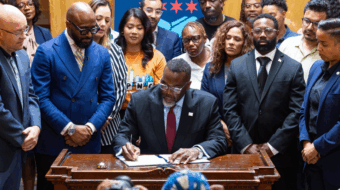
After a morning press conference in Chicago, busloads of members of the Chicago Teachers Union, SEIU Healthcare Illinois, Cook County College Teachers Union Local 1600, SEIU Local 73, the Illinois Federation of Teachers, Warehouse Workers for Justice, and assorted progressive Chicago-area community groups descended on the state capital of Springfield.
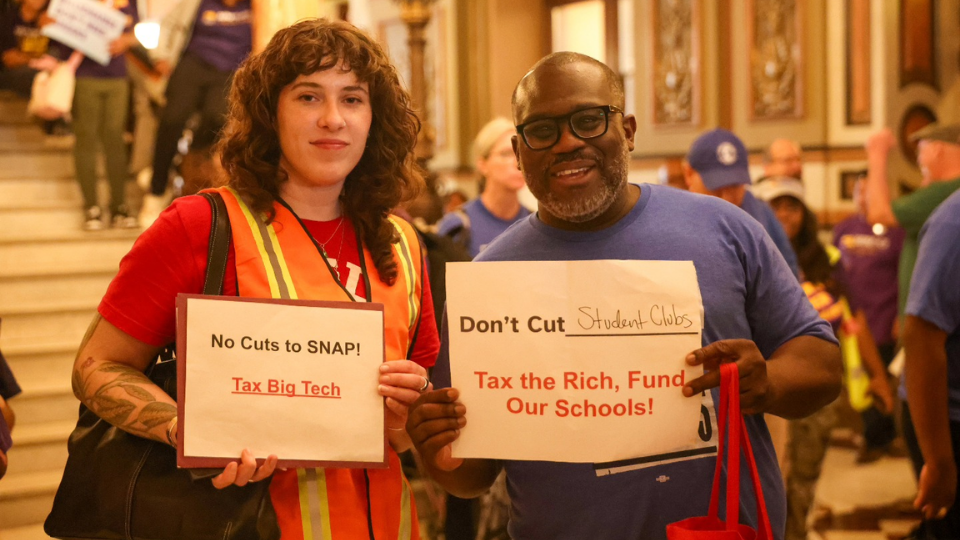
There, as the Illinois Revenue Alliance, they staged a mass rally in front of the Capitol building before fanning out to lobby lawmakers to make the state’s tax code more progressive by raising taxes on corporations and the rich. A parade of sympathetic lawmakers lent their support.
Whether they’ll succeed or not is the $4 billion question. That’s how much they want to garner.
“When we say tax the uber-wealthy, that’s what we’re talking about,” declared CTU Vice President Jackson Potter. “How do you close the [state] deficit? Tax the rich.”
The heavily Democratic state legislature faced an end-of-May deadline to approve a state budget, and that came first on its agenda. But lawmakers in the Land of Lincoln have been known in past years to “stop the clock” when budget talks go down to the wire.
The tax the rich idea has been gathering momentum in various states, especially as lawmakers are wrestling with cuts in federal social welfare programs, notably Medicaid and food stamps, mandated by the right-wing GOP Donald Trump regime, its pliant GOP-majority Congress, and their so-called “Big Beautiful Bill,” passed last year.
The Republicans now rebrand their law as a middle-class tax cut, an idea speakers rejected at the press conference. Instead, they said, that GOP legislation leaves workers and families scrambling to make ends meet, doing without while Trump and his billionaire allies pocket the proceeds.
Besides Washington state, “tax the rich” has passed in San Francisco and Portland, Ore. In California, State Rep. Gary Lee, D-San Jose, became the latest lawmaker to back a one-time 5% “wealth tax” on the Golden State’s 200 billionaires, primarily to pay for health care.
There are also 1.5 million signatures on a petition to put that tax on this November’s California ballot. Unlike the Illinois legislation, SB3796, California’s tax would be a one-shot deal.
The Illinois solution is to tax the rich and, at the same time, straighten out the state tax code, which non-partisan studies show is eighth in the U.S. in unfairness, in other words, lack of progressivity.
“A billionaire has the same” state income “tax rate as a truck driver,” said State Rep. Lindsey LaPointe, D-Chicago.
In a recent issue paper, Kyle Moore of the labor-backed Economic Policy Institute wrote, “We need to structure the [federal] tax code so it becomes more progressive, tapping into a greater portion of the massive amounts of wealth and income that have pooled at the top. We can use that revenue to fund programs and new infrastructure that allow more people to fully participate in the economy.”
That’s the idea—on a state level—which the Illinois unions, their allies, and the pro-worker lawmakers pushed on May 27.
“I represent people” from Chicago’s Northwest Side and nearby suburbs “who get W-2 forms” to show how much bosses take out of their paychecks, “and the short end of the stick,” said LaPointe. “They rely on publicly funded services” such as schools and mass transit. Both would see cuts due to GOP actions in D.C., and state aid to local public schools “has fallen by 50%,” accounting for inflation, in the past decade, she said.
State Sen. Lakesia Collins, D-Chicago, a former SEIU Local 73 organizer, said her constituents on the West Side and stretching down to Lawndale “are under real pressure.
“Costs are up. Wages are stressed. And they’re having to make hard choices. And when the federal government creates giant tax code carve-outs for giant corporations and the billionaires, the Illinois tax code is automatically adjusted” to mirror those changes. One coalition proposal is to decouple the state’s tax code from the federal level and exceptions.
Doing that “would protect our working families” in Chicago, its suburbs, and in downstate, she said.
Still another proposal would tax overseas income corporations now stashed in “tax havens” such as Panama and the Caribbean, said State Sen. Robert Martwick, D-Norwood Park. “That would generate $434 million” yearly, he said. “We could invest it in people.”
“We have people who are struggling to put food on the table or get health care for their kids while others can jet off to Jeff Bezos’s wedding in Venice,” Italy, said State Senate Labor Committee Chairman Robert Peters, D-Kenwood. “This is a moment where we have your backs” in taxing those rich, he told the crowd.
We hope you appreciated this article. At People’s World, we believe news and information should be free and accessible to all, but we need your help. Our journalism is free of corporate influence and paywalls because we are totally reader-supported. Only you, our readers and supporters, make this possible. If you enjoy reading People’s World and the stories we bring you, please support our work by donating or becoming a monthly sustainer today. Thank you!
CONTRIBUTOR