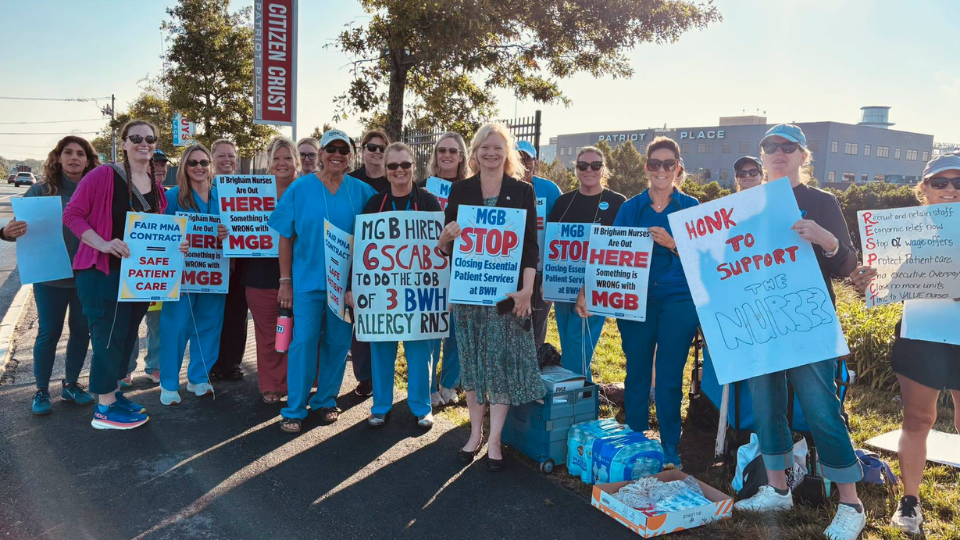
BOSTON and BRAINTREE, Mass.—After last-ditch talks between the Massachusetts Nurses Association and Massachusetts General-Brigham and Women’s (MGB) Hospital bosses broke down, the 4,000 MNA nurses staged a one-day strike starting at 7 a.m. on July 8.
After that walkout from the prominent Boston hospital, over low pay, short-staffing, and the hospital’s use of temps, they’ll go back on the job, having made their point to the hospital’s board and their bosses. But 450 clinicians for MGB Homecare, also MNA members and seeking a first contract, aren’t as fortunate.
They, too, struck, and planned for a week-long walkout. They seek a first contract. But the board, which oversees both the hospital and Braintree-based MGB Homecare, co-opted the strike and decided to lock the clinicians out.
The nurses and especially the home care clinicians thus join the growing legions of underpaid, overworked employees exploited by corporate greed, aided and abetted by the financial class.
Such unholy combinations have led to increasing strikes over the last several years by underpaid classes of workers, including university research assistants and teaching assistants—who are numerous in Boston—adjunct professors, port truckers, retail workers, Starbucks baristas, and Amazon workers.
The conflict between the hospital and the home care firm on one side and the workers on the other has been building through eight months of fruitless negotiations. On July 6, Gov. Maura Healey, D-Mass., convened both sides in her office for face-to-face talks. They went nowhere.
The union reps said they were ready and willing to resume talks on July 7 and go round the clock and all night to avoid a strike. The union reported the bosses refused and didn’t even make a counteroffer. Bosses also refused to agree to further bargaining dates.
Instead, the bosses did not budge off what MNA called an “insulting” wage offer of 0% in the proposed contract’s first year, the union reported. There was a similar refusal to move on the short-staffing and temp issues. In its statements, the union did not disclose the wage hikes it sought.
But living in metropolitan Boston is not cheap. The Commonwealth of Massachusetts says that to qualify for Section 8 or other subsidized public housing, a 4-person family needs a “very low “ maximum income of 50% of the area’s median income. The median in metro Boston is $131,400.
“Our 4,000 Brigham nurses are ready to negotiate to avoid a strike, but MGB has told us at the bargaining table they are not willing to move off their insulting 0% offer or engage on other key issues like health insurance and limiting temporary staff,” said Kelly Morgan, RN, chair of the Brigham MNA Bargaining Committee, after the meeting Healey convened ended.
“MGB’s position is completely disrespectful to Brigham nurses who care for patients under extremely challenging and unsafe conditions.”
“Our 450 MGB Home Care clinicians have done everything possible to reach a fair first contract without a strike,” added Shannon Viera, RN, MGB Home Care MNA Bargaining Committee chair. “We appreciate Gov. Healey’s convening this meeting, but, unfortunately, we do not see a willingness by MGB to negotiate toward a settlement before our strike. Our clinicians are ready to stand together for seven days starting July 8 to protect patient care and our profession.”
The nurses and the clinicians tried to get the board of directors for the hospital and MGB Homecare to push the bosses to bargain in good faith. But the board, dominated by financiers from “venture”—other unionists call it “vulture”—capital and private equity firms, turned a deaf ear.
“As the elected chair and vice chair of the 4,000 registered nurses at Brigham and Women’s Hospital, we are writing to tell you this strike and lockout is your responsibility,” wrote Morgan, who chairs the Brigham MNA Bargaining Committee, and the bargaining committee vice chair, Jim McCarthy, RN.
The reply from Brigham and Women’s board chair Scott Sperling, a private equity firm co-CEO, was a brush-off. The letter from Morgan and McCarthy also went to Massachusetts General-Brigham and Women’s CEO Anne Klibanski, who made $8.4 million in 2024. Her response was silence.
In their letter, the RN duo contrasted the wealthy backgrounds of MGB board members in investment management, private equity, venture capital, and “billion-dollar corporations with the daily reality of bedside nurses caring for patients through trauma, cancer, organ transplants, childbirth, and medical emergencies.
They called on Sperling and other board members to intervene and order Klibanksi and her team to “intervene after more than eight months of negotiations failed to produce meaningful movement from hospital executives,” the union said.
In an emailed response on Sunday evening, Board Chair Sperling wrote: “substantial efforts have been made to find common ground.” The RNs and the clinicians said that’s not the case.
“They have declined to move off their 0% cost of living wage offer for months. On June 2, MGB representatives told nurses they would not change their last proposal and negotiate ahead of the strike, even though nurses offered to compromise,” the union said.
Top Massachusetts Democrats—Sens. Elizabeth Warren and Edward Markey, Reps. Steven Lynch and Ayanna Pressley, and Boston Mayor Michell Wu—urged the nurses and the bosses to return and bargain in good faith, including for a first contract for the homecare workers.
“Nurses are the backbone of our health care system, and we rely on their skills, compassion, and tireless work ethic to care for our loved ones,” they wrote on July 6. “The nurses at the Brigham and Women’s Hospital and Mass General Brigham Homecare deserve a fair contract that reflects the essential contributions they make each and every day.”
A “good faith agreement would “provide stability for this critical workforce, Mass General Brigham, and the patients in their collective care.”
We hope you appreciated this article. At People’s World, we believe news and information should be free and accessible to all, but we need your help. Our journalism is free of corporate influence and paywalls because we are totally reader-supported. Only you, our readers and supporters, make this possible. If you enjoy reading People’s World and the stories we bring you, please support our work by donating or becoming a monthly sustainer today. Thank you!
CONTRIBUTOR