At the end of Charles Dickens’ A Christmas Carol, a reformed Ebenezer Scrooge leans out his window and asks a passing child, “You boy, what day is this?”
These days, working people in Canada are likely to lean out their windows each morning and ask, “You there, is there a trade deal with the U.S. or not?”
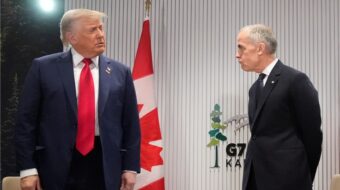
For much of the summer, public discourse was full of reports, updates, and speculation about Canada’s trade talks with the U.S., which could more accurately be described as a panicky scramble by Ottawa to secure a deal ahead of Donald Trump’s arbitrary deadline for another punishing round of 50% tariffs.
On Aug. 18, Trump reported that a deal had been reached and that he will pause the tariffs for three days while details are finalized.
What this means exactly is unclear—in no small part because Trump seems to mark time (and reality) in an utterly different way than the rest of us, but also because details are sparse. However things stand, though, it’s pretty clear that working people are getting shafted.
Consider if the deal falls through. Trump has stated that he will impose 50% tariffs on an estimated $20-30 billion worth of Canadian exports to the U.S., about 5% of total exports. Products affected include dairy, cement, clothing, wine, furniture, and (of course) hockey sticks. Analysts say these tariffs would likely result in about 100,000 job losses in Canada. This is on top of already whopping job losses from the trade war so far, including 61,000 in manufacturing alone.
An economic report from Deloitte described the Canadian economy as being essentially “on pause” as a result of Trump’s tariffs. The threatened new round would likely trigger a recession, which would be devastating for working people and their communities.
But now let’s look at the scenario in which a deal is secured. Lips are tight, but tweets from U.S. Trade Representative Jamieson Greer strongly suggest that Ottawa has bent the knee on Washington’s key demands. These include dropping all retaliatory trade measures against the U.S., removing provincial bans of U.S. alcohol, ending “Buy Canadian” procurement policies, and changing Canada’s supply management system to allow greater access for U.S. dairy products.
Trump also wants Ottawa to finalize its purchase of 88 F-35 fighter jets (Canada has so far formally committed to purchasing 30) and to ensure cross-border energy projects including a revived Keystone XL pipeline.
In a tweet, Greer wrote that “the deal will include comprehensive market access for all American goods, economic security commitments, digital trade alignment, and many important provisions that will continue to protect our market and American workers.”
Is this picture really any better for workers in Canada? For many, including dairy farmers and agro-food workers, those in tourism-related industries, alcohol producers, and smaller manufacturers who rely on procurement policies, it will be devastating. And the massive expenditure on another 58 F-35 jets will no doubt result in new and deeper cuts to social programs.
The entire situation has Canadian working people locked in a vise, facing a terrible dilemma: Do you want to be squeezed to death by U.S. monopolies or Canadian ones? Because that’s exactly whose interests are being represented at the table in these trade talks: monopoly capital. Working people are simply left in the dust.
The way out of this trap is through working-class trade and industrial policies. These are based on a full employment economy, an improving standard of living (involving decent wages, pensions, and services), environmentally sustainable production, and respect for Indigenous rights.
To win that will take a real fight—united, massive, and sustained. We can start by paraphrasing the little boy’s initial answer to Scrooge’s query, and tell monopoly capital to “Shove off!”
People’s Voice
As with all op-eds published by People’s World, the views expressed here are those of the author.
We hope you appreciated this article. At People’s World, we believe news and information should be free and accessible to all, but we need your help. Our journalism is free of corporate influence and paywalls because we are totally reader-supported. Only you, our readers and supporters, make this possible. If you enjoy reading People’s World and the stories we bring you, please support our work by donating or becoming a monthly sustainer today. Thank you!
CONTRIBUTOR