Dockworkers across the world delivered a thunderous rebuke to the imperialist war economy on Friday. In the largest coordinated international work stoppage in decades, workers halted operations at roughly 113 ports across 22 countries and five continents.
Organized under the slogan “Dockworkers do not work for war,” more than 25 trade unions participated in the International Day of Action. The mobilization was the culmination of months of planning, building on the militant coordination network forged in Istanbul earlier this year.
As previously reported in People’s World, the World Federation of Trade Unions (WFTU) had issued the call to action, aiming to physically disrupt the machinery of war that relies on commercial maritime shipping.
The demands were an immediate end to the transportation of weapons and military equipment through civilian ports, an end to the militarization of port infrastructure, solidarity with the Palestinian people, and the defense of workers’ wages and safety.
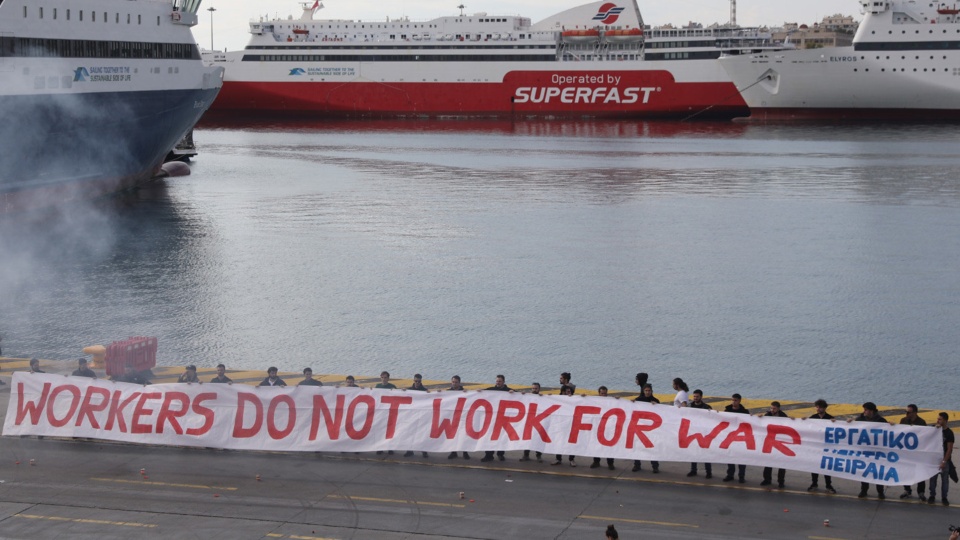
Piraeus brought to a standstill
In Greece, the port of Piraeus, the country’s largest, was brought to a complete standstill. Roughly 3,000 dockworkers and seafarers joined the strike, supported by metalworkers, teachers, healthcare workers, and students.
Giorgos Gogos, president of the Dockworkers Union of Piraeus Port Authority, articulated the core sentiment of the day: “We don’t want to participate in any war, all around the world. We don’t want our ports to be hubs of military material, transferred so as to kill people.”
Dimitris Koutsoumbas, General Secretary of the Communist Party of Greece (KKE), attended the massive rally. Addressing the workers, he declared: “We do not work for their war! We demand ports of peace, belonging to the peoples, not bases and launching pads for the imperialists.”
Italy and France: The Mediterranean erupts
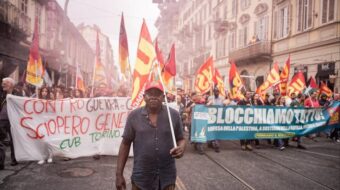
The largest stoppages occurred across the Mediterranean. In Italy, the grassroots union federation Unione Sindacale di Base (USB) called a 24-hour nationwide general strike, linking the anti-war demand to the fight against low wages and the rising cost of living. Millions participated in demonstrations across more than 60 cities. Videos on social media showed police brutality against the strikes as they called for an end to war and for peace.
Dockworkers in Livorno refused to service the Sunaid X, a container ship identified by local unions as supplying the NATO military base at Sigonella. Both night and morning shifts refused to handle the vessel, setting up a physical blockade against the transport of military cargo.
In France, the ports and docks federation of the General Confederation of Labor (CGT) reported over 90% participation in a 24-hour strike. The strike was also supported by the French Communist Party (PCF), which issued a call to action to support the strike. Operations were severely disrupted at major commercial gateways, including Le Havre, Dunkirk, Rouen, and Nantes–Saint-Nazaire.
The French workers again explicitly rejected President Emmanuel Macron’s policies that prioritize military spending while imposing austerity on the working class. Linked with the ongoing student protests across France, the workers are gearing up for more actions on Nov. 2 and again on Nov. 5.
In Turkey, a 24-hour strike was called at Istanbul’s Haydarpaşa port, where workers rallied beneath the banner: “No to war, no to armament!” In Germany, young dockworkers and apprentices at the Port of Hamburg organized a solidarity demonstration, emphasizing the importance of involving the next generation of workers in the anti-war movement.
The strike began in Melbourne, Australia, where dockworkers mobilized from the early morning, and concluded with rallies in Oakland and San Francisco in the U.S, led by the ILWU Local 10. Actions were also reported in India, Morocco, Brazil, Sweden, and Denmark.
The economic cost of peace
The physical impact of the strike was felt immediately, the unions said. They estimated that the coordinated actions affected approximately 52,000 containers and $2.8 billion worth of cargo. Shipping analysts noted that the disruption to international trade was significant, costing tens of millions of dollars in delays before even factoring in cascading supply chain impacts.
The political significance of Oct. 30 far outweighs the balance sheets of the shipping monopolies. In a world where governments and powerful capitalist interests are rapidly integrating civilian infrastructure into war preparations, the unions asserted a different priority: The working class possesses both the collective strength and the international solidarity to challenge the war economy.
No paywalls at People’s World
We hope you appreciated this article. At People’s World, we believe news and information should be free and accessible to all, but we need your help. Our journalism is free of corporate influence and paywalls because we are totally reader-supported. Only you, our readers and supporters, make this possible. If you enjoy reading People’s World and the stories we bring you, please support our work by donating or becoming a monthly sustainer today. Thank you!
CONTRIBUTOR