FORT MORGAN, Colo.—For years, workers at the Cargill beef plant in Fort Morgan, Colorado, have been forced to choose between their jobs and their basic human dignity. Denied permission to use the bathroom during shifts, some soiled themselves on the production floor rather than risk discipline.
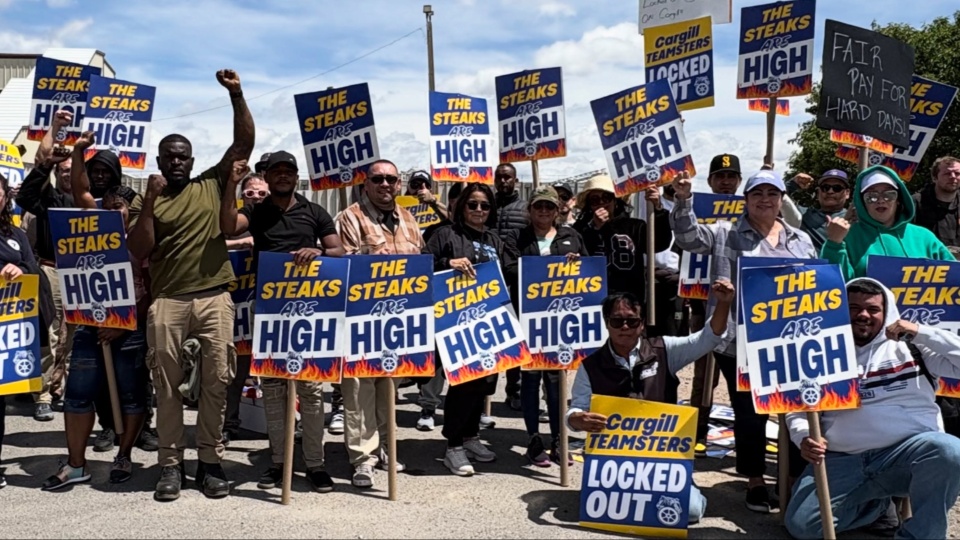
Now, 1,700 members of Teamsters Local 455 are locked out of that same plant because they dared to reject a bad contract offered by management that would leave them unable to afford the very meat they process. The workers here at the Cargill facility are critical to processing millions of pounds of beef for American families nationwide.
“In a town as small and tight knit as Fort Morgan, Cargill Teamsters keep the economy running,” the union said.
Cargill, the largest privately held corporation in the United States, booked nearly $7 billion in profits last year alone. Yet its “last, best, and final” offer to the workers who built that fortune amounts to a paltry 1.82% average annual raise—a hike that doesn’t even cover the rising cost of groceries, let alone rent or healthcare.
Cargill insists the offer was fair and that it bargained in good faith. But the company’s actions—cutting off worker benefits, filing coercive statements, and now facing new unfair labor practice charges filed by the union—tell a much different story.
Cargill has touted a “$33.4 million investment over five years” as a “generous offer.” However, the details reveal a different story. In reality, that “investment” translates to hourly wage increases of just $2.15 over half-a-decade.
According to Cargill’s own figures, base wages currently stand at $23.58. Under the contract terms proposed by management, that would rise to $25.75 by 2031. That represents an average annual increase of roughly 1.82%, a rate that fails to even keep pace with inflation, meaning workers are actually losing money with the proposal.
Servando Shawn Payan, a business agent for Teamsters Local 455, told CPR News, that “With the wages that they were offered, they can’t even afford to buy their own product that they work.”
Since January 2021, research from the U.S. Senate shows that monthly costs for Colorado families have risen by approximately $1,250. The Cargill offer does not even come close to bridging that gap.
The strike was not and is not just about money, though. Workers are demanding basic respect and safety. Payan highlighted reports of “workers who are denied access to bathrooms during their shifts and sometimes soil themselves on the production floor.”
It is a degrading practice that has become an industry-wide scandal. Dean Modecker, the Secretary-Treasurer for Local 455, told a local radio show that this issue has been a festering wound for nearly a decade.
“A lot of people don’t believe me when I tell them,” Modecker said. “Our people are having a hard time just going to the restroom on the line. We literally had to arbitrate this in 2017. The arbitrator ruled with us that our people do have a right to go to the bathroom, just like anybody else in America.”
Yet, the problem persists. The Colorado state government was forced to intervene, passing the “Personal Protective Equipment and Meatpackers Act” on June 5 to codify this basic human right into law. For the locked-out workers, this fight is about basic dignity and survival.
Days after the Colorado bathroom bill was passed, Local 455 filed unfair labor practice (ULP) charges against Cargill. The charges brought by the union center on the company’s coercive statements and unilateral changes to the terms and conditions of employment. For example, the lockout itself has resulted in the immediate cancellation of employee health benefits.
 This is not Cargill’s first brush with federal regulators. For nearly a decade, the company has faced lawsuits from the Department of Labor and the Department of Justice. In 2022, the DOJ’s Antitrust Division brought a case against Cargill for participating in “anticompetitive compensation information exchanges with representatives of its competitors for poultry processing plant workers.”
In April 2024, a final judgment was issued requiring increased regulation of Cargill. And on May 28, the company agreed to pay a $32.5 million settlement for its antitrust actions.
Despite the “challenges facing the meatpacking industry claimed by the company, Cargill reported record profits of $6.69 billion in 2025, followed by $3.81 billion in 2026.
As Teamsters leader Jesse Case noted, these companies are engaged in “price-fixing and ripping off consumers…. Now they’re conspiring to fix labor rates. These large meat packers are monopolies that need to be broken up if they can’t recommit to the communities that helped make them successful.”
For the workers standing on the picket line, the lockout is a painful reminder of years of sacrifice. Elvia Valdez, a mother of three, told PBS of her daily toil: “I’ve worked in packing, bagging, table-line meat processing, sharpening knives, and cutting meat…and it’s a hard job.”
With the lockout cutting off her health insurance, Valdez is terrified. “I feel like shit. I have a kid with a disability that needs to be seen in July, and if this goes on until then, what are we going to do?”
Serena Machuca, a single mother who has given 9-to-10-hour days to Cargill, expressed the deep sense of betrayal felt by many. “We struggled, but I stayed pretty loyal. I put so much time into the company. I don’t know, it’s kind of hard for me to change and start over.”
The economic impact ripples beyond U.S. borders. Many of the locked-out workers are Somali refugees and Haitian migrants who rely on their paychecks to support families back home. Yusuf Ahmed, originally from Somalia, told PBS: “My home, my car, my gas, my family I have to pay in Africa….it’s [a] problem.”
Cargill’s anti-union and anti-worker posturing is not isolated to Fort Morgan. In Canada, the company threatened a similar lockout against UFCW Local 401, pushing workers to accept a contract that passed with only 71% approval under the threat of losing their jobs.
This tactic—using the lockout as a cudgel—is a dangerous trend in American labor relations. Earlier this year, People’s World detailed a similar, still ongoing battle when BP locked out over 800 members of United Steel Workers Local 7-1. As in Fort Morgan, that came after a bad-faith offer from the employer and involved grave safety concerns.
For their part, the Teamsters have stepped up to support their locked-out brothers and sisters, providing $1,250 weekly strike pay to help them keep their heads above water.
The members of Local 455 continue to stand firm against one of the most powerful corporations on Earth. And they are not just fighting for a fair contract. They are fighting against the monopolization of the food industry, the exploitation of immigrant labor, and the erosion of worker dignity.
“I’ve been at Cargill for 33 years, and it’s really upsetting to see the company be so unreasonable,” said Chris Bell, a maintenance worker.
“I am just a few months away from retirement, but I want to be out here supporting the younger workers who are fighting for their future. We can’t believe this company would stoop to this level. We will be out here every day making our voices heard.”
The battle in Fort Morgan is a battle for the soul of the American working class, workers said. “Cargill needs to return to the table and negotiate a contract that respects the workers who built its fortune.”
We hope you appreciated this article. At People’s World, we believe news and information should be free and accessible to all, but we need your help. Our journalism is free of corporate influence and paywalls because we are totally reader-supported. Only you, our readers and supporters, make this possible. If you enjoy reading People’s World and the stories we bring you, please support our work by donating or becoming a monthly sustainer today. Thank you!
CONTRIBUTOR