
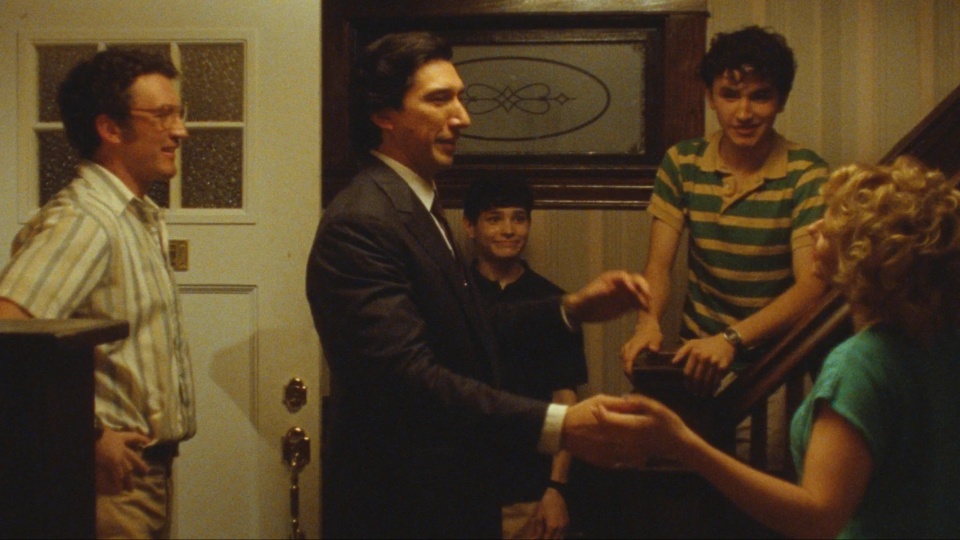
When I was invited to a private screening of Paper Tiger and saw its stellar credits, plus the fact that it was a gangster movie, I was immediately stoked to go see it, assuming that it would be a good fun flick. In fact, James Gray’s nearly two-hour film is far more than that—yes, it is extremely entertaining, but Paper Tiger is also a very solid, moving family drama that Arthur Miller might have been at home with.
The writer/director very deftly, swiftly sets the scene place and time with visuals: The World Trade Center is glimpsed (hence it is pre-9/11 in New York City) and a quick shot of a TV set blaring Jerry Lewis’ annual MDA telethon (which forecasts and foreshadows disaster) tells astute viewers that it is Labor Day weekend. In fact, it’s 1986—smack dab in the midst of Ronald Reagan’s presidency.
Miles Teller (2014’s great Whiplash) and Scarlett Johansson play Irwin and Hester Pearl (in 2003, Johansson was, but of course, Vermeer’s eponymous Girl with a Pearl Earring), a striving middle class Jewish couple nearing middle-age in Queens. This is exactly the social milieu I was born and raised in (as was Gray, although the movie, alas, was not shot in that borough but largely in New Jersey), and thus it rang very true to me.
 Johansson is a Jew from the Bronx, which I’m confident enhanced her understanding of her character and onscreen family. Johansson’s portrayal is spot on and while creating a richly realistic persona, she avoids playing the stereotypical, overbearing Jewish mother. Hester does not reduce her sons Scott (Gavin Goudey, who does not look old enough to be turning 18 as his role requires) and the younger Ben (Roman Engel) to “Mama’s boys,” although she does have a fierce, defensive love for her lads.
As this is a family drama, the characters include Hester’s mother Iris (Cindy Katz), the type of mom who, while she may be argumentative and critical, you know in the end will, through thick and thin, always be there for her children without fail (just as Hester is).
But the other really important character in Paper Tiger, who I believe is the movie’s protagonist, is Gary (Adam Driver). He is a flashy, well-to-do ex-cop who had been prominent in the NYPD and packs a pistol (the sight of which thrills his nephews). Prospering in his retirement as a security consultant, Gary drives a luxury vehicle and offers his younger brother—who has beaucoup bills to pay, not to mention Scott’s looming college tuition—an opportunity to get in on a deal that will bring him big bucks.
While he may believe in looking the other way and possibly bending the rules, Gary does not break them; he’s not a crooked cop. He actually has the very best of intentions for his kid brother, an environmental engineer, when he tries to cut him in on a deal with a Russian company. But the road (or, in this case, canal) is paved with good intentions…
As Glasnost rages in Gorbachev’s Soviet Union, New York has witnessed a surge of exiles from Russia—and perhaps unbeknownst to Gary (who more likely may be turning a blind eye), the enterprise he’s bringing his younger brother into is run by ruthless Russian mobsters. When Irwin pays an unannounced, unexpected nighttime visit to their worksite and attempts as an environmental expert to warn them about a safety hazard, he sets off an unforeseen chain of events that proves to be lethal, forcing Gary to embark on the Herculean task of trying to set matters right.
I felt that the Russian gangsters overreacted, and that their response to Irwin’s interloping was way over the top: Think Putin, not Gorby. But Gray previously made 1994’s Little Odessa about Russian mobsters, setting his first feature in the titular Russian enclave of Brooklyn. So, I imagine that Gray knows this antisocial social sphere better than I, and that I’m underestimating their bloody brutality; I’ll take his word for it and willingly suspend my disbelief.
Gray’s last film, Armageddon Time, was set in a similar NYC milieu as that of Paper Tiger’s Jewish characters and released in 2022, when Trump was in the political wilderness (which, like Sing Sing and the hottest seat in Hades, is where he belongs). In cameos, Jessica Chastain portrays The Donald’s older sister Maryanne and John Diehl plays the future president’s father, Fred Trump.
Armageddon Time was an insightful critique of Trump, and Paper Tiger may be taking subtle, sly swipes at the “free” market-oriented Reagan era’s greed. (Perhaps Donald Trump’s most remarkable political achievement is that he has somehow managed to make Reagan look good in comparison.)
Where did Gray derive his title—which expresses a dualistic sense of power—from? In 1946, Chairman Mao told U.S. correspondent Anna Louise Strong: “All reactionaries are paper tigers. In appearance, the reactionaries are terrifying, but in reality, they are not so powerful. From a long-term point of view, it is not the reactionaries but the people who are powerful.”
Who is the story’s “paper tiger”? Perhaps Gary, whose police background and ties may not make him as powerful as he believes himself too be. (BTW, if you arranged the letters of “Gary” it spells “Gray.”) On the other hand, the ordinary Hester, Irwin, Ben, and Scott may be the truly powerful people.
Hester may be a tiger mom. As she grapples with her own unexpected affliction and the tragedy ripping her family apart, with her inner resolute, stand-by-your-family strength, Johansson actually reminded me of Grace Kelly in 1952’s High Noon. And like that classic Western, Paper Tiger inevitably builds up to an exciting showdown between the good and bad guys. As Chairman Mao also said: “Political power grows out of the barrel of a gun.”
This is a tragedy about good intentions gone terribly wrong in the quest for money, that root of all evil. Although it’s not for children, Paper Tiger is a highly enjoyable, poignant, bittersweet family drama that Oscar is likely to pay attention to. Scarlett Johansson was twice-nominated for an Academy Award, and Paper Tiger may prove that the third time’s the charm.
Paper Tiger theatrically opened Nov. 13.
No paywalls at People’s World
At People’s World, we believe news and information should be free and accessible to all, but we need your help. Our journalism is free of corporate influence and paywalls because we are totally reader-supported. Only you, our readers and supporters, make this possible. If you enjoy reading People’s World and the stories we bring you, please support our work by donating or becoming a monthly sustainer today. Thank you!
CONTRIBUTOR