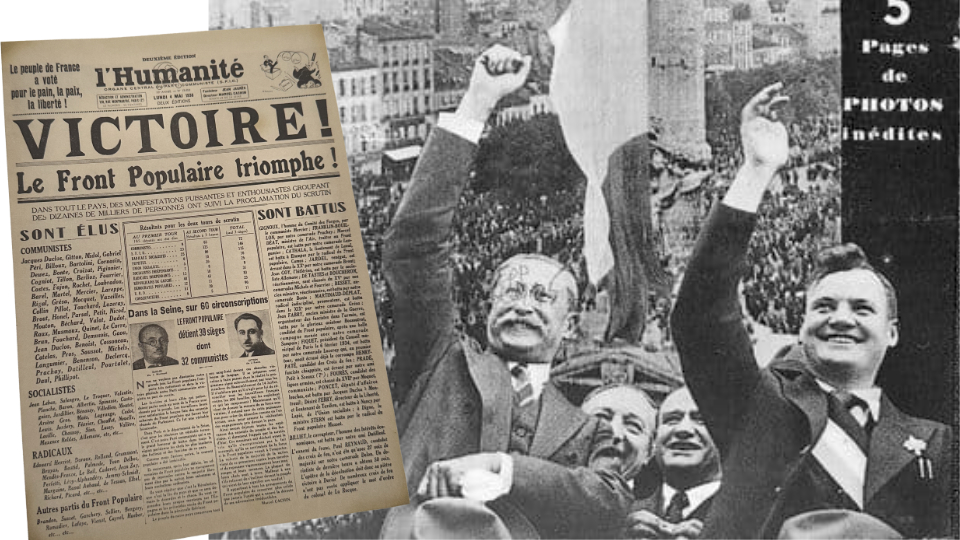
Ninety years ago, fresh from their May Day marches, the people of France went to the polls and made history. The election of May 3, 1936—the decisive second round of legislative voting—delivered a sweeping victory to the Front Populaire, the Popular Front coalition of Communists, Socialists, and Radicals who had united against the growing threat of fascism at home and abroad.
It proved to be no ordinary election result but rather a turning point for French democracy. Workers showed they could transform capitalist society by exercising their collective class power and—together with the workers of Spain, which had elected their own popular front government less than three months earlier—crafted a model for how the left could fight and win.
The anniversary of the Popular Front arrives at a moment that makes it feel less like history and more like a mirror. In France, a new coalition bearing the same name—the Nouveau Front Populaire—scored a surprise electoral triumph in 2024. The NFP succeeded in blocking the far right from power, but maneuvers by the powers-that-be and internal divisions slowed its momentum.
In the United States, with the MAGA movement having remade the Republican Party into a vehicle for authoritarian politics, questions of anti-fascist unity are no longer abstract. What the French Popular Front built in 1936, how it won, and why it ultimately fell apart, carries lessons democratic and working-class movements cannot afford to ignore.
Crisis forges unity
The France of the mid-1930s was in deep trouble. The worldwide depression had hammered the economy, wages had fallen, and fascism—which had already swallowed Italy and Germany—was casting its shadow westward.
The threat was not merely external, though. In February 1934, far-right paramilitary leagues—the Croix de Feu, the Action Française, and others—launched a violent assault on the Chamber of Deputies in Paris, leaving 15 dead and serving as a warning that French fascism had real muscle behind it.
The Communist Party (PCF), the Socialists (SFIO), and the center-left Radical-Socialists had long been bitter rivals, competing for working class support and pursuing different strategies. But the 1934 riots, combined with the new anti-fascist strategy being developed within the Communist International under Georgi Dimitrov, began pushing them toward each other.

The Comintern’s approach urged Communists to join forces with other political and class forces—socialists, liberals, and progressives of all kinds—to stop the fascist tide. It was a defensive move, to be sure, rooted not in sectarian idealism but in historical necessity.
On Bastille Day 1935, the three parties held a massive joint demonstration in Paris, marking the formal birth of their coalition. Their unity was not ideological uniformity—the Communists were committed revolutionaries determined to see capitalism ended, the Socialists preferred a slower reformist path of change, and the Radicals were bourgeois republicans.
But they shared a common goal: stopping fascism and defending democratic institutions. That defensive purpose was the glue that held the Popular Front together.
The Popular Front won 370 of the 618 seats in the Chamber of Deputies, a solid majority. The Socialists emerged as the coalition’s largest party. The Communists surged from 12 seats to 72, driven by working-class neighborhoods in the industrial suburbs of Paris.
Léon Blum, the Socialist leader, became the first socialist—and the first Jew—to serve as prime minister of France. The Communists declined ministerial posts but pledged firm parliamentary support, a “support without participation” arrangement that kept the Radicals comfortable while guaranteeing the government had majority support to pass laws.
The election victory immediately unleashed something neither the parties’ leaders nor their opponents had fully anticipated. Across France, workers who had endured years of wage cuts rose up in a massive wave of factory occupations. By June 1936, nearly a million workers had occupied their workplaces in a rolling general strike, the largest in French history.
Workers’ breakthrough
The Blum government moved quickly to translate the strike wave into legislative gains. On June 7, at the Hotel Matignon, the prime minister brought together the national employers’ federation and the CGT labor federation to negotiate what became known as the Matignon Accords—a document that remade French working-class life.
Workers won the legal right to join a union, to bargain collectively, and to strike, if necessary. Wages rose sharply, and a 40-hour work week was established. Every French worker received two weeks of paid vacation, a right that had never existed before. The CGT, which was led by the Communist Party, saw its membership explode from under 800,000 to more than four million within a year.

The Blum government also dissolved the far-right paramilitary leagues, nationalized key defense industries and the Bank of France, and included women in the cabinet for the first time—even though women could not yet vote in France.
For millions of workers, 1936 was not just an election victory. It was a transformation unleashed by the arrival of the Popular Front government itself.
The fall of the Front
The Popular Front brought many achievements for the working class, and it did so faster than anyone thought possible. But the coalition also came up against a number of roadblocks and faced its own internal contradictions.
The French Senate remained in conservative hands and repeatedly blocked Blum’s program, including plans to give women the right to vote. Capital fled the country, staging what amounted to an investment strike. Inflation eroded some of the rapid wage gains. And elements within the business and military elite were unconvinced that fascism wasn’t still the way to go to secure their interests. They repeatedly used antisemitism as a means to try to undermine support for the Jewish prime minister.
By June 1937, just a year after taking office, Blum was forced from power. The coalition survived in weakened form, but the Spanish Civil War—which split the Front over whether to aid the besieged Spanish Republic—proved fatal to its cohesion. Most of the left wanted to come to the aid of the those defending democracy in Spain, but the right wing was threatening to bring the war to France itself.
Blum, torn between his convictions and fear of a wider war, opted for non-intervention, a choice that haunted him. The Radicals turned on him and forced the Socialists out of the cabinet.
The Popular Front formally dissolved in autumn 1938. When the Radicals joined together with Britain to hand over Czechoslovakia to Hitler in the Munich Agreement, the Communist Party could no longer support the coalition.
France itself eventually fell to the Nazis in June 1940. The reactionaries of Vichy imprisoned Léon Blum, who spent time in Buchenwald. The Communist Party went underground and led the partisan resistance under German occupation, earning it a permanent place in the hearts of French workers.

After the war, the PCF was the largest party in France and entered the government together with the Socialists. Maurice Thorez, the Communist leader, became deputy prime minister. U.S. intervention in French affairs eventually resulted in disrupting the left, but the Popular Front legacy endured. The Matignon Accords became cornerstones of the French social contract rebuilt after the Liberation.
The memory of 1936—of what was possible when the left united—acquired iconic status in French political culture, comparable to the Paris Commune before it. Thorez later evaluated the Popular Front, assessing its nature and strategic correctness.
“The Popular Front wasn’t a revolution, nor was it a vulgar electoral operation,” he said in 1960. “It offered the possibility of a progressive politics within the framework of republican institutions. As realists, we would only demand what was possible in the conditions of the moment, in order to call for it in greater numbers and to be sure of obtaining it: but we would strongly demand it.”
New Popular Front echoes
That memory was explicitly invoked in June 2024, when France’s fractured left parties—La France Insoumise, the Socialist Party, the Greens, and the Communist Party—united almost overnight under the banner of the Nouveau Front Populaire to contest snap elections called by President Emmanuel Macron, who hoped to gain a majority for his minority centrist government.
The parallels to 1936 were unmistakable. As French Communist Party leader Fabien Roussel declared at the NFP’s launch, it was “time to open a new stage for the left.” The coalition’s program—wealth taxes, pension reform reversal, minimum wage increases, ecological planning—echoed the ambitions of the original Popular Front even as it updated them for the 21st century.

The electoral gamble backfired on Macron. The NFP ran joint candidates across all 577 constituencies, deployed tactical second-round withdrawals, and emerged as the largest bloc in the National Assembly with 193 seats, denying the far-right National Rally the majority it had seemed within reach of winning and leaving Macron’s allies squeezed even further.
But also like 1936, the coalition’s internal tensions proved difficult to manage once the election was won. Macron refused to appoint an NFP prime minister, turning instead to the right. The NFP’s parties wrangled over foreign policy and strategy. The Socialist Party’s decision not to support a no-confidence vote against Macron’s appointee, François Bayrou, in early 2025 strained coalition unity.
In local elections in early 2026, the coalition frayed further, as Jean-Luc Mélenchon’s group, La France Insoumise, ran separately and often challenged other NFP candidates. With presidential elections due next year, it’s unclear whether the NFP will again come together. The 2026 municipal contests showed that left side of the political spectrum holds a plurality of French votes, but frustration with politics as usual is propelling the right forward, and divisiveness on the left poses a danger to the effort to build a united front to stop them.
A strategy for our time
The history of France’s Popular Front is not a simple success story. It is a tale of what becomes possible when diverse forces subordinate sectarian difference to a common democratic purpose—and of what is lost when those forces fail to maintain that unity under pressure.
It speaks directly to the present moment in the United States. As this publication has argued, the MAGA movement has not merely won elections; it has systematically worked to suppress the vote, concentrate executive power, attack labor rights, and dismantle institutional checks on authoritarian rule.
And with capital wielding mass influence in both parties of our two-party system, the need for a broad coalition that struggles in all arenas—in elections, in the workplace, at school, in city councils and state legislatures, in the streets—is necessary. Against a coalition of reaction like MAGA, no single party or tendency on the left can prevail alone.
The Popular Front strategy—building the broadest possible alliance of working-class organizations, unions, and democratic movements around a shared defensive goal—is not a relic of the interwar period. It is a political necessity in today’s world.
 This does not mean dissolving left politics into the Democratic Party mainstream. It means honestly assessing, as Dimitrov urged in 1935, who the main enemies are and who the potential allies are—and building unity and relationships accordingly. It means labor unions, racial justice movements, immigrant rights advocates, women’s groups, democratic reform coalitions, tenant organizers, climate justice groups, elected officials, and more all finding their firm points of common action.
The original Popular Front was born in crisis, and so was the new one. Neither was born in comfort. Both were built against the pressure of an advancing right by people who understood that the cost of division was defeat—and that in that context, defeat meant something far worse than a normal electoral setback.
Ninety years after French workers flooded the streets on the night of May 3, 1936—after they occupied their factories and reshaped their country forever—the coalition they built still offers a model. Not because history simply repeats itself, but because the core strategic logic holds: When reaction unites, the working class and its democratic allies must do the same.
We hope you appreciated this article. At People’s World, we believe news and information should be free and accessible to all, but we need your help. Our journalism is free of corporate influence and paywalls because we are totally reader-supported. Only you, our readers and supporters, make this possible. If you enjoy reading People’s World and the stories we bring you, please support our work by donating or becoming a monthly sustainer today. Thank you!
CONTRIBUTOR