Picture it: Chicago, 1886. The rise of industrialism and the jobs it spawned made the city an attractive place for the working class, especially immigrants, and they brought their ideas for better working conditions and pay with them. The years after the Civil War were ripe for the labor movement, and the rising number of unions were a testament to that. Chicago’s population was growing exponentially, and the number of union workers rose with it, making Chicago a focal point of the labor movement.
Anarchists, socialists, and communists worked in factories and mills during the day and, at night, held discussions and meetings on ways to improve conditions on the job and grow the labor movement. It was normal for workers in the U.S. to work 10 to 12-hour days, six days a week, for very little pay and in dangerous conditions. Chicago became the center for several attempts to organize labor’s demands for better working conditions, higher pay, and shorter hours. The push for the eight-hour workday was one of these demands.

“Eight hours for work, eight hours for rest, eight hours for what we will” was the rallying cry, and the bosses hated it. Chicago in the late 19th Century was the site of one of the battles in the ongoing class war, and the capitalists had the money to back their side. Firing and black-listing union workers was common, as was hiring scabs, spies, and private security thugs. Racism and bigotry were tools often used by the ruling class to exacerbate tensions and further divide the workers, sometimes successfully.
Since newspapers often supported business interests, the ruling class had the media’s backing, forcing the workers to create their own newspapers. The German-language newspaper Arbeiter Zeitung, “Worker’s Newspaper,” edited by anarchist August Spies, reached thousands of German immigrants. The Knights of Labor saw its membership grow from 70,000 in 1884 to over 700,000 in 1886. The movement for the eight-hour workday grew stronger by the day.
In October 1884, the Federation of Organized Trades and Labor Unions unanimously set May 1 as the day on which the eight-hour workday would become standard, stating, “Eight hours shall constitute a legal day’s labor, from and after May 1, 1886, and that we recommend to labor organizations that they so direct their law.” As the day approached, labor unions prepared for a general strike.
On Saturday, May 1, hundreds of thousands of workers across the U.S. struck. Rallies and marches took over dozens of towns, putting the bosses and their hired goons on edge. On May 3, August Spies spoke at a rally at the McCormick Harvesting Machine Company, telling the crowd to “hold together, to stand by their union, or they would not succeed.” The general strike, peaceful up to this point, took a turn when a group of workers confronted strikebreakers, and the police fired into the crowd. The cops killed several McCormick workers, and Spies later said, “I was very indignant. I knew from experience of the past that his butchering of people was done for the express purpose of defeating the eight-hour movement.”
A rally was called for May 4 at Haymarket Square to speak out against the murders by the police, where Spies was again a speaker, and where dozens of police stood nearby. “There seems to prevail the opinion in some quarters that this meeting has been called to inaugurate a riot, hence these warlike preparations on the part of so-called ‘law and order,’” Spies reportedly said.
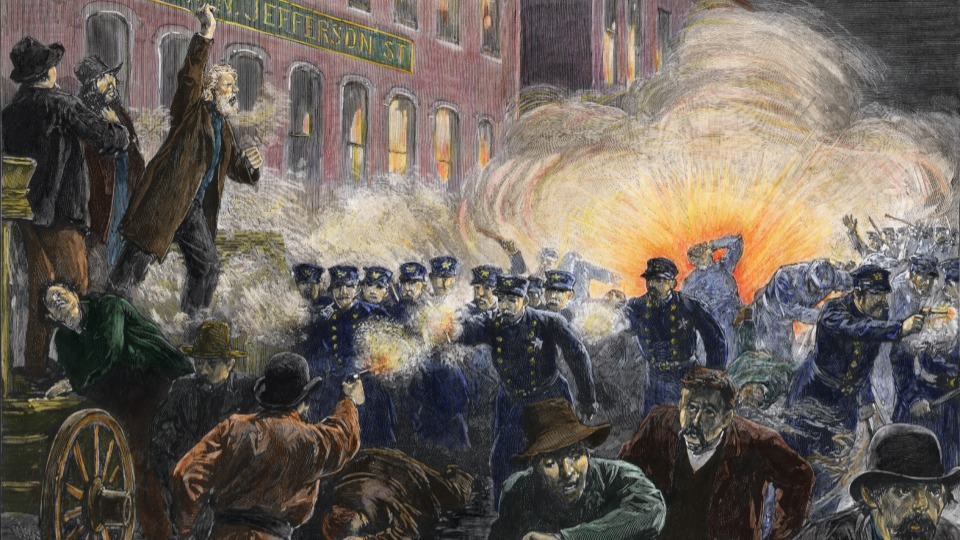
The crowd was calm, so much so that Mayor Carter Harrison III, who had shown up to watch, left early, content with the knowledge that such a calm crowd would not cause trouble. Yet as the last speaker finished, the mass of police advanced on the crowd and ordered them to disperse. A homemade bomb then arced through the air, its thrower unknown, and landed in the path of the advancing police. The explosion killed one of the cops, and the remaining ones opened fire, shooting indiscriminately into the crowd.
By the time the smoke cleared, seven police officers and at least four workers were dead. An anonymous police official told the Chicago Tribune that most of the police deaths were due to friendly fire. The aftermath in Chicago saw an onslaught of media support for the police and a harsh crackdown on workers. The police, ignoring civil liberties and the law, raided homes and offices, detaining dozens of people.

The Haymarket Affair led to eight anarchists being arrested and charged. Newspapers heavily backed the police actions, while the judge and jury displayed open prejudice against the defendants during the trial. Evidence put forward alleged one of the defendants may have built the bomb, but none of those eight threw it, and only two of them were even present at the Haymarket at the time.
From the stand, Albert Parsons—editor of the labor paper The Alarm and a former Confederate soldier turned abolitionist—denounced the charges, saying: “They lie about us in order to deceive the people, but the people will not be deceived much longer. No, they will not.”
Despite flimsy evidence and a vigorous effort by the defense, seven of the men were sentenced to death, and one was sentenced to 15 years in prison. Four of the condemned were hanged, one committed suicide in prison, and two eventually had their sentences commuted to life in prison. As August Spies faced the hangman, his last words echoed over the crowd and on through history: “The day will come when our silence will be more powerful than the voices you strangle today.”
The just demands of the working class continue to this day, and the struggle of those workers of 1886 is now our struggle. May 1 is International Workers’ Day. On this May Day, as every May Day, we remember the workers who came before us, the battles they fought and died for, and our role in the class struggle today. Organize your workplace, start a union, and demand more. You have nothing to lose but your chains. And remember, May Day is the one day of the year you are morally obligated to tell your boss to kick rocks.
We hope you appreciated this article. At People’s World, we believe news and information should be free and accessible to all, but we need your help. Our journalism is free of corporate influence and paywalls because we are totally reader-supported. Only you, our readers and supporters, make this possible. If you enjoy reading People’s World and the stories we bring you, please support our work by donating or becoming a monthly sustainer today. Thank you!
CONTRIBUTOR