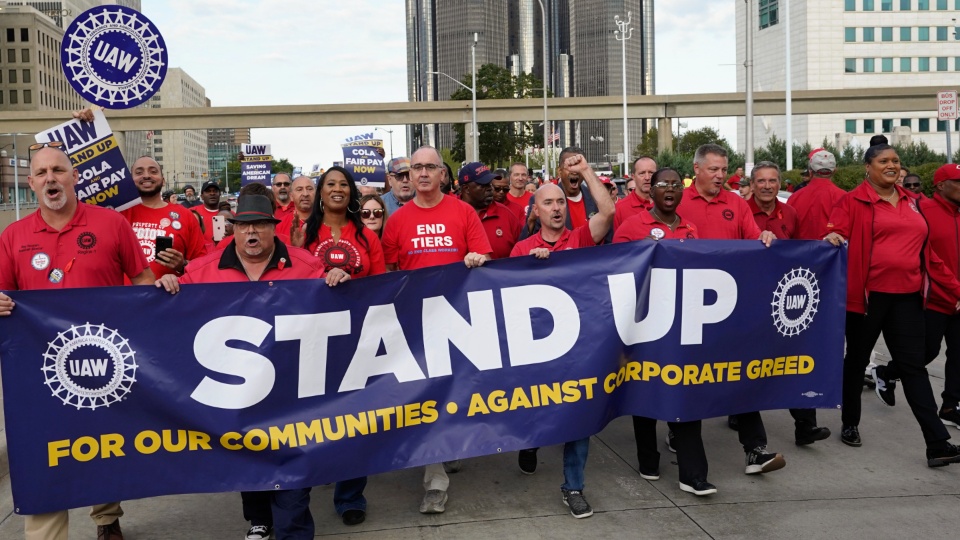
DETROIT—The United Auto Workers (UAW) is challenging the big capitalist-driven trade policies that have gutted American manufacturing and wrecked working-class communities across the country. In a new white paper, “Trade and the American Dream: NAFTA, the USMCA, and the Future of the Working Class,” the union lays out its indictment of “free trade” policies and proposes an alternative:
“NAFTA and the like are the social contract as written by multinational corporations,” UAW President Shawn Fain said. “It’s time we rip it up and start over.”
The 36-page document, released as the six-year review of the United States-Mexico-Canada Agreement (USMCA) approaches, argues that the 1994 North American Free Trade Agreement (NAFTA) was “one of the most dramatic anti-union laws since the notorious Taft-Hartley Act of 1947”—and that its successor, the USMCA, has also failed working-class communities.
The ‘free trade’ disaster
Since NAFTA’s passage in the early ’90s, the U.S. has lost more than 4.2 million manufacturing jobs. Every plant closure, the paper argues, “is a bomb dropped on a blue‑collar community.”
 Studies show that rates of alcohol and drug abuse, divorce, and suicide all rise dramatically after factories shut down. One recent study—”Trading Goods for Lives”—found that communities “more exposed to NAFTA experienced sustained increases in mortality.”
“The fact is NAFTA hollowed out U.S. manufacturing, driving a ‘race to the bottom’—making it easy to move production for the U.S. market to Mexico, where companies can suppress wages and violate workers’ rights with impunity,” the paper states.
Mexican workers have fared no better, nor is the problem due to workers in other countries gaining employment. Despite billions of dollars poured into new plants in Mexico, wages there have also flatlined since the agreement came into effect on Jan. 1, 1994. Inflation-adjusted pay for Mexican autoworkers has been cut in half.
“Mexican workers, simply put, are too poor to buy the cars they produce,” the union writes.
The reality for workers in Canada, the other party to the three-nation agreement, was similar to that faced by those in the U.S. In the first decade of the agreement, Canada saw a massive gutting of its manufacturing base, shedding hundreds of thousands of secure, full-time industrial jobs.
According to data compiled by the Canadian Centre for Policy Alternatives, the influx of corporate-first trade rules severely eroded union leverage, depressed median incomes, and ushered in an era of precarious, part-time service work that disproportionately left working-class families economically insecure.
The automotive sector—once the crown jewel of Canada’s unionized working class—took a direct hit under NAFTA’s corporate-biased framework. The agreement effectively incentivized the Big Three automakers to bypass the relatively high-wage, unionized workplaces of Ontario in favor of low-wage, legally suppressed labor environments elsewhere.
The Council of Canadians highlighted the severe structural imbalance brought on by the deal, noting in 2022 that nine out of eleven auto assembly plants that had been constructed in North America in the decades following NAFTA’s passage were built in Mexico, where average auto-plant wages hovered at a meager $4 an hour at the time.
As investment shifted southward, Canadian autoworkers, like their U.S. counterparts, were subjected to layoffs, plant downsizings, and outright closures, permanently altering communities that relied on the auto sector for generational stability.
Capitalist greed in action
The UAW’s white paper includes detailed case studies of specific auto monopolies using trade deals to attack workers around the world and pit them against each other.
At Stellantis (formerly Chrysler) the company has closed, sold, or idled 18 U.S. manufacturing facilities since 2002 while vastly expanding in other countries. Despite receiving billions in taxpayer bailouts, going back decades, its U.S. workforce is now about one‑third what it was at the time of the first government bailout in 1979.
At Mack Trucks, workers won a strike in 2023 only to see the company announce plans for its first Mexican facility less than six months later. “You’re collateral damage basically, to someone’s stroke of a pen,” said Mack worker Nicole DeFuso.
John Deere has cut over 2,000 jobs in Illinois and Iowa since 2021 while investing tens of millions in plants in Mexico.
CNH Industrial shuttered its nearly century‑old plant in Burlington, Iowa, just this March, destroying hundreds of jobs while sending work overseas.
USMCA fails workers
When the USMCA replaced NAFTA in 2020, it included a labor chapter requiring Mexico to strengthen its laws, a “Rapid Response Mechanism” to address violations, and new rules meant to return some auto production to the U.S. and Canada. But these provisions, however well-intentioned from the point of view of the UAW, fundamentally miss the point.
Although the UAW never endorsed the deal, the AFL‑CIO offered its support in 2019. But from a working-class perspective, the USMCA’s framework remains deeply flawed—not because it includes labor standards, but because it leaves the basic structure of monopoly power intact.

Forcing other countries to comply with U.S.-written regulations, even when those regulations are “progressive” on paper, doesn’t challenge the imperialist logic of trade policy itself. It merely imposes one set of rules—written by the stronger power—on a weaker one. Mexico’s sovereignty is compromised, not by labor standards, but by the reality that its economy has been reshaped to serve U.S. capitalist interests.
Thus, Mexican wages and labor standards remained low. And the new “Labor Value Content” rules were “so complicated that complying with them was a nightmare,” the union said, and since the penalty for non‑compliance was just a 2.5% tariff, major monopolies mostly ignored them.
The “Independent Mexico Labor Expert Board” created by the USMCA has even admitted it hasn’t worked. “If a measure of success is a reduction of the wage gap between Mexican workers and their North American counterparts, USMCA is a failure,” the board concluded.
UAW proposes alternative
The UAW is promoting its vision for a new North American trade deal, which rests on three core objectives:
- Build Here to Sell Here: “Companies should have to create and keep good jobs in the U.S. if they want to sell in the U.S. market.” The union proposes a quota system based on the Canada‑U.S. Auto Pact of 1965, which required a 1‑to‑1 production‑to‑sales ratio. This includes finished vehicles, core components, and overall component production.
“If the production‑to‑sales ratio in the United States were 1‑to‑1, we would manufacture nearly six million more cars per year,” the paper noted.
While this demand is understandable from the perspective of U.S. workers, a truly internationalist approach would require that workers in all three countries have the right to good jobs—not just American workers.
- Real Labor Rights: Workers in all three North American countries must have enforceable rights to form unions, with serious consequences—including targeted tariffs—for labor violations.
However, as mentioned, the prior strategy (in the USMCA) of using U.S. state power to enforce labor standards in Canada and Mexico is contradictory. It risks legitimizing the same imperialist institutions that have historically repressed Latin American workers, for example.
Yet in the short term, workers must use whatever tools are available to defend themselves. The challenge is to use those tools effectively and in the principle of working-class internationalism, while at the same time avoiding the trap of becoming dependent on them.
- Strong Standards on Pay: A new “Manufacturing Wage Floor for North America” would replace the complex and ignored Labor Value Content rules. Mexican autoworkers currently average just $5.70 an hour—16% of the $35.30 their U.S. counterparts earn. A wage floor would raise Mexican pay, end downward pressure on U.S. wages, and strengthen the entire regional economy, the union claimed.
“The moral vision of a society where working‑class people reclaim their dignity relies on reining in the rising billionaire dictatorship,” Fain said.
Importantly, the UAW’s white paper makes clear that workers in Canada or Mexico aren’t the enemy—it’s the corporate “international standards that are dragging down workers everywhere.” The same corporate forces that destroyed American manufacturing have kept Mexican workers impoverished, creating a “race to the bottom” that benefits only the billionaire class, the union said.
The UAW calls for sectoral bargaining across North America, tri‑national enforcement of labor rights, and a commission that subjects corporate investment decisions to public oversight.
“Free trade isn’t free,” the union said. “It comes at great cost to workers across borders, to their families, to their communities, and to democracies around the world.”
The timing of the white paper is critical because the six‑year review of the USMCA is coming soon, and all three countries must decide whether to renew the deal.
We hope you appreciated this article. At People’s World, we believe news and information should be free and accessible to all, but we need your help. Our journalism is free of corporate influence and paywalls because we are totally reader-supported. Only you, our readers and supporters, make this possible. If you enjoy reading People’s World and the stories we bring you, please support our work by donating or becoming a monthly sustainer today. Thank you!
CONTRIBUTOR